
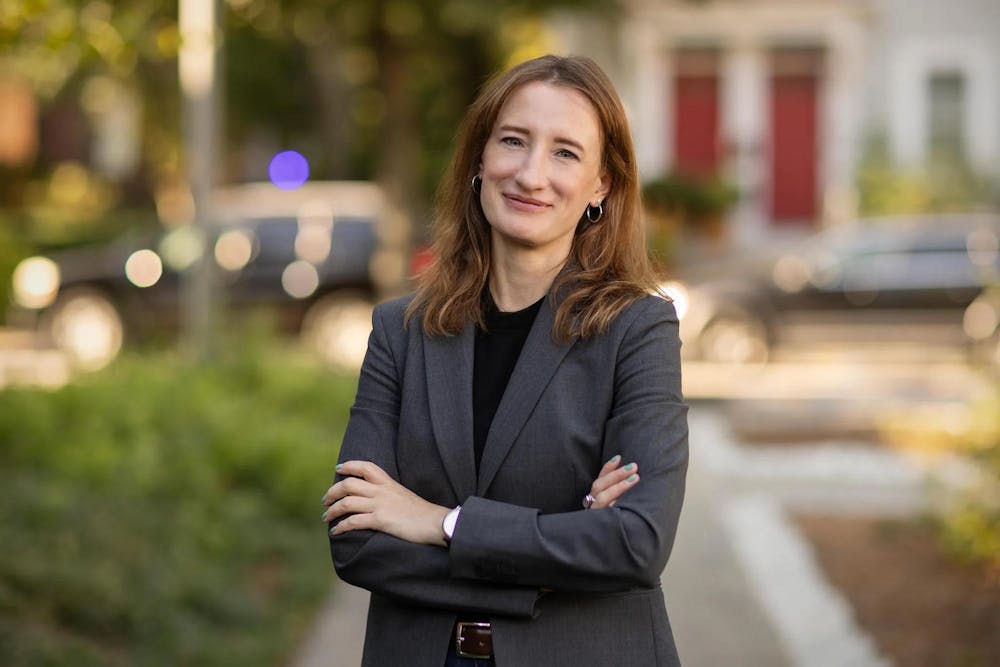
On Oct. 8, the John D. and Catherine T. MacArthur Foundation named Professor of International Security and Anthropology Ieva Jusionyte as a 2025 MacArthur Fellow. The fellowship, awarded yearly to between 20 and 30 recipients, is an $800,000 grant supporting “extraordinarily talented and creative individuals,” according to the foundation’s website. The award is widely known as the “MacArthur Genius Grant.”
Jusionyte, who leads the Center for Human Rights and Humanitarian Studies at Brown’s Watson School of International and Public Affairs, conducts ethnographic research on displacement, violence and law enforcement. She plans to use the MacArthur grant to support her new book, which will investigate the frequent extraditions of organized crime leaders from Mexico to the United States, according to a University press release.
The project is “challenging for many reasons,” Jusionyte wrote in an email to The Herald. Extradition is “heavily politicized,” and many relevant sources are government officials and judges who “don’t want to talk about what’s happening behind the closed doors of the offices.”
She added that the emotional toll of the project is also significant, as it involves interviewing members and leaders of organized crime groups: “I cycle through curiosity, fear, distrust, empathy and a ton of other emotions.”
“The privilege of having received this fellowship is that now I can do this complicated work on a timeline that it needs, and that I need, without rushing it,” she wrote.
Jusionyte has written multiple books, all drawing on ethnographic research methods. Her research focuses on borders and their connections to political and social systems, with a focus on the U.S.-Mexico border.
Jusionyte considers borders to simultaneously be sites of state violence and places for community and solidarity. This inherent contradiction allows for meaningful revelations and a reconsideration of political ideas about “what is lawful and what is unlawful,” she wrote.
At Brown, Jusionyte is jointly appointed to the Department of Anthropology and the Watson School. She works with Ph.D. students and teaches graduate-level seminars, which she explained helped her “think through some of the theoretical and methodological questions” in her own work.
“Ieva is a wonderful colleague,” Jessaca Leinaweaver, a professor of anthropology and chair of the department, wrote in an email to The Herald. Leinaweaver emphasized Jusionyte’s “unquestionably important and cutting-edge work,” as well as her generosity and dedication to her students.
Daniel Jordan Smith, a professor of anthropology and international studies, also said he appreciates Jusionyte’s generosity.
Jusionyte was scheduled to visit Smith’s first-year seminar on the day her MacArthur award was announced. “She came and answered the students’ questions as if there was nothing else she could possibly do that was more important,” Smith wrote in an email to The Herald.
At the Watson School, Jusionyte’s work is “more public-facing,” she wrote, with the opportunity to “engage in conversations that can have direct policy implications.”
Maggie Murphy, program manager at the CHRHS, remarked on the “energy” Jusionyte brings to her role as the center’s director.
After being appointed as director this year, “one of the first things she did was launch a human rights seminar series focusing on the themes of detention, deportation and disappearances,” Murphy wrote in an email to The Herald.
Jusionyte found out she had received the MacArthur fellowship in early September. She was preparing for the first day of classes when she got the call, but she initially didn’t pick up the phone.
“Who picks up calls from unknown phone numbers these days?” she wrote. When they called again, she answered and was shocked. “I didn’t know whether to laugh or to scream.”


