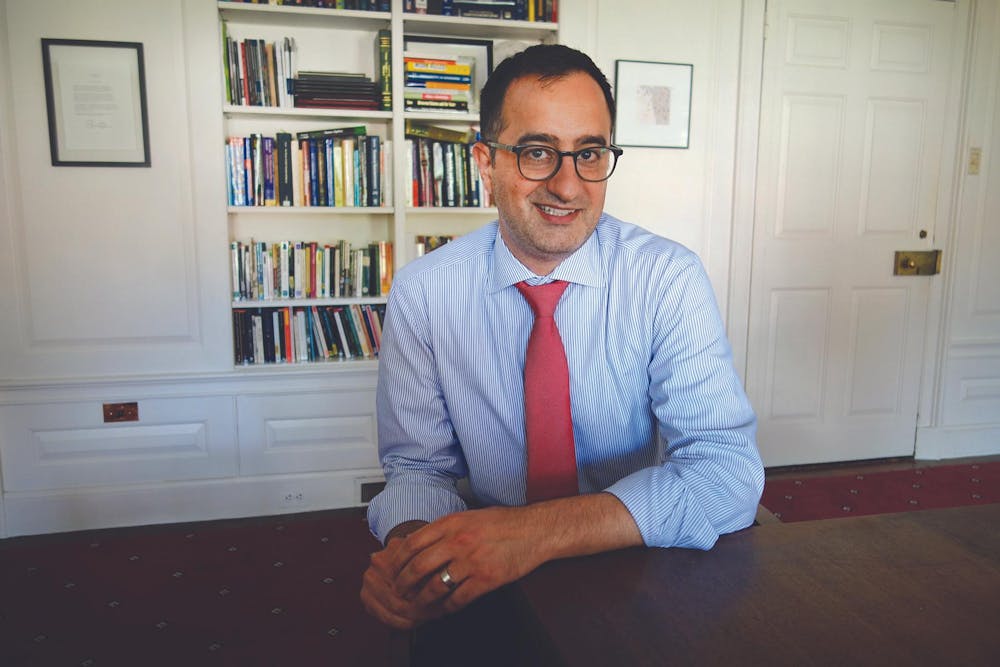
When Dean of the College Rashid Zia ’01 was a student at Brown, his engineering textbooks — which still sit in his office — were among the most expensive items he had ever purchased, he said. Over a decade later, in his first year as dean of the College, Zia established the Book/Course Material Support program to incorporate textbooks into a student’s financial aid.
Zia will end his seven-year-long tenure as dean of the College on June 30 and go on sabbatical before returning as a professor of engineering and physics at the University.
The Book/Course Material Support program was one of many aimed at supporting undergraduate students that Zia undertook throughout his tenure.
He prioritized the development of the Meiklejohn Peer Advising Program, which has grown to include over 350 mentors, making it the largest student group on campus. Zia also re-launched the CareerLAB as the Center for Career Exploration, which now focuses on alumni networking opportunities and specialized career advising.
“I am most proud of those moments where we were able to use advice that folks shared with us, then work together to put that advice into practice to make (the University) a better place,” Zia said.
Zia takes “deep joy” in the expansion of the SPRINT Program, which now includes “winternships” and semester internship opportunities.
The program, which Zia helped develop, makes Brown one of few universities in the country to use a need-aware funding model for internship opportunities, he said. Other schools typically use a “one-size fits some” approach to distributing financial support, which makes funding less “accessible to all students,” Zia said.
Zia served as dean during the COVID-19 pandemic — a time when support and circumstances were “difficult,” he said. After the pandemic’s outbreak, many students had to go home on short notice, while others were unable to get home for 18 months or longer. To ensure a safe return to campus, Zia helped add an additional on-campus semester in the summer to the 2020-2021 academic year.
These support-oriented initiatives connect back to his time as a Brown student, Zia said.
“We’ve had a deep tradition of listening to students and staff and faculty and making that possible,” Zia said. As a student, Zia concentrated in both electrical engineering and English and American Literature. He went on to complete a master’s and PhD in electrical engineering before returning to Brown in 2006 as an assistant professor of engineering.
“Some of the best parts of Brown have stayed the same,” Zia said. “Everybody in our community cares deeply about the work that we do with one another.”
After 12 years teaching engineering, Zia was drawn to administrative work because of “issues of access and inclusion,” he said. In 2018, he stepped into the role of dean of the College.
123, 456: Countless lessons
During his tenure, Zia co-taught UNIV 0456: “Exploring Career Options” with colleagues from the Center for Career Exploration. He also co-taught UNIV 0123: “Practical Introduction to Peer Advising” with two other instructors and the Meiklejohn peer leaders.
UNIV 0456 explores both the process of getting a job and the responsibility of students as they enter positions of leadership, Zia said.
Zia often begins the course with a game of Family Feud, asking his students to guess the most popular undergraduate concentrations among a group of 100 successful Brown alumni pursuing business. The number one answer was economics, but history came in second.
Zia said he hopes to teach students that “career paths are not straight lines.”
“They are nonlinear functions, and we try to help students plan for that,” he added.
Zia “sees the value in having students create tangible change,” said Sydney Stovall ’25, who took UNIV 0456.
As a Meiklejohn leader, Stovall would meet weekly with Zia and the other TAs to discuss UNIV 0123, a course that prepares first-year students to become Meiklejohns. Sometimes, these meetings took place at a table in the Sharpe Refectory.
“My favorite part of (UNIV 0123) is really … getting to know first year students,” Zia said. “It is a deep joy to be able to understand Brown every year through the eyes of someone who’s just arrived.”
In UNIV 0123, students also learn about what instructors called Brown’s “hidden curriculum,” which Stovall described as “knowledge about Brown or any institution that isn’t readily available.” She said that Zia’s office hours in the Ratty actively helped dismantle this “hidden curriculum” for students.
“It is remarkable how approachable he is,” said Meiklejohn Peer Leader Roberto Gonzalez Matos ’26. “He is always open to conversation. He is always open to helping everybody.”
Student-centered leadership
As an international student, higher education always felt “impersonal” to Marcelo Rodriguez Parra ’26. But Zia consistently provided advice and support when it was “needed most.” Rodriguez Parra, another Meiklejohn leader, recalls that he would often come to Zia with questions — ranging from internships to post-college plans — and Zia would always answer with reassuring words and a chocolate.
“I now know that there are people (in higher education) that actually care about students being able to access” resources, Rodriguez Parra said.
During Stovall’s Meiklejohn leadership orientation, the future Meiklejohn leaders sat in a park on the corner of Ives Street, listening to Zia share his personal experience with education, both as a student and as a child of immigrants. Zia was born in Iran, then moved to Rhode Island just before he turned five.
“Oftentimes administrators remain this elusive figure,” Stovall said. But Zia was “approachable through vulnerability and sharing his own lived experience.”
Zia is “so student-centered,” Stovall added. “It was really cool to see someone who is really the face of the undergraduate experience care so much about each individualized student experience.”
Gonzalez Matos saw this individualized experience working with Zia to create a program that mapped each course a student has taken to musical notes, creating a chord for their semester, and a chord progression for their time at Brown. Gonzalez Matos had always been interested in music, but it was Zia who came to him with the idea and funding.
“He’s very good at interacting with students in a comfortable way,” said Meiklejohn Leader Carlson Ogata ’25. For Ogata, Zia has “bridged the gap between administration and student life.”
When Tejal Desai ’94, dean of Brown’s School of Engineering, came to the University in 2022, Zia became a resource during her transition. He had a “deep knowledge about Brown — its policies, procedures and history,” she said.
He “truly cares about students and the entire Brown community and this is evident in all he does,” Desai added.
The power of a name
After Ogata met Zia for the first time, Zia remembered his name. “It made me feel seen,” Ogata said, adding that Zia gets to know “people beyond their names and faces.”
In the first two or three weeks that Zia taught UNIV 0123, Stovall said, Zia took care to memorize every student’s name.
“If you feel seen in some space, it might actually change the level of engagement,” Zia said.
This practice of remembering names began before Zia became dean. In one of his first years teaching at Brown, Zia taught ENGN 0510: “Electricity and Magnetism,” a large engineering lecture course. In the beginning of the semester, a student asked a question in class. In his reply, Zia addressed the student by name.
After the end of the semester, the student gave Zia a card that is still on display in his office, recalling how Zia remembered their name. Since teaching that course and receiving that message, Zia has made an effort to learn the name of every student who took a class with him.
Correction: A previous version of this article misstated Carlson Ogata's first name.

Hadley Carr is the senior editor of digital product and technology of The Herald's 136th Editorial Board.