Brown Dining Services employees say that over the past 20 months, they have faced an increasingly unmanageable workload and toxic work environment driven by alleged understaffing, unsympathetic management and poor communication from senior leadership about changes to dining operations.
Workers’ current concerns build on previous discontent with understaffing, broken equipment and a lack of workplace communication reported after the University’s return to in-person instruction following the COVID-19 pandemic.
The Herald spoke with two former and 12 current Dining Services employees, most of whom were granted anonymity due to fear of retaliation by management. Eight employees shared that they communicated their concerns to supervisors regarding working hours, dining initiatives and understaffing but were met with little response or action from management.
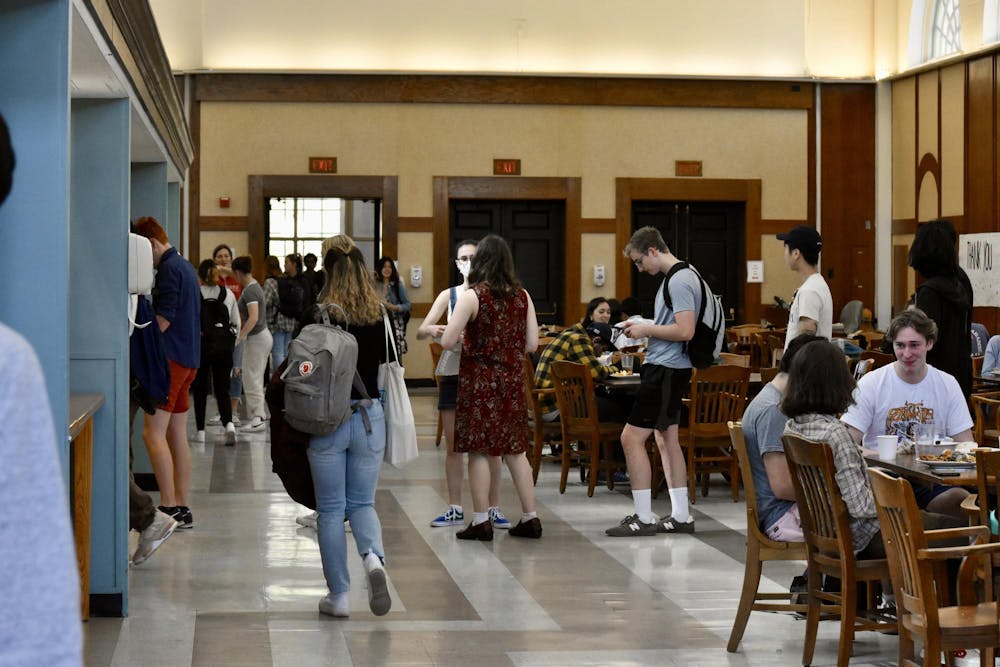
One former and four current Dining Services employees argued that the September 2023 rollout of the new kosher, allergen-aware and halal stations in the Sharpe Refectory put a strain on staffing that has persisted since their opening.
To staff the new stations, Dining Services senior management — led by Vice President of Dining Services George Barboza — reassigned employees from the main Ratty kitchen, said David Chabot, who was an assistant director of culinary operations at the time. Chabot added that newly vacated positions were not subsequently filled.
After working at Brown for 20 years, Chabot quit on April 10 due to growing frustration with being denied promotions for management positions, as well as staff shortages that he says have not been properly addressed by upper management.
In an email to The Herald, Barboza wrote that Dining Services hired four new positions to staff the stations. Two of the four positions were posted in August 2023, before the kitchens opened, while the other two were posted in January 2024 following a staffing assessment.
Barboza did not specify when exactly these positions were filled, but wrote that most of the new positions were filled through internal transfer or promotion, which happens “almost immediately.” But he noted that after internal transfers, it typically takes about six weeks to fill the resulting vacant positions.
He added that the “the staffing assessment did not come from any specific complaint about understaffing,” and staff concerns regarding hiring came while an assessment was already underway.
Some employees said that the staffing issues in Dining Services began just after the COVID-19 pandemic, but Chabot felt that understaffing was still “manageable” until the opening of the new Ratty stations in 2023, even though pandemic-related labor shortages stalled hiring processes.
Across all dining halls, overtime work has become an increasingly prevalent norm, according to Chabot and three current employees. In interviews, four employees described a standard of 60- to 80-hour work weeks.
“If employees decide to not do overtime, just for two days, I don’t think any of these places would be open,” one Dining Services employee at Andrews Commons said about Brown’s dining halls.
In a 2021 contract between the University and the United Service and Allied Workers of Rhode Island — the union representing Dining Services workers — Brown agreed to add 32 positions to address reported understaffing after the pandemic.
But the most recent contract — in effect from November 2024 to October 2029 — contains no explicit provisions for added positions, though a memorandum in the contract states that Dining Services will “endeavor” to convert 12 short-term positions into longer-term ones before 2027. The memorandum also notes that Dining Services “is and will continue (engaging) in a staffing assessment” that will consider management and union perspectives.
Amy Cardone, a business agent for USAW-R.I., said that since the contract came into effect, the union has filed multiple grievances with the University over vacant positions. Several of these grievances have been resolved via “agreed-upon labor relations processes, which are confidential,” according to Barboza.
Barboza also noted that Dining Services is “continually assessing staffing levels.”
Solutions to understaffing spark concerns over food quality
In an attempt to address understaffing, Dining Services has hired temporary culinary staff from staffing companies, including Snapchef, and temporary food-service workers from nextSource, according to two former and seven current employees.
But half a dozen employees told The Herald that they believe temporary workers, while sometimes helpful, are an insufficient alternative to hiring full-time workers to fill vacant positions.
Chabot explained that regardless of what experience level was requested, Dining Services would only receive temporary Snapchef workers who were “capable of being prep cooks, (but) not somebody we can hand a recipe to, not somebody that’s replacing any of our trained union staff,” he said.
A Verney-Woolley Dining Hall cook of 30 years fears students will get sick as a result of temporary cooks’ inexperience. In interviews, two employees cited an incident in which a Snapchef temporary worker touched cheese while wearing gloves still contaminated with blood from raw meat. Though the contaminated food was thrown away after the incident, occurrences like these have raised concerns among employees.
“Temporary staff help cover short-term needs, and they receive food safety orientation and supervision,” Barboza wrote. “While any concerns brought to our attention are taken very seriously, we have had no confirmed food safety issues with temporary staff members.”
Snapchef did not respond to The Herald’s request for comment.
Over half a dozen employees also believe food quality is declining as a result of understaffing. The V-Dub cook explained that because dining staff are “overworked and stressed,” meals are no longer taste-tested before their rollout, leading to a reduction in quality.
“Now, people are just putting things together and hoping that it tastes good because they don’t have enough time,” he said.
“I used to not be able to wait to go to work to eat our food,” said one Ratty food-service worker of almost 20 years. Now, “I would rather go home. Our food is garbage.”
Barboza wrote that Dining Services has received “no feedback to suggest that employees working overtime has impacted food quality.”
An increasingly stressful work environment
Several employees said understaffing and unmanageable workloads have been exacerbated by Campus Executive Chef Keith Halliday, who arrived at Brown in October 2023.
Chabot and six current employees described an increasingly negative and strained environment in the main Ratty kitchen, specifically citing Halliday’s intense management style.
One Ratty cook described Halliday’s attitude as, “Get it done no matter the cost. Whether it be your health, your time, your sanity — get it done no matter what.” Four employees reported experiencing deteriorating morale and increased anxiety due to his management style.
Another Ratty cook added that while cooks are dealing with an unmanageable workload due to understaffing, “you have someone like Keith asking them to do more.”
Two Ratty cooks alleged that Halliday retaliated against several employees after the College Hill Independent published an article in November 2023 about “workplace difficulties” in Dining Services. “Keith actually made a PowerPoint and yelled at all of us inside a room, slamming the paper on the table” in frustration, one cook recalled.
Halliday did not respond to multiple requests for comment.
But not all employees believe Halliday’s management style is at fault. One former manager who worked closely with Halliday and one current employee told The Herald that the pandemic led to confusion regarding expected responsibilities and a lack of management structure, which Halliday is attempting to rectify.
The employee noted that workers did not have a longstanding executive chef between 2019 and when Halliday arrived in 2023, and this habituated employees to working in an environment without much central authority.
Halliday “came into a very toxic situation himself — the lack of management, the lack of discipline,” the employee said, referring to how, under less supervision, employees would allegedly overuse sick days and log inaccurate hours. “You couldn’t pay me enough money to walk into what he walked into.”
“Between 2019 and 2023, we had a highly capable culinary leadership team, including a director of culinary operations and five assistant directors of culinary operations, before we ultimately appointed a permanent executive chef,” Barboza wrote. “Like many industries and employers, we’ve seen some turnover among our staff, but we focus on support and growth for our team, with clear expectations and regular reviews.”
Workers wish for increased transparency, more opportunities for input
Several Dining Services workers also believe menu changes and dining initiatives organized by senior management could be implemented more effectively if management communicated proactively with Dining Services workers.
A Ratty cook told The Herald that workers “are always the last to find out” about changes to dining operations. He added that managers make “these decisions behind closed doors.”
Many of the recent changes to Dining Services, such as moving the Ratty’s grill station to the Ivy Room, have been met with mixed reviews from both students and dining employees. Four employees said they wished they were able to provide more input on initiatives led by senior management, noting that their years of experience could help guide changes to menus.
“We value feedback from all dining employees, past and present, and we are dedicated to sustaining both a positive work environment and high-quality dining experience on campus,” Barboza wrote. “We aim for open communication with our staff through meetings and committees focused on operational changes. We both ask for and value the input of our team.”
One Ratty cook said that when employees provide feedback about proposed changes, members of senior management like Halliday and Barboza “kind of usher you along and say you don’t know what you’re talking about.”
“We’re the front of the house, while they’re in the back in the office on computers,” said one Ratty food services worker of almost 20 years about Dining Services’ senior management. “We know what (students) want — they just don’t listen.”
Correction: A previous version of this article incorrectly stated that Keith Halliday arrived at Brown in February 2023. Halliday began his employment at Brown in October 2023. The Herald regrets the error.

Emily Feil is a university news and metro editor covering staff & student labor and RISD. She is from Long Beach, NY and plans to concentrate in English and international & public affairs. In her free time, she can be found watching bad TV and reading good books.