Earlier this month, Congress passed the Republicans’ landmark tax and spending bill, dubbed the “One Big Beautiful Bill.” Along with cuts to health care, tax breaks and increased spending for border security, the legislation includes a reduction in financial aid programs — a provision that could change the way students at Brown receive financial aid.
An increase on private schools’ endowment tax was also included in the legislation, but Brown’s smaller endowment has made it immune.
In a June 30 announcement, University administrators expressed concern about the bill’s effects, as well as previously announced cuts to research funding. In response to this federal uncertainty, Brown will continue to cut costs by extending the staff hiring freeze, among other measures.
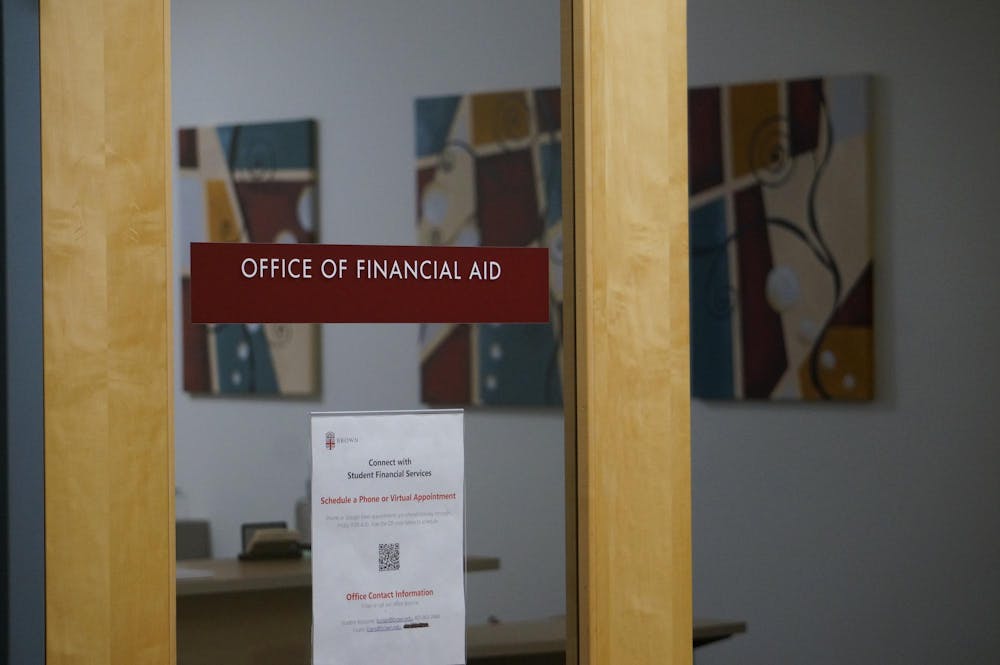
Changes to Pell Grants, federal work-study and student educational opportunity grants could result in an $8.8 million loss for the University, according to the announcement.
The University has vowed to continue meeting students’ full financial need in the face of funding challenges. But the bill makes this more challenging by stiffening requirements to receive Pell Grants — which support high-need students — and reducing options for graduate and medical students to receive federal aid.
The bill fully funds the existing Pell Grant budget shortfall, but makes it so students who have full-ride scholarships cannot receive Pell Grants. It also bases schools’ access to federal student loans on how much graduates earn.
Last year, 37% of students on financial aid had work-study included in their aid package. For the 2024-25 year, about 30% of undergraduates received some form of federal aid and 18% received Pell Grants, according to Sean Ferns, Brown’s dean of financial aid.
The bill has set stricter limits on graduate student loans. Graduate students’ lifetime borrowing limit will be capped at $100,000. A combined individual borrowing limit for a student’s undergraduate and graduate studies is set at $257,500.
In a press release shared with The Herald, Sameer Gadkaree — president and chief executive officer of The Institute for College Access and Success — wrote that “the rushed legislation is sure to have unintended consequences, but it is equally sure to achieve one clear objective: fewer college graduates to support our nation’s economy and workforce.”
Brown’s financial aid and tuition practices are currently under review by a congressional investigation that started April 8. Earlier this month, House Republicans subpoenaed Brown for documents related to the probe.
In previous versions of the bill’s endowment tax resolution, it appeared that Brown could owe over $29 million annually, based on last year’s fiscal returns. The bill proposes a tiered endowment tax system where private universities with a higher ratio of endowment dollars per student pay a higher tax.
In earlier versions of the bill, international students did not count toward the total student population. But as the bill was revised, international students were added to the student population, causing Brown’s endowment to sit at approximately $625,000 per student — under the $750,000 limit for a 4% endowment tax.
Brown will continue to pay the 1.4% tax rate that was signed into law in 2017.
Although the tax won’t impact Brown now, there is potential for a higher tax in the future.
“If Brown’s endowment performs especially well in 2026 (the year the new endowment tax kicks in), then it might need to pay the 4% tax rate. I suspect that will eventually happen, but Brown probably has some years before it will be in the higher tax bracket,” James Murphy, a higher education expert, wrote in an email to The Herald.
Other institutions, such as Harvard, the university with the nation’s largest endowment, will be taxed 8%, or a payment of $200 million each year.
In a letter to Senate leadership shared with The Herald, a coalition of organizations led by the American Council on Education criticized the tax as funneling “charitable gifts away from donors’ intended purposes and to the federal government, without doing anything to benefit students, education or research.”
“Over the course of the summer, as the financial picture becomes clearer on everything from tax on investment income to federal funding for research, we expect to announce additional measures as we contend with federal actions that impact our finances,” University spokesperson Brian Clark wrote in an email to The Herald. “We will continue to communicate about impacts directly to students, faculty and staff in the weeks and months ahead.”

Cate Latimer is the editor-in-chief and president of The Herald's 136th editorial board. She is from Portland, OR, and studies English on the nonfiction track. She previously served as a University News editor covering faculty and University Hall and higher education. In her free time, you can find her playing ultimate frisbee or rewatching episodes of Parks and Rec.

Ciara Meyer is the managing editor of newsroom and vice president of the 136th Editorial Board. She is from Saratoga Springs, New York and plans on concentrating in Statistics and English Nonfiction. In her free time, she loves scrapbooking and building lego flowers.