Brown archaeologists have uncovered new evidence of a medieval Islamic settlement documented on the island of Menorca, Spain — a finding that has the potential to reshape how the island’s history and heritage is understood.
A recent study led by Kathleen Forste, a postdoctoral research associate in archaeology and the ancient world, suggests that Menorca had a substantial medieval Islamic community whose influence can still be traced in the agriculture of present-day Menorca.
Before, “we didn’t have anything, not a single shred of paper that says that there were people there during that period, so this is completely new,” said Alexander Smith PhD’15, associate professor of anthropology at State University of New York at Brockport and co-author of the study. The research can help “expand the conversation” about the island’s heritage, he said.
Menorca is one of Spain’s Balearic Islands in the Mediterranean Sea, and it is well known for its prehistoric Talayotic stone settlements that date back to the Iron Age, Smith said. Compared to its neighboring islands, Menorca is relatively rural, which makes the site “excellent for archeological preservation,” he said.
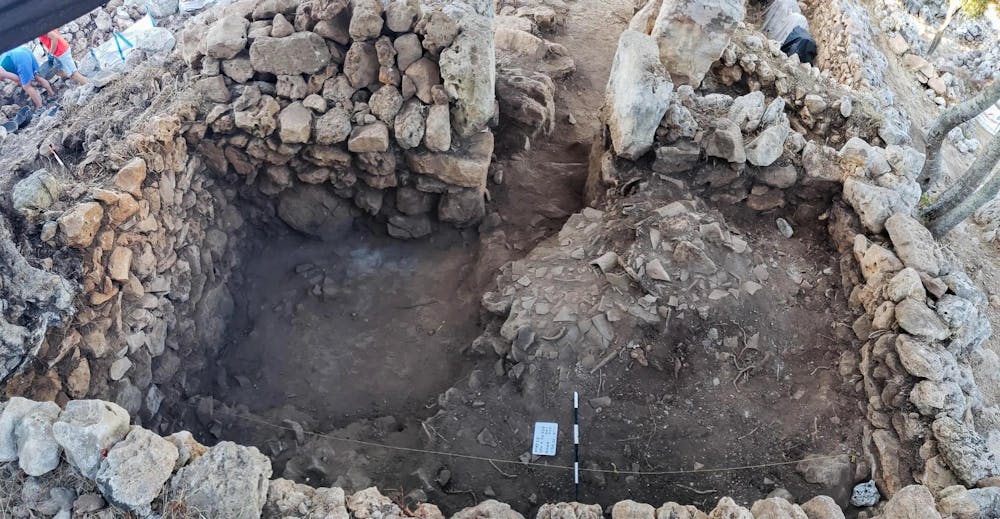
At Torre d’en Galmés, the excavation site on one of the Talayotic settlements, the team uncovered over a dozen large house compounds through survey work and aerial photography, according to Forste.
The archeology team found a collapsed terracotta roof tile — an exciting find for archaeologists because when roofs collapse, they preserve the objects inside houses. The team also found ceramic vessel pieces, including plates, bowls and jars, which indicate human livelihood in the area.
Forste collected soil samples, which were later analyzed at the paleoethnobotany lab at Brown, to understand the settlement’s agricultural practices.
“Some of those same fruiting trees (from the Islamic period) are staple crops of Menorca today,” Smith said. But for the most part, Menorca looks nothing like it did during the late antique period, he said.
Peter van Dommelen, a professor of archaeology and anthropology who was not involved with the study, said this paper points to a broader shift in how archaeologists define heritage.
“We’re now concerned about how to preserve heritage as not just a church or a mosque,” van Dommelen said. “It’s also those irrigation systems, which can be water wheels or water channels or … vineyards.”
In their study, the researchers framed the site in Menorca as a “Cultural Keystone Place” — a place of strong cultural significance for a group of people. Due to the importance of cultural keystone places, there are restrictions on development that can be done on places with this designation. Because the medieval Islamic period is often overlooked, the CKP framework is particularly important in Menorca, Forste explained.
During the Spanish Inquisition, when Christians took control of the Balearic islands, including Menorca, much of the Islamic population was forcibly removed, according to Forste.
“Anyone who remained hid their Muslim identities,” Forste said. Now, most people who live on the island identify as Minorcan, Catalan or Christian. “They don’t necessarily identify those Muslim communities as part of their own heritage.”
Van Dommelen believes Forste’s research fits into a broader theme of lack of visibility of Islamic influence across the Mediterranean, noting that “more specific and local appreciation of the Islamic past is much more recent in Spain.”
Looking forward, Smith noted that Menorca will need to raise public awareness and ensure preservation of the Islamic sites. The team will work “with the government of the islands to ensure that we have proper signage and awareness that these places exist.”
Forste said the study aimed to not only document the settlement, but to “help people understand the enduring cultural importance of a place.”
Practices “actually persist until the present,” Smith said. “So much of the island today is sort of influenced by this 400-year period.”