“Hello, Butler 1199! My name is Dan, and I’m the delegate from BH Call Intake.”
Almost every video on Daniel Camp’s YouTube channel, Delegate Dan, begins in a similar fashion. The content itself differs by day — some videos comment on ongoing strike negotiations, while others provide live updates from the front line at a demonstration — but he always opens with the same catchphrase.
Camp works at the call center of Butler Hospital, a psychiatric facility in Providence. For him, communication is the most important part of being a union delegate, he told The Herald in an interview. Keeping union members informed, he said, helps them stay invigorated — especially when striking.
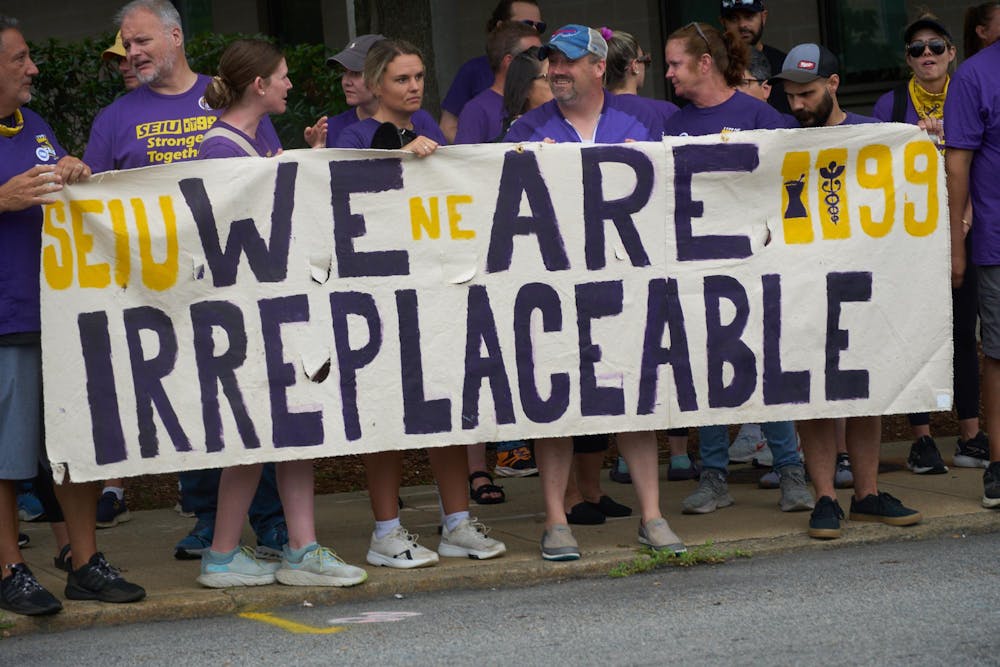
In May, Camp walked out of Butler Hospital alongside around 720 of his colleagues to join his union’s unfair labor practice strike. The strike culminated Aug. 19 with a new four-year contract — making it the longest hospital strike in Rhode Island history at just over three months.
To chronicle the three-month strike, The Herald spoke with three employees, all of whom recalled their time on the picket line as an inspiring and transformative experience that further deepened the sense of collective community among their colleagues.
The three months were rife with struggle. By the end of May, striking workers had lost their health insurance. A few days later, Butler endeavored to permanently replace their striking workers.
“Psychological uncertainty is just very hard,” said Brooke Huminiski, a clinical social worker in Butler’s emergency room. “A lot of us, myself included, thought we were gonna walk out and then, three hours later … walk back in.” Instead, strikers found themselves playing a waiting game.
“Being on strike is not a job,” Camp said. “This is something you have to want to do.”
In recent years, R.I. health care workers have faced workplace issues like understaffing, stagnant wages, burnout and poor administrative support — problems exacerbated by the state’s relatively low Medicaid reimbursement rates.
But at Butler, these problems have been exacerbated by ongoing patient-on-staff violence, according to both Camp and Huminiski. Huminiski also pointed to other state-wide systemic problems — like increases in housing insecurity and substance use — that have contributed to patient behaviors that are “harmful to staff.”
“I would just feel nervous driving into work because I wouldn’t know what would happen that day,” she said.
Mental Health Worker Ben Degnan has worked at Butler for over 23 years. Although he’s participated in numerous negotiations, this was his first time going on strike.
“Our goal was always to get back to work as soon as we possibly could, but we had to do it with a fair contract,” Degnan said.
To achieve this, strike organizers had to galvanize union members as much as possible. For Camp, this meant launching a YouTube channel to remind members that the strike — and their involvement — was important.
He told The Herald that the union’s open bargaining, which began a month into the strike and allowed more union members to engage in negotiations, was another reason why workers felt compelled to “buy in” and participate.
Degnan was initially cautious of this move, worrying that open bargaining might overwhelm people and dampen momentum. But, to his surprise, it only “empowered and engaged people at an even further level,” he said.
“There was so much connection and unity amidst really hard times,” Huminiski said. She recalled bonding with other members at the front lines and hosting community support events, like clothing swaps.
“I had the thought of, ‘As long as we stay together, as long as we can address the hardships that come up … we can get through this,’” she added.
Despite the challenges involved with maintaining a three-month-long strike, Degnan found being away from his patients and his work to be the most difficult of all.
“My heart breaks that people did not get as good care” during the strike, Huminiski said. But she believes the strike was necessary. “If we had just accepted the (initial) contract they offered, we would have kept losing staff,” she added.
Huminiski, for one, could not be happier to be back at work. Morale is high, she noted. When she walks down the hallway, she takes pride in greeting colleagues by name — names she wouldn’t have known if not for the strike.
Degnan now considers his fellow union members to be his “brothers and sisters,” with newfound bonds stemming from “one of the most meaningful experiences of his life.”
“There was a profound, unambiguous sense of unity,” Camp said. He remembers being the last union member to walk into the State House during a May 29 emergency rally calling for increased taxes on the wealthy and seeing his colleagues on the balcony.
“I just stood there in the middle, and everyone started cheering and hooting and hollering,” Camp said. “I’ll never forget it.”
Megan is a contributing metro editor covering health and environment. Born and raised in Hong Kong, she spends her free time drinking coffee and wishing she was Meg Ryan in a Nora Ephron movie.