
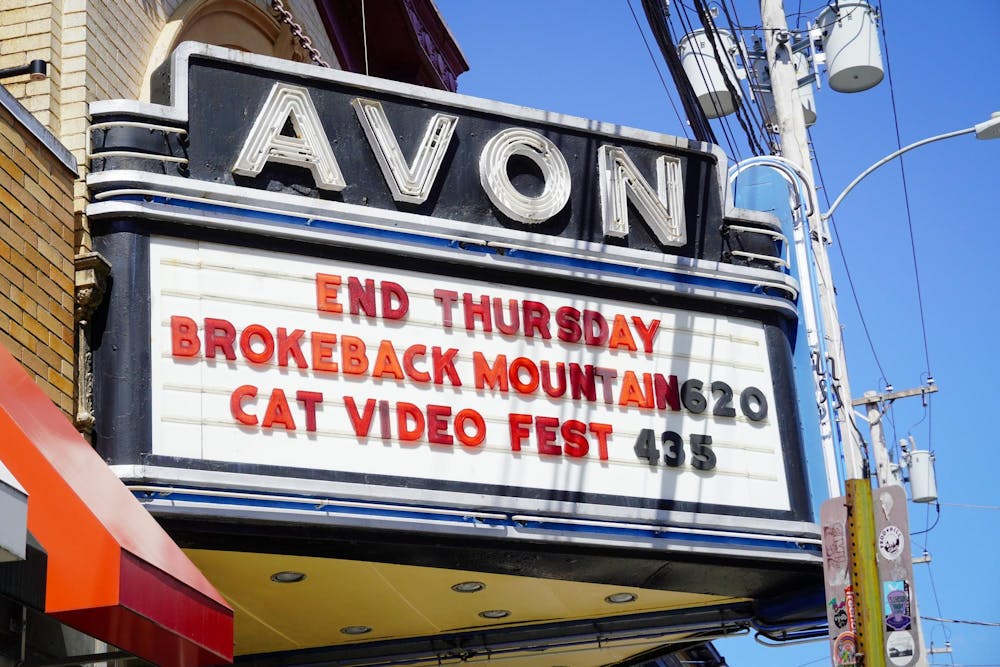
Ang Lee’s “Brokeback Mountain” tells the story of two young cowboys — Jack Twist (Jake Gyllenhaal) and Ennis Del Mar (Heath Ledger) — herding sheep on the titular mountain in 1960s Wyoming. Over the course of the summer, the two fall in love, and the film follows their epic love story across the next two decades.
In celebration of its 20th anniversary, the film returned to the big screen this year at select theaters, including Providence’s Avon Cinema. The Herald spoke to theatergoers, as well as the film’s executive producer Michael Costigan ’90, about the enduring impact of “Brokeback Mountain” two decades later.
Costigan said the movie had a long journey to becoming the cultural classic it is today.
“The list of directors who read it and passed on it and considered it is epic,” he added. “People were afraid of it.”
It was finally tackled by Lee, who — fresh off of “Hulk” — “really wanted to go back to a story that he really could connect with and wanted to tell in a very organic, naturalistic way,” Costigan explained.
When “Brokeback Mountain” was first released, the film was met with controversy from some religious groups due to its positive portrayal of LGBTQ+ characters.
Costigan still has a box of clippings from 2005, including a headline reading “Will ‘Brokeback Mountain’ ruin Heath Ledger’s career?” Costigan recalled the press asserting that neither Ledger nor Gyllenhaal could ever “be a leading man in a Hollywood film again.”
Nevertheless, the film was met with critical success, winning Best Adapted Screenplay at the 2006 Academy Awards, as well as Best Director and Best Original Score. In addition, both Gyllenhaal and Ledger were nominated for Best Supporting Actor and Best Actor, respectively.
This month at the Avon, the film was met with praise from theatergoers, both new and old.
“We are getting a lot of people thanking us for bringing older films back, but this film in particular,” said James Nocera, the general manager at the Avon. “I think that people now are able to vocalize more how it resonated with them.”
The film “was such a big step forward at the time, and (now) we’re sliding backwards,” said Kat Lopez ’27, who watched “Brokeback Mountain” at the Avon. “We need more big steps forward just like this.”
Gay marriage was legalized in 2015, 10 years after the film’s initial release. But now, in 2025, gay marriage may be at risk with the Supreme Court considering to take a case that challenges its ruling from a decade before.
They added that as a queer person, they feel lucky to “get to live and be queer,” free from the kind of “regret” and “fear” represented in “Brokeback Mountain.”
“It also empowered me to be queerer,” Lopez said. “I asked a girl on a date right after.”
Katie Dupper ’28, Oliver Drachman ’28, Nolan McCloskey ’28 and Brandon Richard ’28 all saw the movie for the first time. Heading into the showing, they knew just two things about the film: “It was sad and gay.”
McCloskey “was really mad at the characters for not talking more,” he said. “Like, where was the communication in this movie?”
“Their aggression and affection is very intertwined,” Drachman said of the film’s main couple.
Costigan said the film’s crew was not aware at the time that “Brokeback Mountain” would have such an enduring impact on popular culture.
“It was one of those magical shoots (during which) everybody knew we were making something special,” he said. “It felt intimate and like it was gonna be a beautiful film, but no one had any idea that it would reach a larger audience the way it did.”
The makers of “Brokeback Mountain” didn’t approach the film as a particularly politically or socially “important” story to tell, Costigan said. Rather, the filmmakers approached it as a love story. And the best love stories, according to Costigan, ask “Why can two people not be together?”
Rebecca Goodman is a university news senior staff writer covering career and alumni. She is a junior from Cambridge, MA, studying English. Outside of writing, you can find her at the Avon or in the basement of the Rock.


