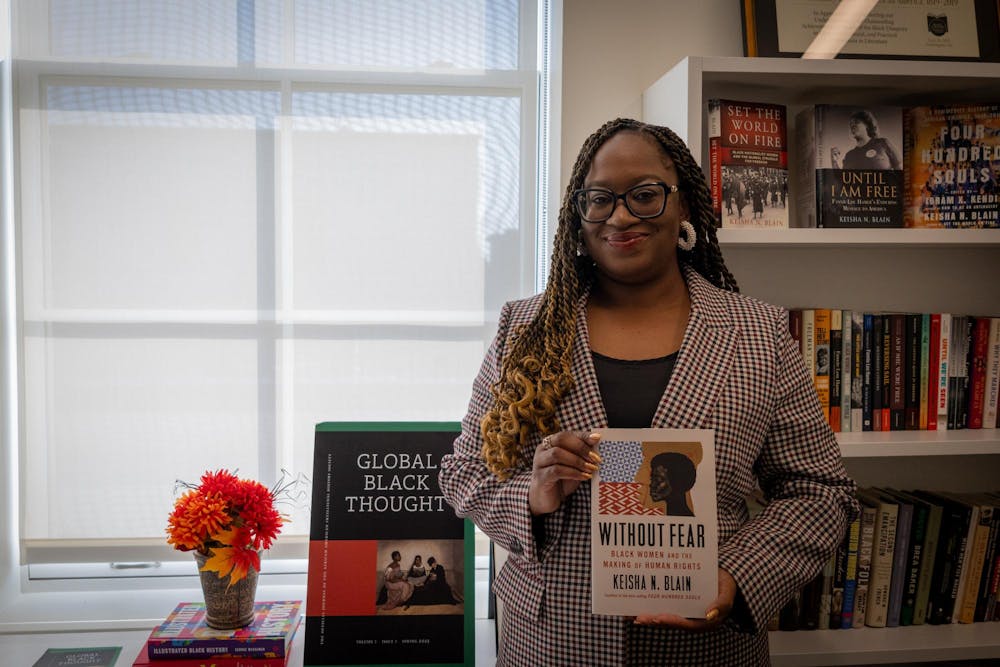
Earlier this month, Professor of History and Africana Studies Keisha Blain published her new book, “Without Fear: Black Women and the Making of Human Rights.”
In the book, Blain explores how Black women activists “made human rights their own,” she said.
Typical dialogue surrounding human rights tends to overlook “ grassroots activism” — which Blain believes “is actually an important part of the story.”
The idea for “Without Fear” arose while Blain was working on a previous book, “Until I Am Free: Fannie Lou Hamer’s Enduring Message to America,” which was nominated for the 2022 NAACP Image Awards.
While conducting research on activist Fannie Lou Hamer, Blain came across speeches where Hamer connected civil rights struggles in the U.S. to human rights globally.
“Activists were recognizing that their fight was so much bigger than a national context, that it truly was part of a global struggle,” Blain said. “I wanted to be able to write a book that would explain that history in more depth and go beyond just (Hamer) and think about Black women’s activism broadly.”
While Blain’s research planted the seed for her book, it was the 2020 Black Lives Matter movement following George Floyd’s murder that “compelled (her) to actually sit down and start writing,” she said.
The events of 2020 were “very much reflective of a longer history and a longer tradition of Black women’s political advocacy and human rights advocacy,” she added.
The book’s title comes from a 1944 speech by educator and civil rights activist Mary McLeod Bethune. In it, she encourages a group of Black women to come together and create change “without fear.”
When she feels “disheartened” by current events, Blain holds onto Bethune’s words of encouragement — to “maintain hope” and “make a difference,” she said.
“Without Fear” is “an amazing book that really expands the field and offers us a fuller picture of Black women’s contributions,” said Kim Gallon, an associate professor of Africana studies. “She gives us the voices of people that we may not be necessarily aware of and whose stories ... broaden and complicate our understanding of human rights.”
Because Blain wrote about figures with limited written records, she had to be creative in her research by piecing together sources like census records, newspapers and oral histories.
During her research, she came across Pearl Sherrod, a 1930s working-class advocate for Black and Asian solidarity, in an archival collection about a 1937 pan-Pacific women’s conference.
“Who is this person?” Blain recalled asking herself. “Who is this random Black woman who shows up at a pan-Pacific conference and tells these women — white and Asian women — they need to pay attention to what’s happening to Black people?”
“It was a lot of piecing together,” she said, adding that Sherrod’s story took her “about 10 years” to research.
Blain intends to incorporate her research into a history course she will teach next semester titled HIST 1571: “The Intellectual History of Black Women.” The course will explore “intellectual productions and theoretical traditions of African American women,” according to Courses@Brown.
Reflecting on her career, Blain said she is especially proud of her 2024 anthology, “Wake Up America: Black Women on the Future of Democracy.” And she’s already begun her next work: a book about how Black thinkers across the globe “fundamentally shape the world with their ideas,” she said.
“One of the things that I admire about Dr. Blain is her insistence on writing robust, rigorous scholarship, but not wanting to just write it for academic audiences,” Gallon said, adding that Blain is “really clear that her work should be accessible.”
“She is a thoughtful mentor,” said Mickell Carter GS, an Africana studies Ph.D. candidate. “She cares about the holistic being, not only my research.”

Ivy Huang is a University News and Science & Research editor from New York City. Concentrating in English, she has a passion for literature and American history. Her favorite authors include Marilynne Robinson, Vladimir Nabokov, and Toni Morrison. Outside of writing, she enjoys playing basketball, watching documentaries, and beating her high score on Subway Surfers.