
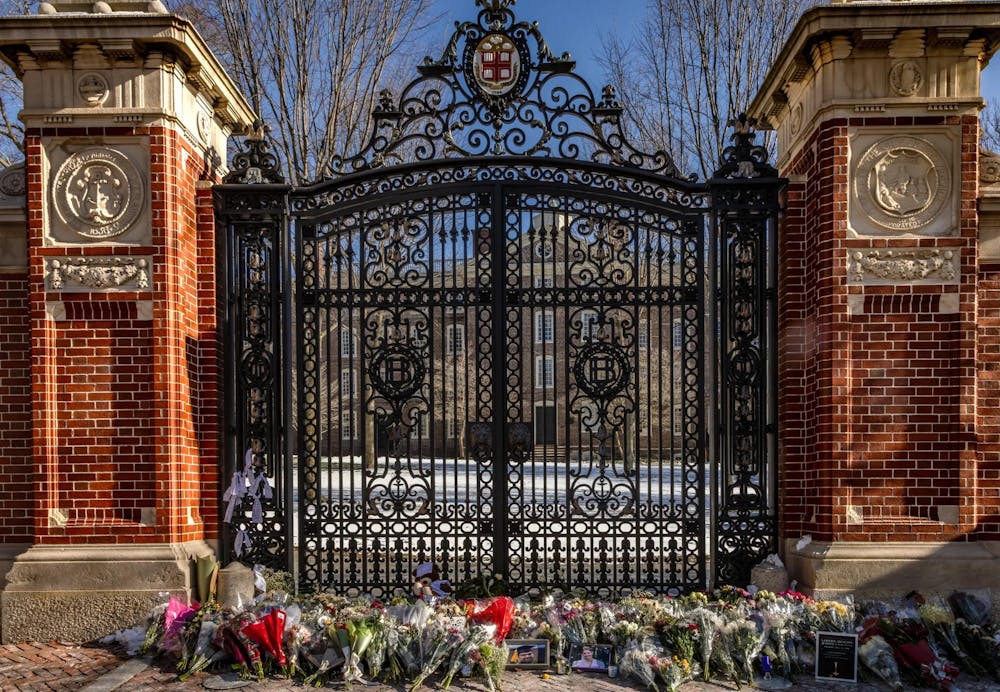
Stepping out of my dorm on Dec. 14, I was met by five of my friends gathered outside the room of Ella Cook ’28. Flowers lay next to the door and tears streamed down our faces. We stood together in silence — gutted by the tragedy that lay before us and unable to comprehend what we had lost the day before. Ella was my next-door neighbor, classmate and dear friend. Standing shoulder to shoulder with my dormmates, I was confronted with the permanence of the tragedy that took place the day prior.
In the days since, many have remarked on Ella’s exceptional ability to speak across disagreement. Ella taught me lessons about being friends with others not in spite of our differences, but because of them. She bridged ideological divides, seeking to foster authentic mutual understanding. On a campus often consumed by ideology and moral certainty, Ella offered something rarer and more difficult — a truly human understanding of political difference. Her commitment to pushing past the facades of partisanship to the substance of discussion elucidates an antidote to our current political crises.
I first met Ella in my first year seminar, POLS 0821D: “How to Think in an Age of Polarized Politics.” In a class where almost all voices were different shades of liberal, Ella offered a fresh perspective that embodied the importance of the course. After two and a half hours of discussion each week, she and I often walked back to North Campus, continuing our conversations from class. We shared stories of our pasts, discussing our experiences growing up in the deep south of Alabama and northern woods of Maine.
As I was a staunch progressive and Ella was fiercely libertarian, we agreed on certain topics but disagreed on most. This didn’t stop us from forming a friendship that was built on mutual care and respect. She welcomed people in, refusing to make broad judgements about them based on their politics. Almost every week, she invited me to attend Brown Republicans’ meetings — not to persuade me, but to include me. She welcomed me into a space where I never would have found myself otherwise, asking nothing in return but openness. Through our friendship, I didn’t just learn more about her beliefs, I began to think more deeply about my own.
While I’ve long noticed the dearth of ideological diversity on Brown’s campus, Ella gave me a window into what it feels like to be on the other side of that divide. On campus and in the country, we are increasingly sorting ourselves into our morally “pure” groups and cocooning our beliefs in echo chambers that insulate us from differing political views. Social media is reshaping how we consume political information, rewarding outrage and division instead of meaningful connection. When shocking acts of violence occur — whether it’s the killing of U.S. citizens by federal agents, the killing of Charlie Kirk or even yet another school shooting — too many people seem unable to take off their partisan goggles to see the reality before them. We are left kneecapped in our ability to grieve, to organize for change and to recognize the humanity of our neighbors.
This fractured politics is exactly the kind of environment that urgently needs Ella’s ethos — one grounded in grace and meaningful engagement. Where often our first instinct is to act or fight back, Ella’s was to understand — to inspect and digest issues, hold our political opponents close regardless of vitriol and to engage in the challenging work of bringing others in instead of casting them out. When we seek to first understand and then act and persuade, we lead our politics with empathy and grace. This is the road to not only bridging our chasms of disagreement, but also to long-term political stability and societal restoration.
We must start by applying the lesson Ella taught us to our own community. The way forward from this senseless tragedy is through the very kind of community she fostered. We have seen the power of Brown’s collective spirit in the past month. What makes this University so spectacular is not just its academics, but the students who fill its campus and the culture we forge together.
We are in a dark place right now, but the path ahead is illuminated with the light in each of us. Recovery asks us to take responsibility for one another, to stand in supportive roles and to resist the urge to retreat inward. Ella showed us how to do this. In this way, she remains with us, guiding us to find our strength together.
Tommy Leggat-Barr ’28 can be reached at thomas_leggat-barr@brown.edu. Please send responses to this column to letters@browndailyherald.com and other opinions to opinions@browndailyherald.com.


