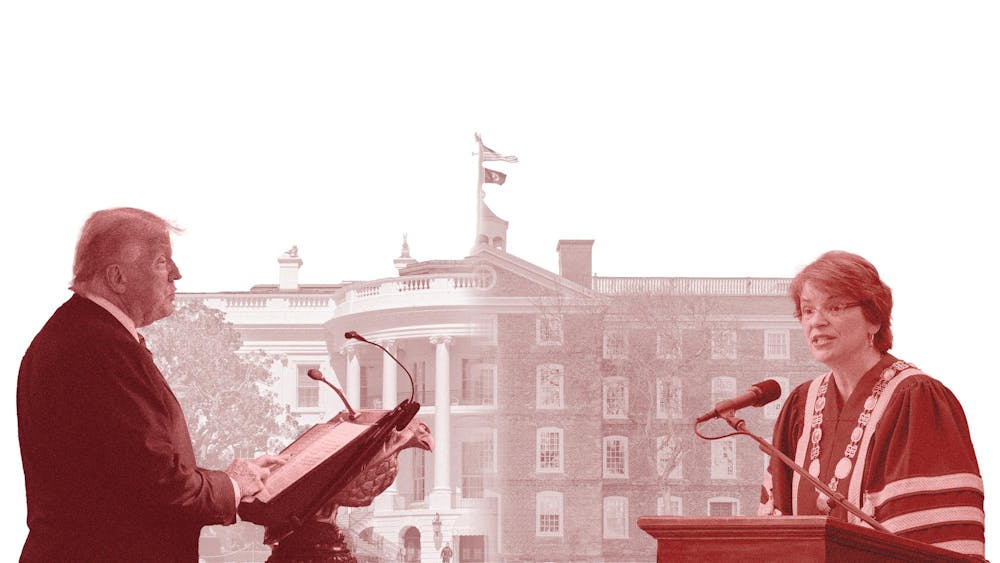
While Brown faced down investigations and unprecedented funding cuts masterminded by a White House looking to exert influence over American higher education, the campus’s gaze focused on the University’s top leadership, anxiously waiting to see whether they would choose to strike a deal or fight back.
On July 30, they got their answer. Over the summer, Brown had been privately negotiating with the Trump administration and the two parties had reached an agreement.
The feedback was swift. Some praised University leadership for extracting a comparatively noninvasive deal that did not give external officials on-the-ground oversight over campus matters — a power that had been granted by peer institutions. Others decried the move, calling it an unacceptable bow to President Trump.
As the Brown community grapples with how this deal will shape the future of College Hill, The Herald sat down with President Christina Paxson P’19 P’MD’20 — now 13 years into an eventful tenure at the helm of the University — and Provost Francis Doyle in University Hall for their first interview since the deal was announced.
“I recognize there are people who are unhappy about the agreement,” Paxson told The Herald. “Finally, I can actually talk to them, and that’s something I really appreciate.”
Why enter negotiations?
In April, the White House confirmed plans to freeze $510 million of Brown’s federal funding. While Brown never received formal notice of the Trump administration’s plans, the spigot was dry. Every dollar from the U.S. National Institutes of Health funding was frozen — no new awards were granted, renewed or paid.
But that was just the opening salvo. Later that month, the U.S. Department of Health and Human Services also placed the University under a Title VI investigation aiming to review allegations of antisemitism on campus.
“We were at a point where we knew that we had to take some action or it would have really dire consequences for the University,” Paxson said.
The University chose to start negotiations, in part, due to the lack of communication it received about the funding cuts from the federal government, Doyle said.
“We were in limbo,” he added, explaining that Brown is more reliant on federal funding than nearly all of its peer institutions.
But the University is keeping a keen eye on this vulnerability, aware that the current presidential administration has taken an adversarial posture against elite American higher education institutions, and it must safeguard its future.
Part of this plan, Paxson said, is weaning Brown off its reliance on the federal government by diversifying Brown’s funding sources through philanthropy, corporate engagement and foundation support.
“It’s been a wake-up call that there is a lot of intertwining of universities and the federal government,” Paxson said.
Commitment to workforce development organizations
Despite the federal government’s affirmation in the agreement that it found no instances of wrongdoing by the University, Brown will pay $50 million to Rhode Island workforce development organizations over the next decade.
Paxson stated that the University has the authority to pick which organizations receive grants but has not yet selected the organizations. The recipients will be chosen through a transparent application process, she added.
Paxson and Doyle declined to elaborate on the particulars of how the University reached this particular resolution, or any other provisions in the agreement, with the Trump administration.
Support for Jewish students and the wider community
Paxson stressed that the University will honor its agreement with the federal government to combat antisemitism and support Jewish students, but this “is not to the exclusion of our other commitments to other students,” pointing to “a good network and web of resources to support our students who come from very different identities.”
Brown plans to conduct a campus climate survey by the end of 2025. The survey will build on previous ones the University has conducted, but it will be expanded to include topics of interest for the federal government, such as the climate for Jewish students and social media harassment.
According to Doyle, the University’s last survey in 2023 was conducted using an external firm. The University plans to use a similar third party to administer this year’s survey to ensure high response rates while giving respondents confidence their answers will remain confidential.
While she reiterated that the University supports research and education regarding Israel, Paxson noted that Brown also supports research and education on Palestine, Southeast Asia and other regions globally.
Some students have expressed concerns about the future of affinity centers and groups.
The University has always required affinity centers and all other student organizations to be open to all students on campus, regardless of race, although this policy hasn’t “been enforced as vigorously” as it is now, Paxson said. “An affinity center can still exist, but it has to have programs and genuinely welcome all people who are interested.”
The Student Activities Office began conducting a vigorous review of affinity- and identity-based events in the spring semester to ensure they are open to all students, The Herald previously reported.
Support for Brown’s transgender community
In the deal, Brown agreed to comply with the National Collegiate Athletics Association’s rules regarding transgender athletes that ban student-athletes not assigned female at birth from competing in women’s sports. They also agreed to prohibit gender-affirming care for minors, although few minors are enrolled at Brown.
Responding to concerns regarding the safety and inclusion of transgender community members, Paxson stated that University administrators are still emphasizing that they “care about our trans members of our community and our gender nonbinary members.”
As of right now, there are no specific actions the University is taking to reaffirm this commitment, she said.
“We need to really sit down and hear what people are saying and hear what would make them feel more comfortable,” Paxson said. But administrators have yet to start these conversations, she added, explaining that the semester has only just started and that they expect this effort to begin in earnest in the coming weeks.
Doyle acknowledged the loss of trust between the University and its transgender community as a result of the agreement and emphasized that administrators “endeavor to rebuild that.”
Implications for peer institutions
Other universities, such as Columbia and Penn, have also made deals with the federal government. As higher education institutions enter into agreements, others, like Harvard and Northwestern University, find themselves under increasing pressure to restore their funding, as their peers have done.
But the fate of other institutions was not Paxson’s primary consideration.
“At the end of the day, we have to do what’s best for Brown,” Paxson said. “We’re all in somewhat different situations.”
Paxson added that these “different situations” mean that schools like Harvard are able to take different actions than schools with fewer resources. On Thursday, a federal judge ruled the cuts against Harvard were illegal.
She added that any pressure for other schools to accept similar agreements likely come from their own needs for federal funding, not Brown’s agreement itself.
“How long can they hold out and not have their research at the university just collapse?” she asked.
Further federal actions
While the agreement resolved three ongoing investigations against the University, it is only set to last for three years and does not prohibit the federal government from launching additional probes.
Paxson acknowledged this impermanence, but she said that the agreement allows the University to “think about how we respond to future federal issues, as they arise.”
“Just as the federal government still has options, we still have options too,” Paxson said. “We haven’t committed to not doing anything in the future.”
The University is currently anticipating where it may be impacted by further federal actions, Doyle said. He added that he is concerned about a decrease in federal research funding from sources including the U.S. National Science Foundation and the NIH, a phenomenon he described as “undeniably destined.” He also raised concerns about financial aid programs and international students having issues securing visas.
Other financial concerns include a higher endowment tax. Following the passage of the Republican’s landmark tax-and-spending bill, the University’s endowment tax remains at 1.4% but could increase to 4% in the near future if the endowment continues to grow at historic rates, Paxson said.
Looking toward the future
Both Paxson and Doyle encouraged Brown’s community to remain hopeful for the University’s future.
“This University has been around for 260 years. It’s going to be around for another 260 years, I hope,” Paxson said. “And so people have to keep looking over the horizon and not get too caught up in what’s right in front of us.”
The past year was filled with uncertainty that limited the University’s ability to further its mission and trajectory, Doyle said. Now, the agreement will allow the University to “concentrate proactively on the mission, on the excitement,” he said.
Paxson said that University administrators knew there would be changes in higher education after Trump was elected in November, but emphasized the need to take “the long view” and “keep moving forward,” she said.
“I hope that when people look back to this time period at Brown, they remember the advances in so many different areas,” Paxson said. “We have a new school. We’re building this great new life sciences program. Our students are phenomenal in so many different dimensions. That’s what I want people to focus on.”

Roma Shah is a section editor covering University Hall & Higher Education and Admissions & Financial Aid. She's a sophomore from Morgan Hill, CA studying neuroscience. In her free time, she can be found doing puzzles, hiking or curled up with a book.