
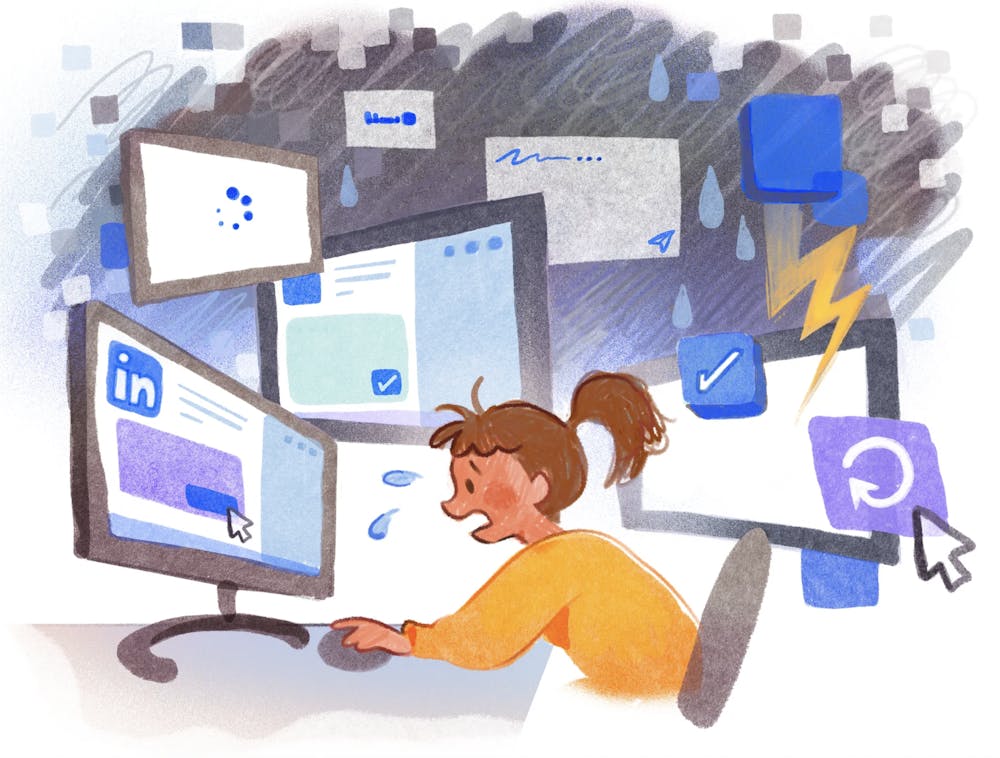
In an applied math lecture a few days ago, I noticed a peer scrolling through LinkedIn on his laptop. A friend landed an internship at Deloitte; another at McKinsey; someone started a new consulting club. Beside professional headshots were messages thanking recruiters, families and of course God for these opportunities. Responding to these posts, others eagerly commented courteous words like “Impressive work!” and “Excited to hear more about your experience.” The student viewed a curated feed of his holy trinity — the chief executive officer, chief financial officer and chief operating officer. While our professor was solving differential equations, this aspiring executive was planning out his path to success in corporate America.
Giving my peer the benefit of the doubt, I’ll assume he already knew the material being covered that day. But the interaction represents a problem beyond a lack of attention in class. By focusing so much on grinding for their next internship, Brunonians are missing out on the point of their liberal arts education — to learn for the sake of learning and to better themselves as human beings rather than employees.
LinkedIn’s fundamental issue stems from its design as a social media platform. The site is just as addictive as traditional social media. Users get alerts when others post and feel compelled to like and comment just as they would on a friend’s vacation post on Instagram. If curated images on social media cause people to feel isolated and left behind — the infamous “FOMO,” or “fear of missing out” — it is not difficult to imagine how they would react to constant reminders of other people’s professional success.
But LinkedIn is a game. Anyone with the right professional lexicon can embellish a summer of sitting at a desk and fiddling with an Excel sheet into a post that highlights acquired skills and meaningful projects. The seasoned LinkedIn poster captures the attention of even the most skeptical users. The platform is meant to be performative. Your thank-you note to your manager, blasted on public display, means little compared to a handwritten card or private conversation. These meaningless gestures are consuming college students’ attention, pulling their focus from classes to careers.
Brown is not just a step toward becoming the next doctor, lawyer or executive. A liberal arts education is meant to challenge the mind and encourage academic discovery. Upon graduating, students receive a diploma that certifies that they have read difficult texts, grappled with complex problems and pursued knowledge in a range of disciplines. College is meant to foster intellectual growth, producing individuals who know how to think critically and have an appreciation for learning. It is an environment for personal development rather than professional development. While employers value a college degree, they are wrong to assume that the four years we spend in the academic setting are for their benefit. Amid the fear of life post-graduation, we have forgotten why we chose a liberal arts education.
Why have an Open Curriculum that encourages engagement with diverse material if your sole focus is career planning? Other universities offer business degrees and a pre-med major; why choose Brown if you plan to spend your time in college chasing after a job? A meaningful education on College Hill cannot coexist with a pervasive LinkedIn culture. Brunonians must realize that the platform is a distraction during these formative years.
I am aware that many of my peers will think I am naive to suggest that students can afford to stop worrying about their future careers in a job market that has become increasingly competitive. In June, the unemployment rate for recent college graduates was higher than the overall unemployment rate in America, and those who do find work are often paid less than they expected. Understandably, students may fear the consequences of not actively using LinkedIn to their advantage. The conflation of the corporate and academic worlds is not inherently their fault. Employers bear most of the responsibility, as they have expected students to be fully polished professionals, inhibiting their personal growth.
This does not mean that college students are helpless. While deleting their LinkedIn accounts may be impractical, Brunonians should still be aware of their current situation as students and know that the platform does not dictate their fate. Your life will be full of corporate formalities once you leave College Hill. Do not waste the opportunity to read a book, debate a peer and research fascinating concepts while you are still here. Failing to do so will irrevocably harm one of America’s greatest institutions — the university.
Ethan Canfield ’28 can be reached at ethan_canfield @brown.edu. Please send responses to this column to letters@browndailyherald.com and other opinions to opinions@browndailyherald.com.
Ethan Canfield is the head of the Editorial Page Board and an opinions editor. He previously was a columnist and a copy editor for the Herald. He is a sophomore from Houston, Texas and is studying Applied Mathematics-Biology.


