
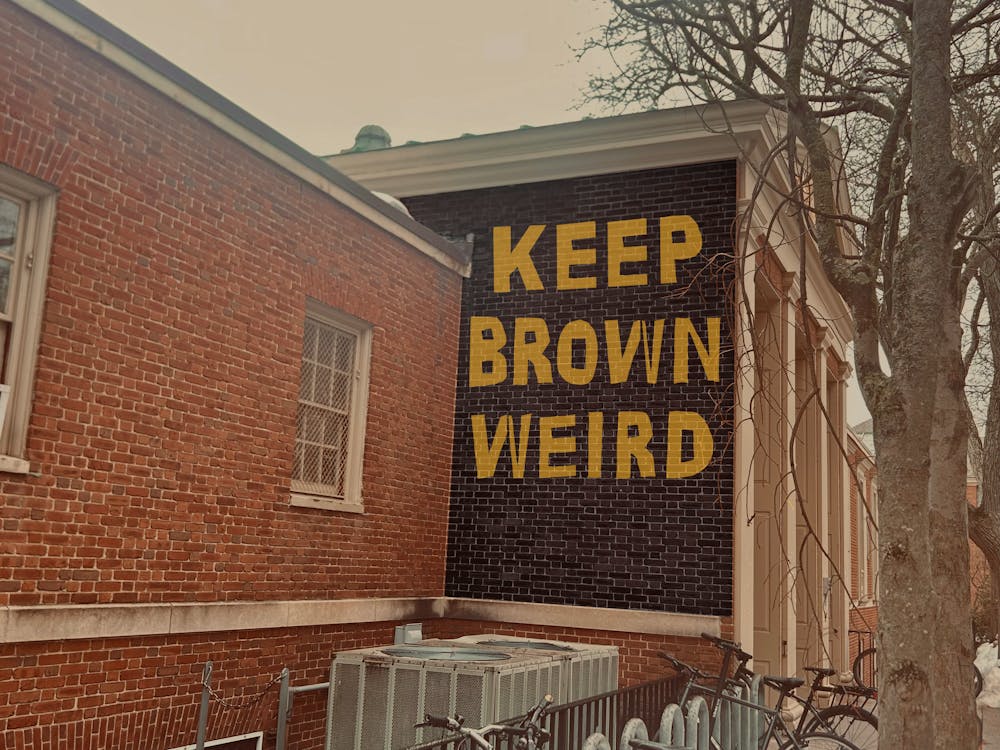
Brown does things differently.
We call majors concentrations, we are one of four universities bearing the name of a color and our Open Curriculum requires no core classes. Brown students founded the first college radio station in the ’30s and the University pioneered the study of semiotics and modern literature and society in the ’70s. This nonconformity persists today — perhaps best captured by the fact that once a semester, students run naked through the libraries, handing out donuts. Our culture of free exploration has shaped generations of Brunonians. Brown became the “Happy Ivy” because Brown was the unconventional Ivy.
Though Brown continues to offer opportunities for students to tread their own paths, academically and otherwise, this culture of individuality has been increasingly sidelined as more students feel pressure to compete and embrace pre-professionalism. Careerism is leading to a loss of individual eccentricity and agency over one’s future — core attributes of a Brown education — but if students learn to balance professional pursuits with their unique identities, this doesn’t have to be the case. To keep Brown’s status as a uniquely happy university, its students need to embrace “pre-personalism.”
This year, College Hill saw a surge in applications for limited spots in investing clubs, consulting clubs and unpaid hospital volunteer positions. A notable share of the class of 2029 wants to pursue finance, medicine or law. These narrow career paths require intensive preparation, whether it’s through networking, applying for dozens of competitive internships or conducting research.
As the labor market tightens and barriers to entry rise, students face ever more pressure to start earlier and compete at a higher level. If students aim to conform to just a few professional paths, they encounter more competition and comparison. This can leave them feeling like they can’t afford to spend time exploring their interests and makes them doubt their qualifications relative to peers. This phenomenon, known as imposter syndrome, is worsened when we focus on conforming to a set path instead of forging our own way. Individual quirks are forgotten about when there are measurable ways to assess your success against others who are on the same journey as you.
Even hobbies, traditionally viewed as a source of stress relief for personal growth, have been co-opted into strategies to stack your resume’s “interests” section. The things we do for fun have become another source of fuel for comparison. Especially at Brown, where students are nationally recognized for their hobbies, these passions, intended to be fulfilling, lose their “low-stress” benefits and distinctiveness.
My fellow columnists have warned of this growing preprofessional crisis as a problem within itself, but I disagree. They have missed the underlying individuality crisis that is worsened by careerism — but not caused by it. While pre-professionalism can make us want to turn our distinctiveness into conformity, we can resist. We can balance our desire for career success with our need to be unique.
Embracing our individual weirdness and pre-personal attitude can bring us both personal happiness and professional success. A model for this dedication to individuality is Olympic figure skater Alysa Liu. Liu, who had been skating since she was five, quit at 16 because she was not competing on her own terms. When she decided to come out of retirement ahead of the 2026 winter games, she competed for herself and not for others. Liu resisted conforming to her sport’s diet-culture or traditional look. And she was different on the ice, too. Liu’s 2026 individual freeskate performance differed from the standard for the discipline, which has emphasized the challenging tricks over artistry. In Milan, Liu skated with artistry and style. With her multicolored hair, unconventional dress and joyful performance, Liu competed for herself — and won. She showcased the power of pre-personalism on a global scale.
The work hard, play hard mindset embodied by Liu is definitely present at Brown. But to further embrace individuality, we could all work harder at play. Intentionally structuring playtime — yes, playtime — into our adult lives can feel strange, but dealing with this discomfort is itself beneficial. Time dedicated to simply participating in fun activities — such as building igloos on the Main Green when it snows and making tiramisu in the dining halls — is worthwhile. It’s good for our hearts and our minds. Academics-wise, the Open Curriculum allows us to enroll in both career-oriented classes while pursuing more pre-personal ones like RELS 0010: “Happiness and the Pursuit of the Good Life.” Distinctly Brunonian classes like this challenge students to learn to lead more fulfilling lives.
To gain access to classes like these, all prospective Brown students must answer the question “What brings you joy?” But once we walk through the Van Wickle Gates, we might feel tempted to turn away from our unique passions and toward building our future careers. Brown’s nonconformist history and spirit of exploration challenge us to remember that we don't need to choose.
Clara Murray ’29 can be reached at clara_murray@brown.edu. Please send responses to this op-ed to letters@browndailyherald.com and other opinions to opinions@browndailyherald.com.


