
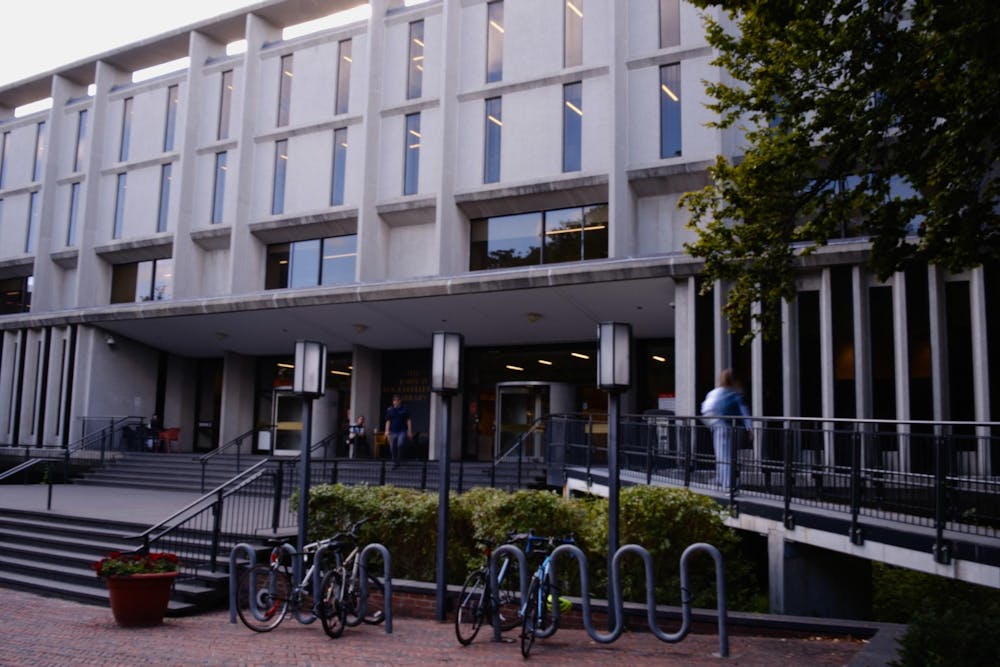
Last Tuesday morning, a member of this editorial page board was studying in the quiet of the John D. Rockefeller Library’s basement. Through the west-facing glass wall, what should have been an ordinary morning gave way to an extraordinary sight: masked federal agents detaining a man with his son and escorting him into a U.S. Immigration and Customs Enforcement vehicle. To witness such a scene — and from the stacks of Brown’s primary humanities library — was a reminder of the vulnerability faced by many of our undocumented peers here at Brown.
More than an isolated incident, this detainment symbolizes the hostile environment that undocumented members of our community must navigate every day. The sight alone carries a chilling effect — a silent message that Trump’s rash immigration policy may intrude at any moment, leaving many to wonder whether they are safe even going to school.
This should trouble us all. Brown is meant to be a place where students feel able to throw themselves fully into intellectual life — to ask questions, take risks, dissent and debate without fear. But when undocumented and international students must constantly calculate the risks of visibility, their participation in that vital intellectual exchange is compromised. An ICE vehicle parked outside the Rock is not simply a spectacle — it is an obstacle to unfettered academic freedom.
Brown maintains an official webpage on its approach to government requests regarding immigration, which explicitly states that Brown will share immigration status information only under subpoena, and that the Department of Public Safety will not “inquire about or act on” a student’s immigration status. Meanwhile, in the Undocumented, First-Generation College and Low-Income Student Center’s support materials for Deferred Action for Childhood Arrivals recipients and undocumented students, Brown commits that the DPS does not partner with federal or state agencies. The University also offers enhanced counseling resources for undocumented and DACA students, as well as emergency financial and educational support should students’ circumstances change.
These institutional actions are necessary and meaningful. They lend some structural protection and set moral boundaries. But they cannot erase the pervasive fear created by the visible presence of federal agents in our neighborhood. Institutions can assert policies, but they cannot shield students entirely from a federal government that seeks not only to intimidate but also to deport as many immigrants as possible.
Here lies the uncomfortable truth: Brown, as an institution, has done much of what it can under the law. Universities cannot rewrite immigration statutes, nor can they block ICE from operating in public spaces, including campus greens. Federal enforcement jurisdiction is independent of campus consent. The responsibility, then, lies with Brown and Providence community members who can together ensure that those most vulnerable are not left to navigate that fear alone.
This responsibility begins with solidarity. On campus and in Providence, student groups such as Brown Dream Team — which supports students who are undocumented, DACA recipients or from mixed-status families — have long mobilized communal advocacy for these marginalized groups. This year, The Herald has reported how Dream Team organizers have voiced concern that shifting federal policy has made the school no longer a safe space for undocumented students. At the same time, local networks such as Movimiento Cosecha and community defense organizations are mobilizing in response to the recent ICE action. These are the organizations where energy, strategy and care are already concentrated. Students who wish to act should begin there — attend meetings, lend logistical or financial support, offer visibility and amplify their voices in public forums.
Solidarity is more than symbolic. Across the country, community presence at ICE detainments has prevented escalation. Students can alert, accompany, monitor and document — when safe — so that federal agents know their actions are witnessed. In classrooms, social spaces and student groups, we must speak openly — refusing to let fear become the default. Offering companionship, sharing legal resources and keeping each other informed are small acts that will accumulate into a network of resilience.
This is not strictly a question of goodwill. It is also about defending the conditions that make academic engagement at Brown possible. A campus where some must remain silent out of fear is a campus diminished — not only in its humanity, but in its capacity to generate knowledge. Brown’s touted commitment to free inquiry rings hollow if it applies only to those who feel secure enough to exercise it.
We cannot ignore the danger that has arrived on our doorstep. The image of masked federal agents conducting an arrest just several yards away from the Rock will remain etched in the minds of the students who saw it.
The freedoms that many of us assume are sustained by structures that simultaneously exclude and endanger others. The integrity of scholarship at Brown depends on more than institutional slogans. It requires that every member of our community feel secure enough to take part in it.
Editorials are written by The Herald’s editorial page board, and its views are separate from those of The Herald’s newsroom and the 135th Editorial Board, which leads the paper. A majority of the editorial page board voted in favor of this piece. Please send responses to this column to letters@browndailyherald.com and other opinions to opinions@browndailyherald.com.


