
First released in March 2010, “How to Train Your Dragon” was a box office success, earning $494.9 million globally. The film holds a 99% critic rating on Rotten Tomatoes, making it one of DreamWorks Animations’ highest rated films. The animated film also garnered nominations for two Academy Awards, a Golden Globe and a British Academy Film Award.
Over a decade after the original film’s success, director and writer Dean DeBlois has released a new live-action adaptation of the animated film. In June, the live-action “How to Train Your Dragon” hit theaters, earning a franchise-best $83 million domestically and nearly $201 million globally in its opening weekend.
The live-action adaptation follows the same plot as the first animated film, showcasing the growing relationship between Hiccup (Mason Thames) and his dragon, Toothless. Much like the animation, Hiccup is met with resistance from his classmate Astrid (Nico Parker) and his father Stoick the Vast (Gerard Butler) as the young Viking attempts to navigate the fundamental difference between himself and the other Vikings living on the Isle of Berk — his inability to kill dragons.
The adaptation centers around this difference, which is a direct contradiction to the lifestyle of the Vikings, who believe that the dragons must be killed off to prevent them from raiding the villages of Berk. This coming-of-age, dark-horse film captures audiences for the same reasons the animation did: Hiccup’s character arc, the worldbuilding of Berk and the relationship between Hiccup and Toothless.
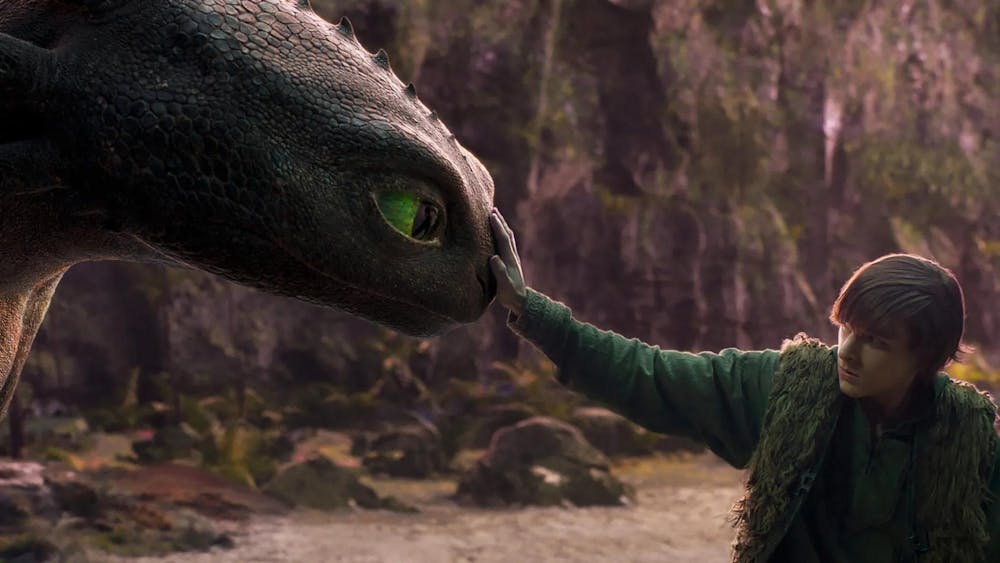
While the new film successfully brings animation to life, it does so in a way that feels much like a copy-paste of the original. Some of the most iconic scenes from the animated movie — including the scene in which Hiccup finally touches Toothless for the first time — are captured to a tee. By following the original plotline so closely, the “How to Train Your Dragon” live-action adaptation captures the same emotional connections and tensions between Hiccup, Toothless and the other characters.
However, in an attempt to replicate scenes perfectly, the live adaptation loses the ability to fully express the characters’ personalities. While the cartoon format allowed animators to create exaggerated features of joy, wonder and panic, the remake loses the ability to convey these emotions solely through the facial expressions of its human actors. The live-action adaptation also suffers from a refusal to add additional scenes and dialogue to fill in its visual holes.
While the minimal changes that are made in the adaptation help with the advancement of supporting characters, the price of these changes are to the detriment of Hiccup’s own character development. For example, when Hiccup is set to slay his first dragon in the original animated movie, he asks Astrid to make sure that if something were to go wrong, no one would find Toothless. In the live-action remake, Hiccup tells Astrid not to get involved, as his father — the town chief — respects her too much. This change in dialogue removes Hiccup’s sense of morality and replaces it with praise for Astrid.
The remake also shows Astrid commanding Hiccup and the others when they attempt to rescue the rest of the Vikings, whereas the original film had Hiccup orchestrating the plan. In the animation, this is Hiccup’s breakthrough moment, when everyone can finally see his growth as a person. But in handing this dialogue to Astrid, the audience doesn’t get the chance to see Hiccup’s “I made it” moment.
Although the live-action adaptation of “How to Train Your Dragon” emphasizes the growth of other characters over Hiccup at times, the close parallels of the new movie with the original provides audiences with the same comforting and nostalgic feelings. Similar to the animated movie, the live-action film takes audience members on a journey of self-discovery.

Alice Xie is a section editor for Science and Research from Los Angeles, California. She studies Applied Mathematics and Biology, and enjoys reading gut wrenching literature in her free time.


