
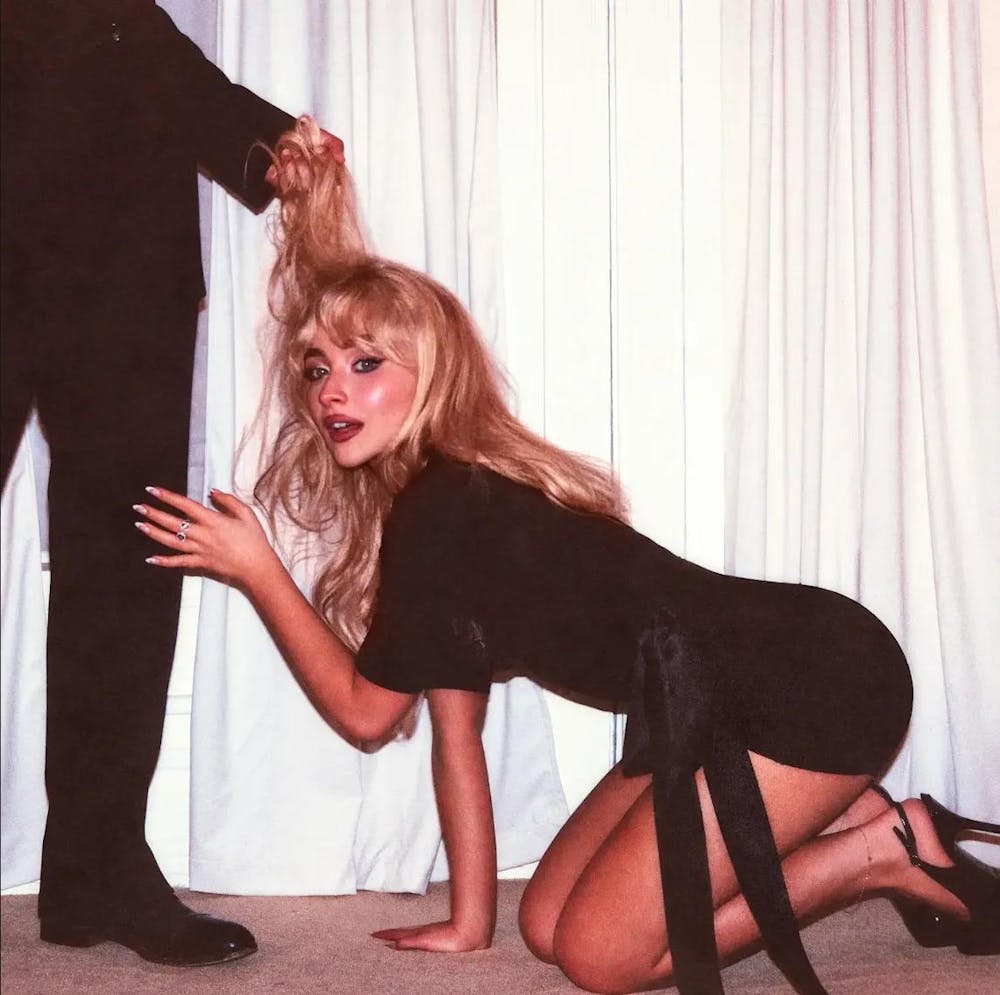
Anyone online on June 11 was there to witness the absolute pandemonium that followed the cover reveal for Sabrina Carpenter’s new album, “Man’s Best Friend.” The photo depicts Carpenter on her knees, staring knowingly into the camera. Her hair is tangled in the hands of a man visible only from his torso down. The suggestive photo split the internet in half, with some praising its cheekiness and others decrying it for being blatantly misogynistic.
Wherever you land on the issue, one thing remains true: Carpenter is no stranger to controversy, and the 38-minute record is astonishingly self-aware. Carpenter’s pop star persona — one in which she is perpetually horny and at the whim of terrible men — reaches its peak in clever lyrics, fun dance tracks and a coherent narrative thread across the album.
Released on June 5, the album’s first single, “Manchild,” serves as its opener. The song was an immediate hit and debuted atop the Billboard Hot 100 chart. The song leans into the country sound that Carpenter began exploring in her preceding album “Short n’ Sweet.” The single sees Carpenter hold nothing back as she describes her male subject as “stupid,” “slow” and “useless.”
“Manchild” is followed by “Tears,” a track which begins to muddle black-and-white perceptions of the album’s messaging. While Carpenter acknowledges her man is incapable of the bare minimum, she can’t help but be attracted to the idea of him stepping up. Lyrics like “A little respect for women can get you very very far / Remembering how to use your phone gets me / Oh so, oh so, oh so hot” are backed by a lively disco-pop track.
Such is the nuance of Carpenter’s most ambitious project yet. Her portrayals of the taboo and humiliating aspects of dating, such as having to ask for communication, are accompanied by an awareness that she can’t help but come back for more. “Man’s Best Friend” is critical, honest and completely partial to the hedonism of young adulthood that allows one to keep making bad decisions.
While critiques of the men she’s involved with are a common theme throughout the album, Carpenter often acknowledges her own role in these narratives. “Don’t Worry I’ll Make You Worry” is the closest the album comes to a ballad, showcasing Carpenter’s dynamic vocals. Slow and intimate, the track is stripped down as she sings about her tendency to sow insecurity in her partner. The song opens with the blatant “You think that I’m gonna fuck with your head / Well you’re absolutely right.” For a singer who shot into the spotlight after being embroiled in a teenage love triangle, “Don’t Worry I’ll Make You Worry” is a claim to agency within the tumult of her dating life.
“Go Go Juice” and “Never Getting Laid” also see Carpenter calling the shots. In the former, she turns her heartbreak into a fun series of drunken calls to exes, even one whose name “rhymes with ‘villain.’” The bridge breaks out into a rowdy chorus of slurred words and jovial sexual propositions. “Never Getting Laid” is its opposite: her solution to a breakup is not reconnecting but instead manifesting a life of forced abstinence for an unfaithful former partner. The song’s dreaminess reflects Carpenter’s vivid imagination of “a lifetime full of happiness / And a forever of never getting laid.”
“When Did You Get Hot?” is a song chock-full of sexual innuendos and a contagious beat. While some lyrics are more cringe-inducing than others — “I bet your light rod’s like bigger than Zeus’s” — lines like “You were an ugly kid but you’re a sexy man!” highlight Carpenter’s trademark wit. She continues her racy lyricism in “House Tour,” which brings to mind ’80s movies and neon leotards with its aggressive synth-pop sound.
Shifting tone, “My Man on Willpower” is the great tragedy of the record. Despite her two Grammy awards, chart-topping hits and Old Hollywood beauty, Carpenter can’t understand why her partner has suddenly lost interest. “What in the fucked up romantic dark comedy / Is this nightmare lately?” is how she describes his newfound emotional journey — which doesn’t include her.
“Nobody’s Son” is another lamentation on the state of her romantic life and is one of the album’s shining points. An immediate earworm, the song’s catchy chorus and hilarious bridge place her in her element as she calls out the corruption of a former partner who left her with “PTSD on the daily.” “We Almost Broke Up Again Last Night” is similarly sardonic, possessing a gritty opening that explodes into an upbeat chorus.
The album’s weakest links are “Sugar Talking” and “Goodbye.” The production of “Sugar Talking” is predictable, and the song is largely unmemorable, seeing Carpenter express her frustration at empty words from an apologetic partner. Meanwhile, “Goodbye”’s fault is its empty lyrics. There are multiple interludes within the song, such as “Arrivederci / Au Revoir / Forgive my French but / Fuck you ta ta.” While Carpenter’s brand is largely tongue-in-cheek adlibs, the concept is annoyingly overdone by the end of the album. “Goodbye” is a microcosm of this issue, leaning too heavily on TikTok-able sound bites that quickly become grating.
Despite a few slumps, “Man’s Best Friend” takes what makes pop music so fun and earnestly ups the ante. Carpenter is simultaneously embracing the messiness of youth while railing against the conventions that make it so difficult for her to trust the men in her life. The record is vulnerable, even if it lacks some depth, and launches Carpenter’s pop princess persona into a new stratosphere. With a little glamour, even heartbreak can be a good time.

Alyssia Ouhocine is a Senior Staff Writer covering Arts & Culture. Hailing from Bayonne, New Jersey, she is concentrating in English and History with a particular interest in Algerian history and literature. When she’s not writing, she can be found listening to music and sending Google Calendar invites.


