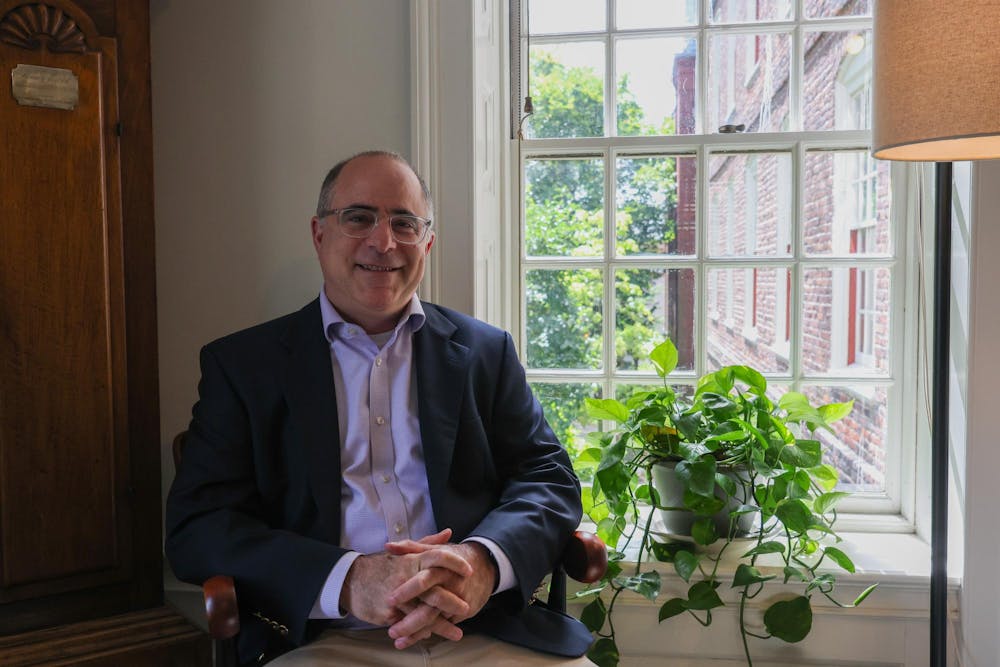
On July 1, Ethan Pollock began his tenure as dean of the College. Now at the helm of Brown’s undergraduate program, Pollock hopes to prioritize students’ needs and recenter intellectual curiosity.
With the foundations laid by his two predecessors — Professor of Engineering and Physics Rashid Zia ’01 and Maud Mandel — Pollock is hoping to focus “less on an agenda for change, and more on an agenda for sustained excellence,” he said in an interview with The Herald.
As a self-described humanist, Pollock has a “firm belief and respect not only for disciplines as they exist, but also for the opportunities that come with interdisciplinary learning,” he said.
An essential part of the college experience, he said, “is exploring what it means to be human.”
From Russia to the West Coast, Pollock’s career has been anchored by intellectual exploration.
Pollock first arrived at Brown nearly 20 years ago. By that time, he had written his first book, worked in Moscow, studied at the University of California, Berkeley and George Washington University and taught at Syracuse University.
As a junior at Tufts University, Pollock studied abroad in Moscow in the spring of 1990 — a time when “everything seemed to be in motion,” he said. Known as the Moscow Spring, that time marked the period of Mikhail Gorbachev’s democratizing reforms.
“For me, it was mostly just an adventure,” Pollock said.
Pollock then traveled back to the U.S. to complete his Bachelor of Arts in history at Tufts.
With his degree in tow, Pollock returned to Moscow in 1991 to teach English at the Mendeleev University of Chemical Technology. At the university, Pollock led a program called Space Bridge, which allowed students in the U.S. and Moscow to communicate via satellite hookup.
But as Pollock began teaching English, he soon realized it was history that truly captured his heart. While teaching at Mendeleev, he launched American history programs at the Moscow Aviation Institute and Moscow International University.
It was these experiences in Russia, Pollock said, that made him realize he enjoyed teaching.
“I was really struck by how much I was learning by being in front of all these” students, Pollock said. If you’re teaching right, “you’re learning as much as you’re teaching,” Pollock said.
In 1993, Pollock returned stateside, settling at UC Berkeley to work towards a Ph.D. He was still unsure of what he wanted to study, but the school’s historians convinced him to pursue a doctorate in Russian and Soviet history.
“They sort of sold me on the idea that I could spend half my time in the cafes in Berkeley sipping coffee and talking about life, and half the time in Moscow sipping vodka and talking about life,” he said.
After living in a variety of bustling metro centers — from Moscow to the Bay Area to New York — Pollock moved to the smaller yet vibrant city of Syracuse. There, Pollock worked as an assistant professor of history for three years before starting his nearly 20-year career on College Hill.
At Brown, every student in his classes is there because they want to learn, he said. “That, to me, has always been what makes Brown an amazing place.”
Pollock arrived at Brown within a few years of Professor of American History Seth Rockman, who is now the director of undergraduate studies in the History Department.
Since then, the two have been able to share in the trials and tribulations of the academic world, Rockman said.
“Over the intervening years, we’ve shared all the various struggles of an academic life, of how to write a book and how to continue to conduct research, how to teach with integrity and how to navigate the complications of life,” Rockman said.
Rockman added that throughout these experiences, Pollock has been one of his most “conscientious” and “congenial” colleagues.
When Jennifer Johnson ’04, associate professor of history and director of graduate studies, joined the History Department in 2015, Pollock served as her mentor, she told The Herald.
When Pollock became chair of the department in 2020, the two worked closely on different committees to develop the History Department’s strategic plan and new curricular structures for honors students, among other initiatives.
As chair, Pollock fostered an environment that allowed everyone to thrive, Rockman said. Pollock “was always looking for ways (to) say, ‘What do you need?’ and ‘What can I get for you to make you the best professor you can be?’” Rockman added.
In his 20 years at Brown, Pollock has advised five students’ senior theses.
Among them was Fiona McBride ’13, who approached Pollock about a potential thesis in the winter of her junior year, McBride recalled. Since Pollock didn’t advise many theses, he wanted to know that McBride would be committed to the project, she said.
That quality “really struck me about him,” McBride said. “He’s someone that is extremely committed to all of the things that he does.”
For the next several months, McBride and Pollock would exchange ideas and arguments to build out her thesis, which ultimately won the Christian Yegen Thesis Prize.
Because Pollock was committed to the work of his students, McBride said, compliments were few and far between. But when McBride received positive feedback from her mentor, “it meant the world,” she said.
Noam Bizan ’22, who wrote her thesis on American depictions of Soviet ballet exchanges, first met Pollock in one of his Russian history classes and became hooked.
When Pollock was teaching, “you could feel the excitement from him,” Bizan said.
She began conducting research with him in the spring of her junior year, and helped him create a class focused on Americans in the Soviet Union. The class’s topic ultimately became the focus for her senior thesis.
“I felt like he cared about me as an individual,” she said.
When Pollock was named dean of the College, everyone in the History Department was excited by the news, Rockman said.
“We all know that he’s a tremendously adept manager. He’s tremendously invested in undergraduate education,” Rockman said.
With elite higher education institutions facing intense scrutiny from conservative officials in the federal government, having a dean “who can argue that Brown’s core mission is to educate young people in thinking broadly and constructively … is something we need more than ever,” Rockman added.

Hadley Carr is the senior editor of digital product and technology of The Herald's 136th Editorial Board.