
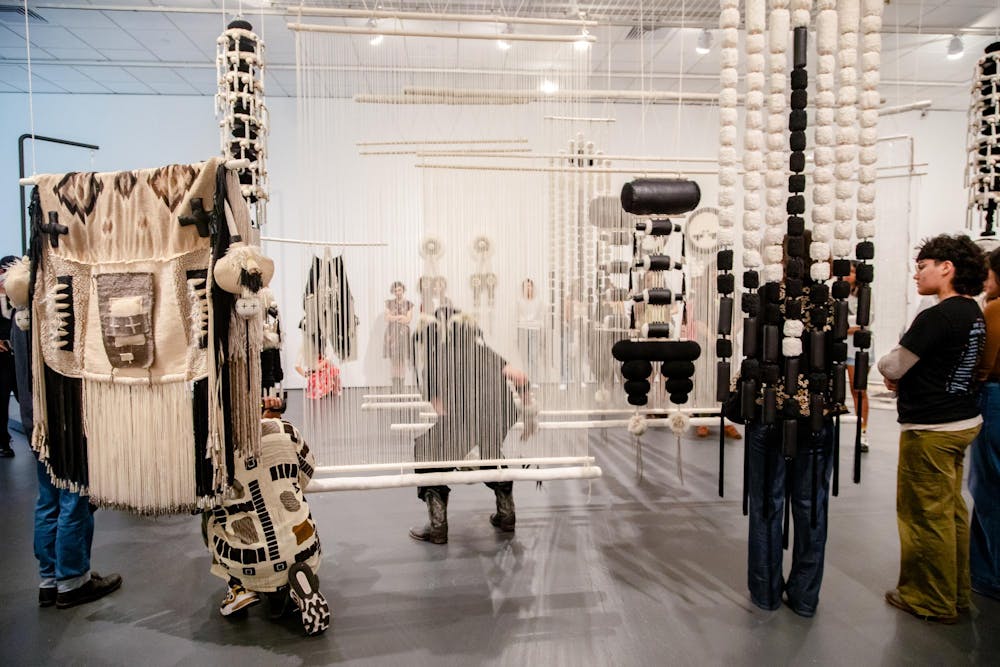
Through fiber sculpture and performance art, artist Eric-Paul Riege is highlighting the stories and culture of the Navajo, or Diné, people in “ojo|-|ólǫ́,” a new David Winton Bell Gallery exhibition housed in the List Art Building. The free exhibit has been on display since the start of September and will be available for viewing through Dec. 7.
In an interview with The Herald, Riege, a Diné artist, said he encountered fiber arts early in life, whether by playing with and disassembling dolls or learning how to sew. He described himself as descended from “a history of makers.”
The exhibition was curated by Nina Bozicnik, senior curator at the Henry Art Gallery at the University of Washington in Seattle, and Thea Quiray Tagle, associate curator of the Bell Gallery and Brown Arts Institute. The two first encountered Riege’s work at a New Orleans show, where Bozicnik was fascinated by Riege’s examination of “the way Diné objects have circulated through various colonial institutions,” Bozicnik said.
The partnership allowed Riege to work with the Diné collections at Brown’s Haffenreffer Museum of Anthropology and at the University of Washington’s Burke Museum of Natural History and Culture.
When Riege first dove into the archives for this project two years ago with Quiray Tagle, he felt like the pieces in Brown’s collection were “buried alive,” he said. “They’re meant to be activated by a person.”
Initially, Quiray Tagle was unsure whether the exhibit would borrow works from the Haffenreffer or just use them as inspiration for Riege’s work. But after Riege saw the museum’s collection, it piqued “his interest and desire to do right by these archives,” he said. The exhibit ultimately borrowed a number of pieces from the Haffenreffer.
The exhibit’s pieces embody the creation stories and holy figures within Navajo mythology, often seen through memories of his “childlike imagination,” Riege said.
Hoping to “reference the archive but then flip it on its head,” Riege encourages guests to touch his work, welcoming “viewership and access,” he said.
On Oct. 9 and 10, the Bell will also host “Sound/Performance/Curation as Care (Artists’ Convening),” an event in which a variety of artists and speakers will come and “activate the space,” according to Riege.
During the exhibition’s opening celebration this past Thursday, Riege wove through the gallery as part of a dance performance, which Quiray Tagle described as a conversation “between him and the sculptures and the objects he’s made.”
Throughout the performance, Riege made different objects jingle, brushed a weaving comb through particular pieces and carried Hólǫ́ — a humanlike figure and collaborator, according to Riege — through the gallery.
At one point, Riege brought Hólǫ́ “face to face with a photograph of (his) great grandmother.”
“It was a really beautiful way of thinking about history and family lineage and how we pass on knowledge to one another,” Quiray Tagle said.
After its time at the Bell, the exhibition will be put on display at the Burke Museum in the spring. But in order to be relocated, some of the pieces will have to be disassembled and restrung in different ways, according to Riege.
“I see objects as limitless, so I’m always disassembling and reassembling and adorning and decorating the pieces,” Riege said. “I never see them as completely finished or static. There are just periods of time where they’re at rest.”

Ann Gray Golpira is a Section Editor covering Arts & Culture. She is from Norfolk, Virginia and plans on concentrating in both International and Public Affairs and Anthropology. Outside of The Herald, you can find her writing, recording and producing her original music.


