
On Sept. 11, the Cohen Gallery at the Granoff Center for the Creative Arts filled with conversation, light and rhythm as “the sun has its own drum” held its opening reception. Running from Aug. 19 to Dec. 14, the exhibition displays artworks by four Indigenous artists whose work explores sound as a medium of kinship, storytelling and resistance.
“the sun has its own drum” derives its name from Warm Springs, Yakama and Navajo Nation poet laureate Elizabeth Woody’s idea of “sonic geographies.” The exhibition positions sound not only as vibration but as relation between human and spiritual beings, and between ancestral traditions and contemporary practices, according to a speech delivered by curator and public humanities master’s student Christina Young GS at the opening.
Elizabeth James-Perry, whose work is on display, is Aquinnah Wampanoag, a federally recognized Native American tribe in Massachusetts.
James-Perry said that the curators reached out to her after seeing her “Echolocation” woven wampum piece, which resonated with the theme of sound. The work translated the repeated signals of a sperm whale calling during dives into woven wampum, a reflection of her background in Indigenous art and marine science.
“As Wampanoag people, we have a relationship with whales that goes back to ancient times,” she said.
James-Perry also revisited a theme from one of her earlier works, creating seven large wampum earrings as a tribute to Squant, a giant female being in Aquinnah Wampanoag heritage. Each oversized earring depicts a species tied to the ocean and is adorned with spun plant-dyed fiber and beads. “Each is around eight to 10 inches long — bigger than a typical wampum earring — but small enough to draw the viewer in,” she added.
Duane Slick, a Meskwaki painter and a professor at the Rhode Island School of Design, described his displayed works as “dream paintings” that lean toward the spiritual rather than the physical.
“I am constructing the space and orchestrating the geometry to a type of rhythm,” he wrote in an email to The Herald. The stripes in his nocturnal abstractions recall blanket patterns, both as landscape geometries and ceremonial objects, Slick added.
“Night is the absence of light, which can heighten our senses,” he wrote. “I liken some of it to the experience of listening to traditional singing and drum playing.” Slick frames his paintings as distillations rather than direct ceremonies, given his “separation from daily tribal life.”
“It is a form of cultural preservation, in that it is informed by culture and the environmental conditions from which the culture exists,” Slick added.
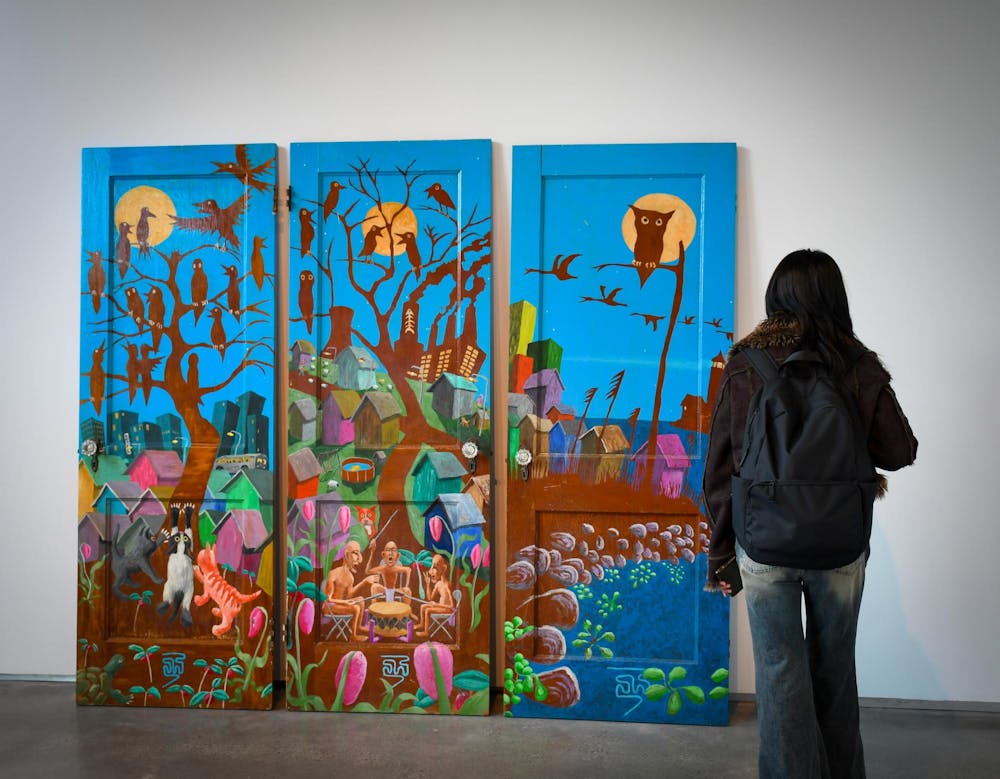
Robert Peters, a Mashpee Wampanoag artist, painted three old wooden doors with a scene featuring a village with colorful houses, music, birds and people.
“The three doors really show how the natural world and the automated world come together,” Peters said. “We have natural environments, city environments … and (the piece is) about how they intersect.”
Erin Genia, another artist in the gallery, is a member of the Sisseton-Wahpeton Oyate tribe and a multidisciplinary artist. She contributed a video project about fire to the gallery, which runs just over an hour.
Throughout the opening ceremony, visitors reflected on the significance of seeing these works displayed in a collegiate setting. Ruth Torres, a staff member with Brown’s Native American and Indigenous Studies Initiative who is also a member of the Schaghticoke tribe, said she was especially moved by James-Perry’s wampum jewelry.
“I really like the traditional materials and techniques that not all wampum artists use nowadays,” Torres said, explaining that while “it’s more commercially efficient to do it in a more modern way,” James-Perry’s use of natural dyes and elements stood out.
Javin Felipe ’26, co-coordinator of Natives@Brown, said he felt a personal connection to the exhibition. “I think it’s really beautiful that this exhibit is happening and incorporating so many Indigenous artists throughout the region,” he said. Felipe said that since Indigenous art is often sidelined in contemporary galleries or treated as anthropological rather than artistic, it was impactful to see this work represented at the exhibition.
“I think it’s truly powerful to see Indigenous artworks like this come to fruition at an institution like Brown,” Felipe said.

Summer Shi is a senior staff writer and illustrator for the Brown Daily Herald. She is from Dublin, California and is currently studying design engineering and philosophy.


