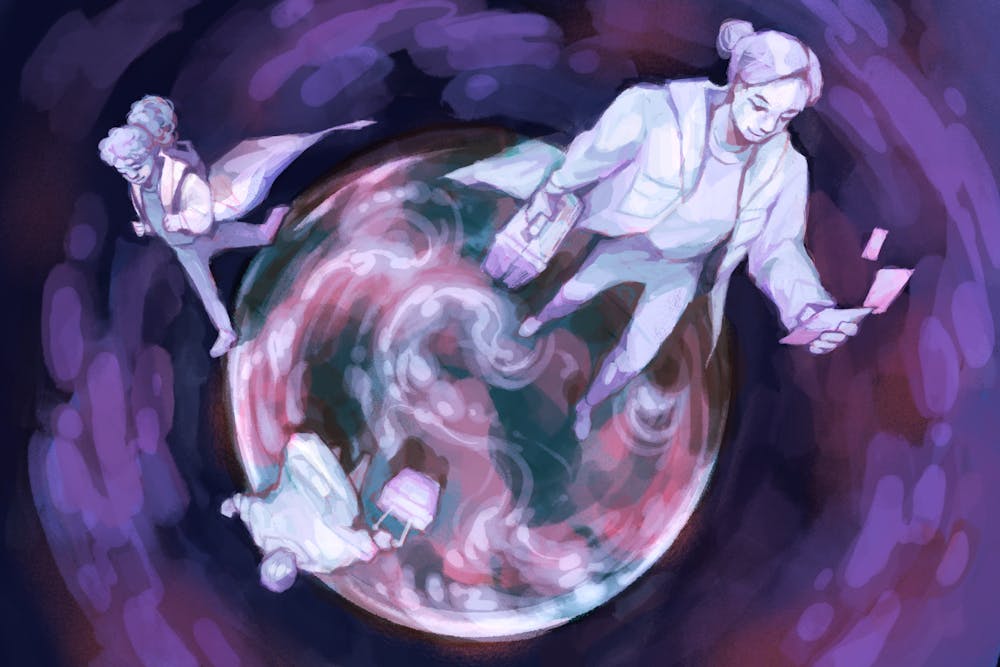
Every October, seniors in the Program in Liberal Medical Education receive an email from their academic deans asking whether they will be matriculating to Warren Alpert Medical School the following fall. They can either accept their spot at Warren Alpert, reject it or defer it to take a gap year.
Students who apply to PLME as seniors in high school are guaranteed admission to Warren Alpert following the completion of an undergraduate degree at Brown. Without the need to study for the MCAT or draft medical school applications, the security of their spot in medical school allows PLME students to take less traditional gap years than non-PLME students.
“So many of my (non-PLME) classmates took gap years and were taking the MCAT or applying to medical school during their gap year,” Hamsa Shanmugam ’24 MD’29 said.
Shanmugam, who studied music and health and human biology, spent her gap year in India researching ethnic musicology on a Fulbright Scholarship.
While there, she studied Thevaram, a type of South Indian devotional music. She took lessons, conducted archival research and performed full-time.
Other PLME students used their gap years as opportunities to explore career paths outside of medicine.
Still hesitant about committing to medical school, Nicholas Sawicki ’23 MD’29 chose to take a gap year to explore “something in the corporate world.”
After graduating, Sawicki worked as a project manager for Epic, an electronic medical records system. There, he assisted the implementation of Epic’s software in major hospital systems throughout Utah, Montana and Nevada.
At Brown, he concentrated in computer science and biology but felt more excited by his computer science classes. He also did not feel fulfilled by the clinical research he did as an undergraduate.
Sawicki said he decided to work at Epic because it gave him a lot of responsibility quickly, and he wanted something that was “truly representative of what it would be like” to work in the corporate world.
While he enjoyed the salary he earned from the “corporate world,” Sawicki said he could not see a future career in the field.
He ultimately made the decision to come back to medicine because it is “such a privilege and a rewarding opportunity,” he said.
Tori Cook ’23 MD’29 also entertained working in the corporate world, spending two years at a biotech startup in Seattle, where she worked to bring a drug through the Investigational New Drug application process, she said.
During her gap year, Cook said that she enjoyed being separated from the expectations of an academic environment. She was able to define success for herself, she said, rather than by the grades on her transcript.
Sawicki expressed a similar sentiment. “As a student, you are in consumption mode where you are taking more than you are giving,” he said, adding that he enjoyed being able to work on projects that had a more immediate impact.
She decided to take a gap year to “discover who (she) was outside of being a student,” while still “contributing to society.” She said she also wanted to explore the possibility of deferring her admission to Warren Alpert to pursue a doctorate program.
Despite the guaranteed admission to medical school, some students took gap years to further develop their medical experience.
Akshay Amesur ’24 MD’29, a former Herald staff writer, spent a year away earning his master’s of science in translational health sciences at the University of Oxford, where he focused on how research innovation facilitates practical health solutions.
He was first introduced to translational medicine through research for his undergraduate honors thesis in international and public affairs, which focused on pharmaceutical innovation in India and China. During his gap year, he hoped to learn more about “how innovation can improve patient care,” which involved conducting research in the United Kingdom’s House of Lords, a chamber of the United Kingdom Parliament.
Despite being a full-time student in the master’s program, Amesur was also heavily involved on campus. He started the Oxford Translational Health and Medicine Society and was on the rowing team for his academic college.
Rafael Davis ’25 is staying in Providence for his gap year, where he is working as an EMT for Coastline Emergency Medical Services and conducting research with the Brown Department of Emergency Medicine.
He views his time off not as “pausing” his medicine journey but rather “deepening it and broadening it.” Davis said he looks forward to having more time to gain clinical experience.
“For me, the gap year was not about stepping away from medicine, which I think sometimes has that stigma,” Davis said, “but about stepping into it and the experiences that will make me a better physician down the line.”
But the decision to defer a spot at Warren Alpert is not made lightly.
Shanmugam was initially hesitant about taking a gap year. She was worried of being “left behind by her friends,” with whom she would have otherwise continued to medical school.
Upon arriving at Warren Alpert after her time off, she soon realized that being a year behind her undergraduate PLME peers had less impact on her social life than she previously thought. Around 100 medical students in each cohort do not matriculate through PLME, meaning many also did not know their peers and were open to new connections.
Sawicki noted that a potential deterrent from taking a gap year was the prospect of entering the job market.
“There were definitely times where I thought … it would be a lot easier if I had just decided to go straight through” and not endure corporate interviews, he added.
Despite her initial hesitance, Shanmugam was ultimately glad she took time off because of burnout at the end of her senior year.
For Davis, the “beauty” of PLME was the security it gave him to pursue other opportunities that he would not have had on the traditional path to medical school. “Medical school will always be there.”
Alejandro Ruiz is a university news senior staff writer covering academics and advising. He is a junior from Edison, NJ studying biochemistry and philosophy. In his free time, he can be found with his friends or with an AirPod in.