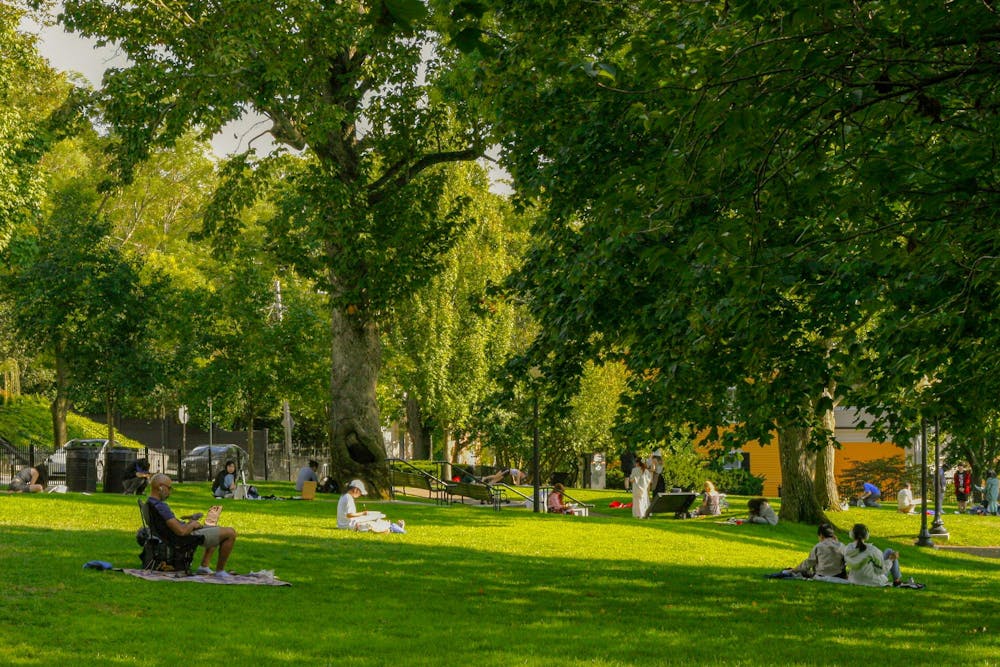
Gano Street Park, India Point Park, Prospect Terrace and the Blackstone Conservation District make Brown students part of the 99% of Providence residents who live within a 10-minute walk of one of the city’s 120 public parks.
This greenery is an escape for Providence residents, spurring local organizations to protect the public spaces.
With daily lives increasingly dominated by screens, “providing space for people to get outside, interact with each other, put their screens down and just have direct face to face communication is more important than ever,” said Kurt Teichert, a teaching professor in environment and society at Brown.
He added that access to green spaces is “fundamental” for health and well-being, as humans “have a biological need to connect with the outdoors and connect with nature.”
Multiple organizations are at work to protect Providence’s green spaces. In 2000, David Riley and Marjorie Powning founded Friends of India Point Park, a nonprofit organization dedicated to stewarding and protecting the park. Today, the organization is still going strong, with around 10 seasonal members, Powning said.
India Point Park is located at the confluence of the Seekonk River and the Providence River, making it one of the only shoreline green spaces in Providence, according to Powning. She began FIPP to ensure that someone was not only “speaking for the trees,” but “speaking for the water and the shore and the land.”
During the Providence Renaissance in the ’90s, a crop of black pines was suddenly removed. Dismayed at the loss of greenery, Powning and Riley realized there was a need to advocate for the spaces at the head of the bay.
FIPP’s founding mission was making the area more safe and more attractive to residents. As the park grew and developed, FIPP found that preserving its natural beauty meant meticulous maintenance: Dead trees were removed, new ones were planted and the space was kept clean. Now, the organization is one of the main voices that advocate for the upkeep and preservation of the park.
Jeffrey Haile ’28 called India Point Park a “happy place,” as he recalled watching people picnicking, fishing and going on walks on his visits.
“Everyone is just soaking in the sunshine and being present and being outside,” Haile said.
Other students also appreciate the tranquility that green spaces offer. For Turner Lie-Nielson ’28, Gano Park became an escape from the chaos of college life. “When I was going through difficult times, I would just go out and chill or take a walk to Gano,” he said, describing the park as a “meditative” space.
Students also appreciate the access to green spaces on Brown’s campus. Lie-Nielson referred to spending time on the Main Green as the “quintessential college experience.”
As students’ lives are increasingly “dominated by their screens,” Teichert said, green spaces are vital for mental health.
But they also play a physical role in keeping temperatures down, he added. “It’s critical to have lots of tree cover and lots of areas that aren’t paved and hardscaped, so that we can also be more resilient to the increasing effects of climate change,” such as increased humidity and erratic and more extreme rainfall events, Teichert said.
While most Providence residents enjoy nearby green spaces, not all access is built equal, he added. Places that have experienced historical racism, often through redlining, are also the places where “there’s less tree cover and less access to those amenities that come from green space.”
Creating these spaces requires planners to walk a line between increasing access and gentrification, Teichert said. Making a community more “desirable” with green infrastructure can attract new residents and “actually can displace the people who the amenities were originally intended to serve.”
Initiatives such as the City Walk project, which provides residents with a pathway to get to a green area, are aimed at alleviating this discrepancy, Teichert said. Community gardens are also an option to improve access, providing both food and “connection,” he added.