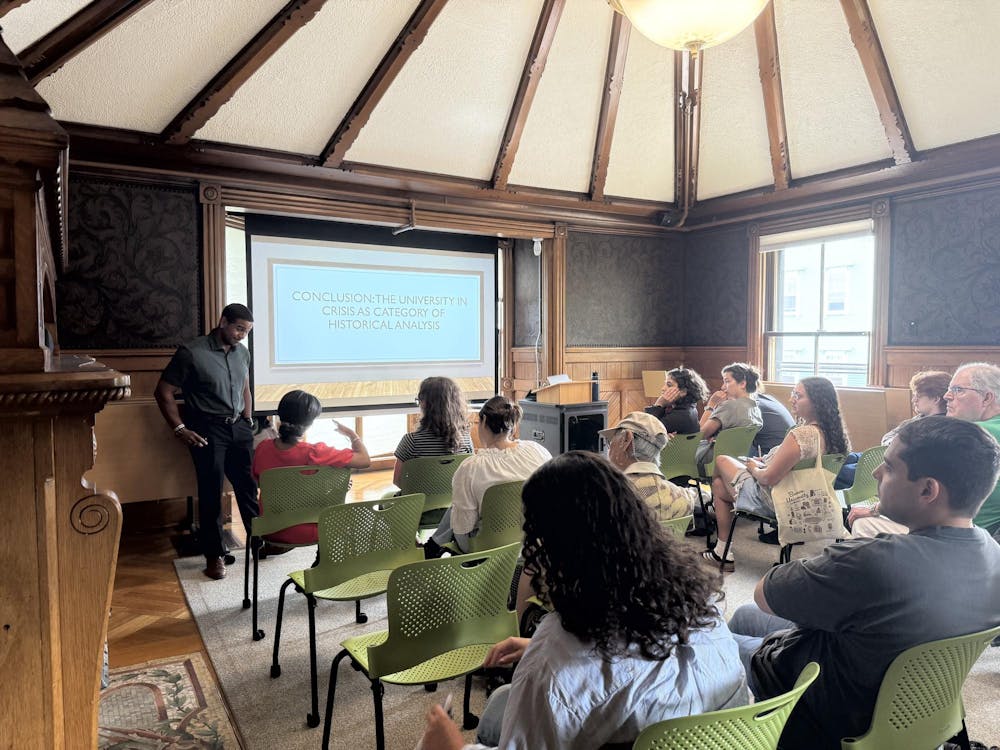
At a Monday lecture, Williams College Assistant Professor of History René Cordero PhD’23 discussed the 20th century transformation of the Dominican Republic’s largest university under political pressure, drawing parallels to threats facing higher education in the U.S. today.
The event, titled “Legacies of Autonomy: University Politics in Global 1960s Hispaniola,” was the fifth lecture in the Department of History’s “University in the Middle — Past and Present” lecture and discussion series, which aims to explore “past and present instances of universities at the focus of political attention,” according to the event description.
Using the Autonomous University of Santo Domingo, or UASD, as a case study, Cordero highlighted the historical and contemporary significance of academic freedom at higher education institutions. Drawing on an academic model he uses in his research, Cordero defined three key pillars that historically have led to a “university in crisis”: linguistic and epistemological transformation, demographic change and outside agitators.
The hour-long lecture offered a brief snapshot of his current manuscript project, “Legacies of Autonomy,” which chronicles the institutional history of the UASD and its role in the Dominican Republic’s national politics during the 20th century.
At the UASD, the 1965 U.S. invasion of the Dominican Republic coincided with a movement that restructured the university’s curriculum and saw the removal of professors who were hired during Rafael Trujillo’s authoritarian regime. With this example, Cordero used his model to understand why universities come into crisis with the state.
He described a drastic transformation in the early 1960s at the UASD under the University Renovation Movement, where students, professors and staff challenged the state’s notions of race, authoritarianism and political exclusion.
Cordero called attention to the similarities between the UASD’s relationship with Dominican leaders like Joaquín Balaguer — who Cordero called the “intellectual architect” of the Haitian massacre — and President Trump’s adversarial relationship with higher education in the United States. Balaguer’s economic “strangulation” of the university attempted to control the ideological changes occurring among students, which skewed toward the opposition, Cordero explained.
“The parallels between authoritarian President Joaquin Balaguer and the UASD and Donald Trump’s relationship with higher education are stunningly similar,” Cordero said.
Cordero’s talk encouraged audience members to think about the current moment in America and the role of universities in contemporary society.
“The Santo Domingo context opens up a whole arena of debate and reflection for our current moment,” he said.

Amber Marcus-Blank was a senior staff writer covering undergraduate student life. She is a junior from outside of Boston studying Political Science and Public Health on the pre-law track. She is interested in working in politics and journalism in the future and enjoys playing soccer and making playlists in her free time.