
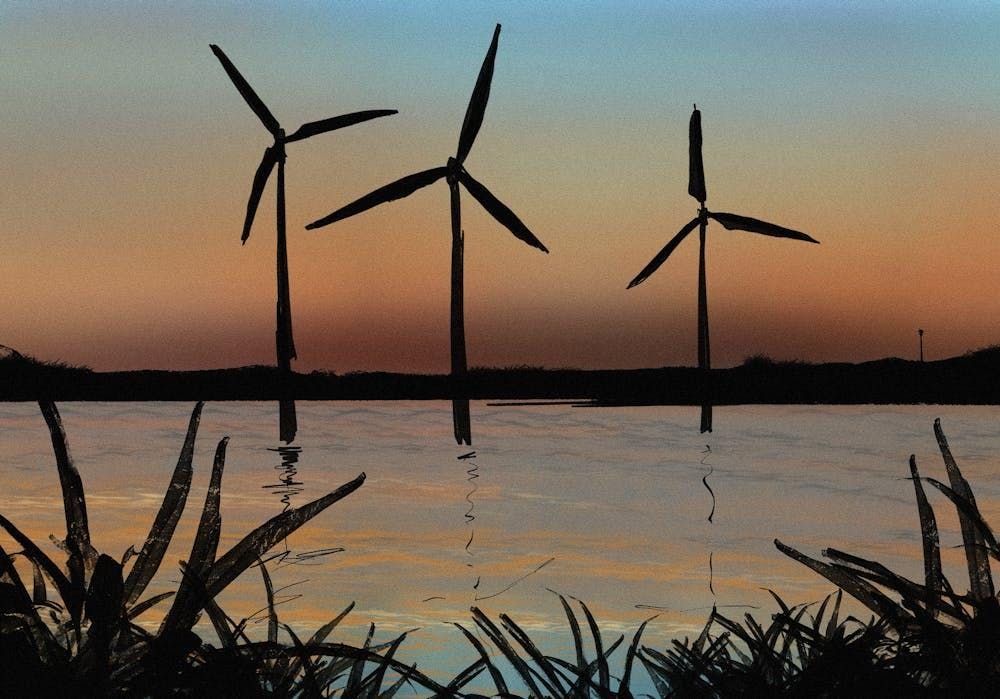
Rhode Island is suing the Trump administration over its Aug. 22 order to halt construction on Revolution Wind — an offshore wind farm located 15 miles off the coast of R.I. — just hours after Revolution Wind filed a similar legal complaint.
R.I. Attorney General Peter Neronha P’19 P’22 announced the lawsuit in a Thursday press conference alongside Connecticut Attorney General William Tong ’95.
The halt of the $4 billion, 704-megawatt project — which was 80% complete — has drawn criticism from community organizations and some environmental experts. The wind farm, which was scheduled to be operational in 2026, would have powered 350,000 homes annually across R.I. and Connecticut and generated over 2,000 jobs nationwide.
“Revolution Wind is fully permitted,” Tong wrote in a statement. “Now, with zero justification, Trump wants to mothball the project.”
The complaint alleges the Trump administration violated the Administrative Procedure Act and the government’s authority under the Outer Continental Shelf Lands Act.
“Both laws demand reasoned decision-making, fidelity to statutory limits and respect for the settled expectations of sovereign states and regulated parties,” the statement continued.
According to Revolution Wind’s complaint, the project has been “consistent with federal and state law” and has been subject to extensive, multi-year reviews by the federal government.
Neronha and Tong condemned the administration’s stop-work order in a Thursday news release, emphasizing that Revolution Wind was integral to the states’ climate, economic and energy reliability goals.
Under its current 20-year power-purchase agreement with R.I. utility regulators, Revolution Wind could end up generating up to a quarter of the state’s electricity consumption, Stephen Porder — a professor of ecology, evolutionary and organismal biology and environment and society — wrote in an email to The Herald.
The agreement also fixes the cost for electricity at 9.8 cents per kilowatt hour, significantly cheaper than the regional average. Last February, energy prices in R.I. reached about 16.4 cents per kilowatt hour, The Herald previously reported.
The Trump administration has targeted offshore wind since January, saying it will review federal licensing and permitting practices due to concerns over environmental impacts and national security. Eighteen attorneys general, including Neronha, filed a suit in May over the administration’s attempts to block wind energy development.
A letter from the Bureau of Ocean Energy Management cited protecting national security as a primary reason for halting development on the project. Porder described this concern as “vague,” noting that the Department of Defense had previously cleared Revolution Wind.
The letter cited environmental concerns as another reason for the stop-work order. Local conservation nonprofit Green Oceans challenged Revolution Wind and BOEM on Tuesday for harm done to offshore aquatic habitats and fisheries.
A law firm representing Green Oceans and several other groups pressured Brown in August to retract research that linked anti-wind groups to the fossil fuel industry, the New York Times reported.
Federal legislators — including Senators Jack Reed (D-R.I.), Sheldon Whitehouse (D-R.I.) and Representatives Gabe Amo (D-R.I. 1) and Seth Magaziner ’06 (D-R.I. 2) — have condemned the administration’s attempts to obstruct wind energy development and expressed support for Thursday’s lawsuit in a statement shared with The Herald.
Other community members and organizations echoed similar sentiments. Kat Burnham, senior principal at energy advocacy group Advanced Energy United, decried the stop-work order as undermining “years of planning, billions of dollars in private investment and thousands of jobs” in a statement written to The Herald.
David Langlais, the business manager of Iron Workers Local 37, estimated that the project has provided over 100,000 work hours for his union. He mentioned that around one-third of his union voted for the Trump administration, but with the stop-work order, many are now wondering how they are going to meet the number of work hours required for health care coverage eligibility.
“They tell themselves they’re the party of the working class, yet they’re literally potentially putting thousands of construction … people out of work,” he said about Republican leadership.
Langlais also emphasized the wide-ranging nature of the work, adding that the supply chain spans from shipbuilding yards in Louisiana to small businesses that build widgets in Providence. More than 40 states are involved in the project’s supply chain, according to a statement from Denmark-based Ørsted, a parent company of the Revolution Wind joint venture.
“At the end of the day, the work stoppage, should it continue or even lead to the removal of the turbines, would be a tremendous blow to Rhode Islanders’ wallets, air, water and future,” Porder wrote.
Additional reporting by Annika Singh.
Correction: A previous version of this article incorrectly referred to Stephen Porder as the associate provost for sustainability and a professor of ecology, evolutionary and organismal biology and environment and society. Porder is no longer the associate provost for sustainability and solely a professor of ecology, evolutionary and organismal biology and environment and society. The Herald regrets the error.

Talia is a metro section editor covering the health and environment and community and culture beats. She is a sophomore from Bethesda, MD studying history and international and public affairs. In her free time, she enjoys exploring Providence one wrong turn at a time.


