After a months-long disciplinary process and suspension, Brown’s chapter of Students for Justice in Palestine was re-recognized as a student group last May and is on probation until the end of this academic year.
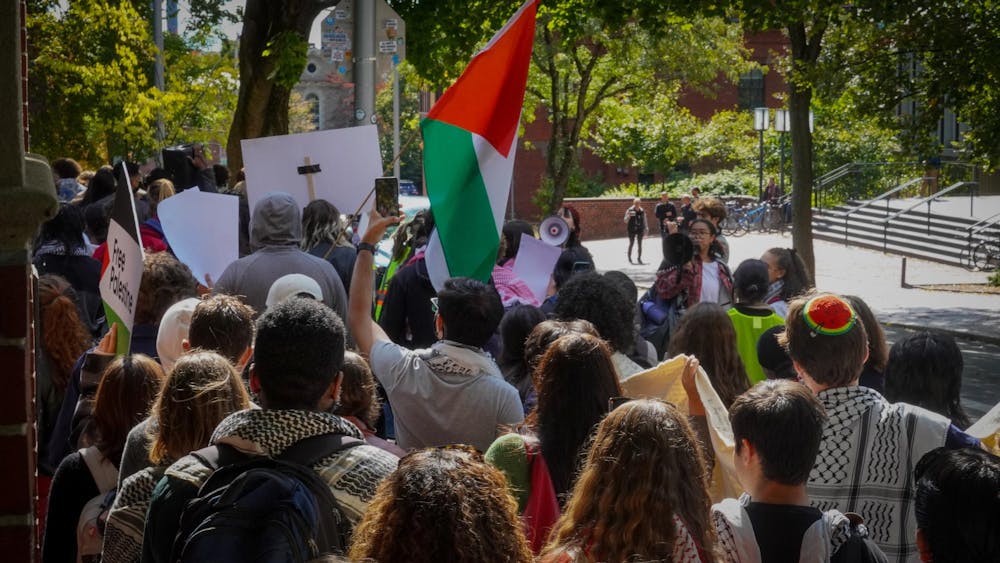
At the end of October 2024, the University suspended SJP subject to an external investigation into conduct violations at a pro-divestment protest held earlier that month outside a meeting of the University’s Corporation.
Following months of back-and-forth between the University and SJP, the University found SJP responsible for violating two provisions in the Student Code of Conduct — “disruption of community” and emotional “harm to persons,” according to SJP Member Matisse Doucet ’27 and University Spokesperson Brian Clark.
Still under probation, SJP remains unable to hold rallies or demonstrations for the remainder of the academic year, according to Clark and Doucet. While the group is currently permitted to hold general body meetings, they can't host teach-ins and speaker events until November.
When the group itself was under investigation, two SJP members, who were responsible for registering the group under the Student Activities Office, served as the points of contact throughout the disciplinary process.
Kenan Zaidat ’25, one of these members, said that the process felt unnecessarily “long and drawn out.”
“We could not do anything as an organization for many months, which was frustrating, to say the least,” Zaidat said. In his view, the University did not have sufficient evidence against SJP, since the group had communicated effectively with the University leading up to the protest and guaranteed they were following policy.
Doucet said that there was an SAO representative at the protest to ensure SJP was following University guidelines. “We weren’t aware at any point during the protest that we had been in violation of any policies,” Doucet added.
“Brown leaders have continued to work to ensure that all members of our campus community understand the expectations and community standards for demonstrations and protests on campus,” Clark wrote in an email to The Herald. “While Brown’s policies make clear that protest is an acceptable means of expression on campus, it cannot interfere with the normal functions of the University.”
Zaidat added that the American Civil Liberties Union of Rhode Island’s January letter to the University, demanding Brown immediately lift the group’s temporary suspension, was seen among members as significant in helping the investigation progress.
During the investigation, the University relied on surveillance and dash camera footage as evidence against SJP members, said RL Wheeler ’25, another student contact for the group. While being interviewed by the external investigator, Wheeler said they were asked to identify individuals who appeared in protest footage.
“I think a lot of students didn’t really feel comfortable with that,” Doucet said. “It felt unsafe for a lot of international students or folks who might not have secure visa statuses.”
The Trump administration has threatened students’ visa statuses in an effort to crack down on pro-Palestinian activism on college campuses. Student activists previously demanded the University destroy surveillance footage of political speech out of fear of retribution by the White House.
For Zaidat, SJP’s suspension was a significant blow to Palestinians on campus who found themselves without a dedicated space “for education, for culture, for grief.”
“It just created this feeling of outrage,” Wheeler said. “At the same time as there was this immense grief that was happening … we couldn’t gather and grieve together.”
Correction: A previous version of this article incorrectly stated that SJP is unable to hold general body meetings until November. SJP can host general body meetings now, but not speaker events or teach-ins until November. The article also incorrectly stated that Matisse Doucet '27 was class of 2026.5. The Herald regrets the errors.

Sophia Wotman is a University news editor covering activism and affinity & identity. She is a senior from Long Island, New York concentrating in political science with a focus on women’s rights. She is a jazz trumpet player, and often performs on campus and around Providence.