Following Brown’s July 30 agreement with the Trump administration to restore federal funding, student activist organizations have condemned a variety of the deal’s resolutions, citing concerns with the agreement’s new regulations on transgender students, commitments to sharing records to the federal government and restrictions on diversity, equity and inclusion programs.
Among the various resolutions outlined in the University’s agreement with the Trump administration was a requirement that Brown provide investigative files, including “student disciplinary records” to the federal government upon request.
Now, some student activists say that group members feel hesitant to engage in activism, citing concerns over uncertainty about how this provision of the agreement will be enforced.
In April, the Trump administration announced plans to freeze $510 million in federal research
funding over concerns regarding antisemitism on campus, as well as diversity, equity and inclusion initiatives. By agreeing to pass a series of resolutions, Brown reached a deal with the Trump administration to restore the frozen funds on July 30.
According to the agreement, the University may use a unique identifier for students in place of their name or other personally identifiable information when sharing requested information with the federal government. But the Education Department’s or the Department of Health and Human Services’s Offices for Civil Rights may ultimately request the identifiable information if they deem it necessary to monitor Brown’s compliance with the agreement.
In response to a request for comment, University Spokesperson Brian Clark referred to a series of frequently asked questions posted by the University to address concerns with the agreement, emphasizing that there are “no changes in how reports are made to or handled by the Office of Equity and Compliance Reporting.” The guidance also reemphasized that records will share “de-identified information” that does not include the names of any reporting or accused parties.
“Now that student records can be shared with the Trump administration, I think that groups are going to have a lot more fears about engaging in activism,” Sunrise Co-Coordinator Charlotte Calkins ’27 said. “Even though there’s steps in between directly sharing students’ names, that is very much possible.”
"It is particularly worrying to students who are vulnerable to the government," she added, saying that it could lead to "investigating their visa or citizenship and threatening their ability to reside in the" U.S.
In an Aug. 23 statement posted on Instagram, Brown Democrats wrote that they were “deeply alarmed” with the agreement and called upon the Brown community to “hold the University accountable to its previously stated values.”
One of the club’s primary concerns with the agreement were sections regarding transgender and gender-non-conforming students’ access to female-only spaces on campus such as restrooms and housing, according to Brown Democrats Vice President Jacqueline Zhang ’27.
“I think that’s really disappointing that trans students’ livelihood and their experience at Brown is so easily given up to this capitulation,” she added. “The agreement also adds to this overall unwelcoming, unsafe environment for the trans community.”
Clark explained that the agreement does not prevent the University from “implementing gender-inclusive measures on campus,” such as gender-inclusive housing and restrooms.
“We remain fully committed to serving the needs of all students and community members in a manner consistent with our long-established policy of nondiscrimination,” Clark wrote.
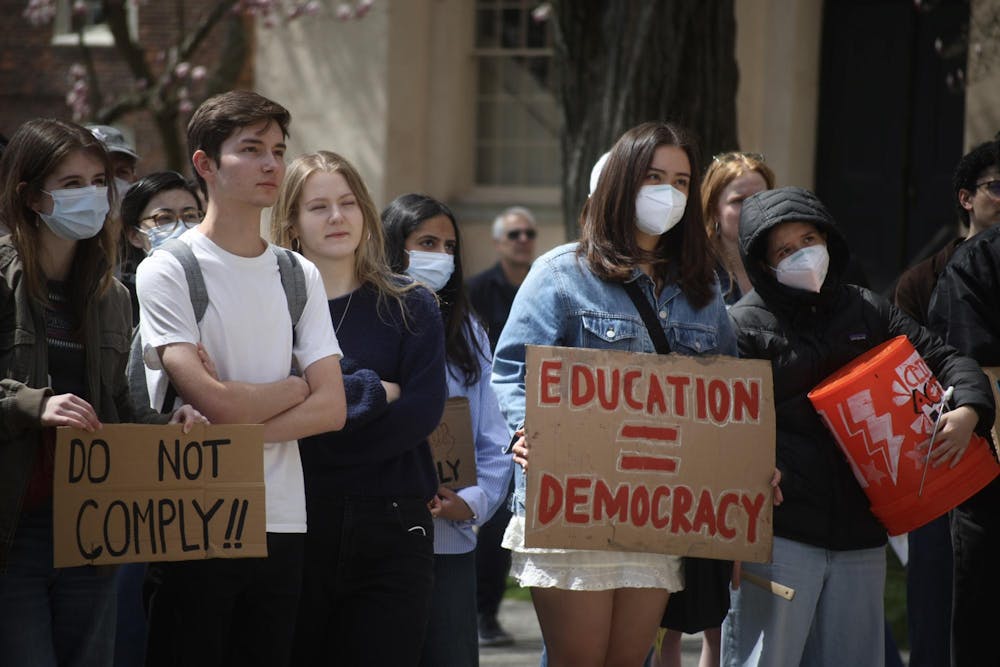
Do Not Comply, a student group advocating against the Trump administration’s directives on higher education, criticized the agreement’s impacts on transgender students in a statement posted on their Instagram profile. The group also condemned the elimination of DEI programs and the provision outlining the conferral of student records to the federal government when requested.
This fall, Brown Democrats plans on organizing progressive support around midterm elections in Rhode Island, New York, New Jersey and Virginia to further push back against the Trump administration, said Sylvie Watts ’26, president of Brown Democrats.
While the student group leaders were unhappy with the University’s compliance, they emphasized that the overall blame lies with the Trump administration.
“Brown was put in a very impossible position,” Zhang said. “It’s really important to remember that it was Trump’s fault, and Brown is complying with them.”
The Trump administration did not respond to a request for comment.
Amid the uncertainty regarding the enforcement of the agreement, Calkins said that student groups are putting more value in behind-the-scenes organizing work, especially for “students who maybe can’t speak out quite as much.”
“Even though they’re nervous and that’s what’s affecting what actions groups take, there’s also a renewed energy to join organizations,” she added.
Simon Aron ’28, one of the leaders of Do Not Comply, emphasized the importance of student and faculty voices in pushing for the University to stand up against the Trump administration.
“I’m proud of all the work that we have done, and I’m ready to keep going and keep fighting,” Aron said. “Because this is not over.”

Zarina Hamilton is a university news editor covering activism and affinity & identity. She is sophomore from near Baltimore, Maryland and is studying mechanical engineering. In her free time, you can find her reading, journaling, or doing the NYT mini crossword.