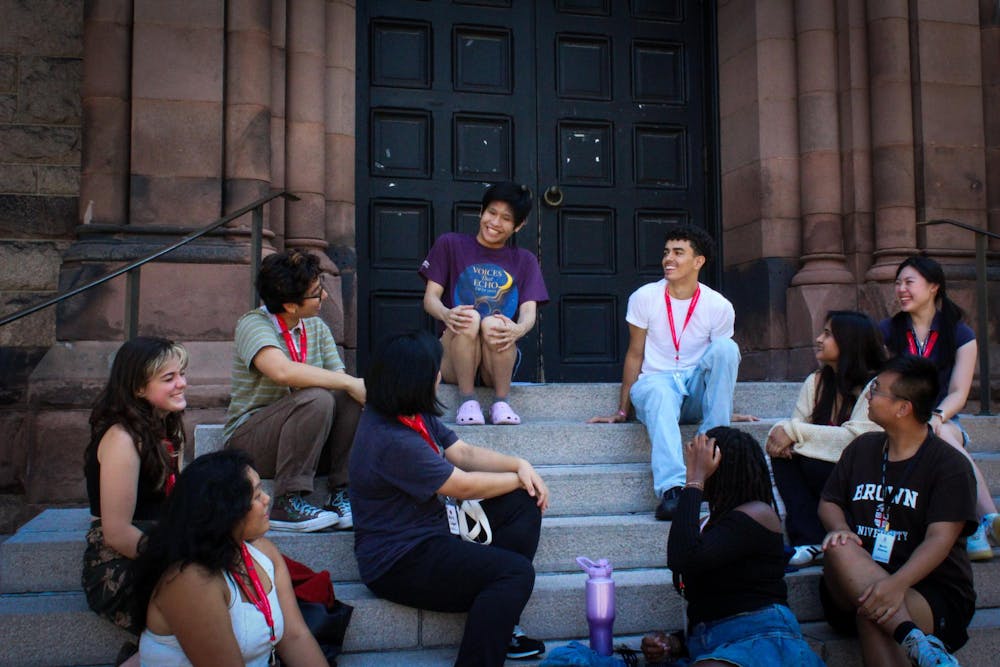
While most incoming first-year students were still packing their bags, some of their peers had already arrived on College Hill for the Third World Transition Program. The five-day program, organized by the Brown Center for Students of Color, hosted a wide range of events including workshops, discussion groups and social activities over the week preceding the full-class orientation.
Founded in 1969, one year after Black students at Brown and Pembroke College led a walkout to demand an increased number of Black students be admitted to campus, the program aims to unpack oppression faced by minorities in the United States and build community among incoming students, according to the program’s website.
The program theme for this year, “Voices that Echo,” was designed to remind students that despite living in “a moment of fear,” students can look back on similar moments in the past to “think of a better tomorrow,” TWTP Co-Coordinator Marco Lima ’27 explained.
Now, weeks into classes, The Herald spoke with several first-year students who participated in the TWTP about the program’s impact on their time at Brown so far.
Julia Cuy ’29 said attending the TWTP gave her a “sense of grounding in seeing other people of color also being incredibly successful.”
TWTP students have the opportunity to attend a wide range of workshops that tackle issues including classism, racism, cisheterosexism, religious discrimination and more according to the TWTP website.
“It’s very healing,” Lima said. “It’s all the things you want to talk about but never have the space to, and you get to do it here.”
One impactful workshop for Nadia Patel ’29 was a lecture centered on ableism. “Someone that may present as a healthy individual actually may be dealing with their own struggles on the inside,” she said.
For Selina Kao ’29, a Rhode Island native, the workshops were “eye opening to see how a lot of these issues do play out within my community,” she said. “It did open my worldview.”
Students also appreciated the effectiveness of affinity-based discussion groups, called Collective Conversations — another core component of the program. Each group was composed of first-year students, Minority Peer Counselors and students formerly enrolled in the program, who bonded over their shared experiences, Cuy said.
“The Collective Conversations were very healing,” she added.
Patel attended two of these Collective Conversations — a religion and spirituality group and an Asian-American group. She emphasized the value in learning about others’ cultures, while simultaneously finding similarities.
“If I notice that maybe someone isn’t fitting in, I feel more inclined to be able to go up and talk to them,” Patel said.
Kao emphasized the importance of having a space to “share ideas and build community and empowerment” amid threats to affinity groups and diversity initiatives at universities nationwide.
“Everyone there really wanted to see what you had to say, and that was something that I really enjoyed,” Kao said.
This year’s program took on additional significance given that first-year students are no longer required to read the “Report of the Brown University Steering Committee on Slavery and Justice,” Lima noted. In lieu of the whole-class reading, the program hosted an additional presentation to discuss the report, he said.
“We have our own power in order to make sure that diversity, equity and inclusion is included in these spaces,” Patel added.
The program also featured a variety of community-building events, including a movie night, multiethnic dinner and introductions to student groups and wellness resources on campus.
For many students, the community formed by TWTP was just as impactful as the learning component, and many of them are still close with their TWTP circle.
“Once this swarm of other people comes in, it just gets to be a lot,” Cuy said. “It’s nice to have those other TWTP-ers that you can ground yourself to.”

Zarina Hamilton is a university news editor covering activism and affinity & identity. She is sophomore from near Baltimore, Maryland and is studying mechanical engineering. In her free time, you can find her reading, journaling, or doing the NYT mini crossword.