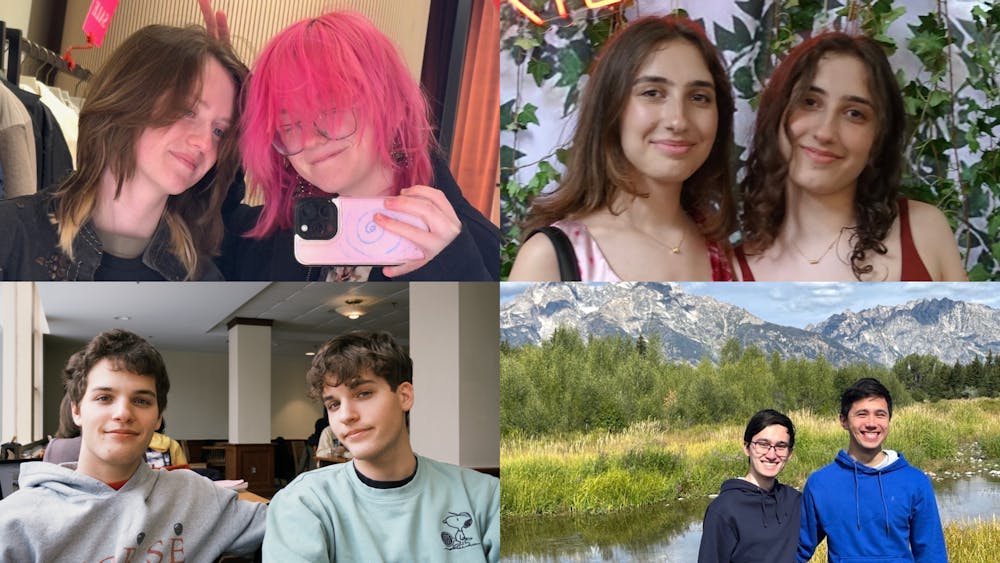
At Brown, some students arrive already paired: near-identical faces, shared histories and a lifetime of inside jokes. For twins on campus, college is often a juggling act between individuality and built-in companionship.
For Marshall O’Callaghan ’28 and his twin Logan O’Callaghan ’28, that companionship is part of daily life. The pair, both history concentrators, have explored a wide range of activities together on campus, including mixed martial arts, ballroom dancing and tutoring.
The best part of having his twin on campus is having “a default hangout person,” Marshall O’Callaghan said.
“If I’m like, ‘You want to go to the gym?’ it’s pretty much always yes,” he said. “It’s a pretty practical benefit.”
But the pair haven’t always been on campus together. Marshall O’Callaghan enrolled at Brown first, while Logan O’Callaghan spent a year at the University of Alabama before transferring.
The year apart taught them independence, but being on campus together has strengthened their bonds with each other. “Having done a year of college without him and a year of college with him,” Logan O’Callaghan said, “I would say with him is more fun.”
While the pair doesn’t share the exact same social circle, there is a “huge overlap” between their friends, Marshall O’Callaghan said. “It’s like doubling the friend pool,” Logan O’Callaghan added. “We have two gigantic groups that kind of all come together.”
For Emily Cook ’29, proximity to their twin was intentional from the start. Their other half, Rex Cook, attends Rhode Island School of Design, and the twins both ended up in Providence by design.
Rex Cook had always been committed to attending art school, and once RISD became the plan, Emily Cook began researching nearby universities and built a college list centered on Providence and the greater Boston area.
During their first semester, they saw each other roughly three times a week, connecting through music and spending weekends together. “We also got matching tattoos in Boston,” Emily Cook added.
Now, even as Rex Cook is studying abroad in Florence, Italy, the twins remain closely connected.
When Rex Cook returns, both twins plan to take classes at their siblings’ respective universities. “I’ll be surprised if … Rex (didn’t) take a class with me at Brown,” Emily Cook said.
Ian Cressman ’28, a copy editor at The Herald, and Nicholas Cressman ’28 initially agreed they wanted to go on independent journeys when it came to college. In high school, Ian Cressman told classmates they would go their “own separate paths.”
Nicholas Cressman applied early decision to Brown, while Ian Cressman was admitted regular decision and found himself choosing between Brown and several other schools. After visiting campus during A Day on College Hill, he reconsidered.
“I decided that just because Nicholas was here, that shouldn’t be a factor in determining whether I did or did not want to go,” Ian Cressman said. “Now I’m very happy that we’re both at the same college.”
The brothers have very different academic interests. Nicholas Cressman is studying physics and may also pursue mathematics, while Ian Cressman is concentrating in history and political science.
“Our schedules are quite different,” Nicholas Cressman said. “It never really feels like ‘Oh, we’re stuck together.’ It’s more like we get to be together.”
This question of individuality also affected twins Lila Safer-Bakal ’28 and Eve Safer-Bakal ’28, who were initially worried about losing their identities by attending the same college.
“You’re automatically linked to someone else,” Lila Safer-Bakal said. “I was, like a bit, yearning for independence.”
The sisters deliberately separated their college decisions. They tried to take each other “completely out of the equation,” Lila Safer-Bakal said, asking themselves what school they really wanted to attend without the other’s choice influencing their own.
In the end, influenced in part by their older brother’s positive experience at Brown, they both decided they wanted to attend the University and were accepted through early decision.
Now sophomores, they say Brown has allowed them to redefine their relationship. “Rather than just out of circumstance, we get to choose to hang out,” Eve Safer-Bakal said.
Living on different parts of campus and getting to know different groups of people has eased fears of being seen as a single unit, they both said.
Still, mistaken identity remains part of daily life for twins on campus.
“Sometimes, I’ll see people walking down Thayer and they’ll wave at me,” Logan O’Callaghan said. “And I’ll just (do) a polite nod because I have no idea who they are.”
Logan O’Callaghan had to show his Brown ID once during transfer orientation to prove he wasn’t his twin. Lila Safer-Bakal has to similarly convince classmates she isn’t her sister. But confusion isn’t always a drawback.
“I was definitely more worried that being a twin would be more of like a social inhibitor because people mix you up,” Eve Safer-Bakal said. “But I kind of find that it’s the opposite.”
Moments of confusion often turn into new introductions rather than awkward misunderstandings. “Because they know Lila, they’ll just … be very nice and comfortable with me,” Eve Safer-Bakal said.
For some, the greatest benefit is simple proximity. “It’s like having my best friend on campus,” Lila Safer-Bakal said.
“It’s nice being able to catch up in off moments more regularly,” Nicholas Cressman said, such as during walks back from the dining hall. Those moments could not be occur if they attended separate schools.
Rajaa Ghandour is a senior staff writer covering undergraduate student life and student government.