
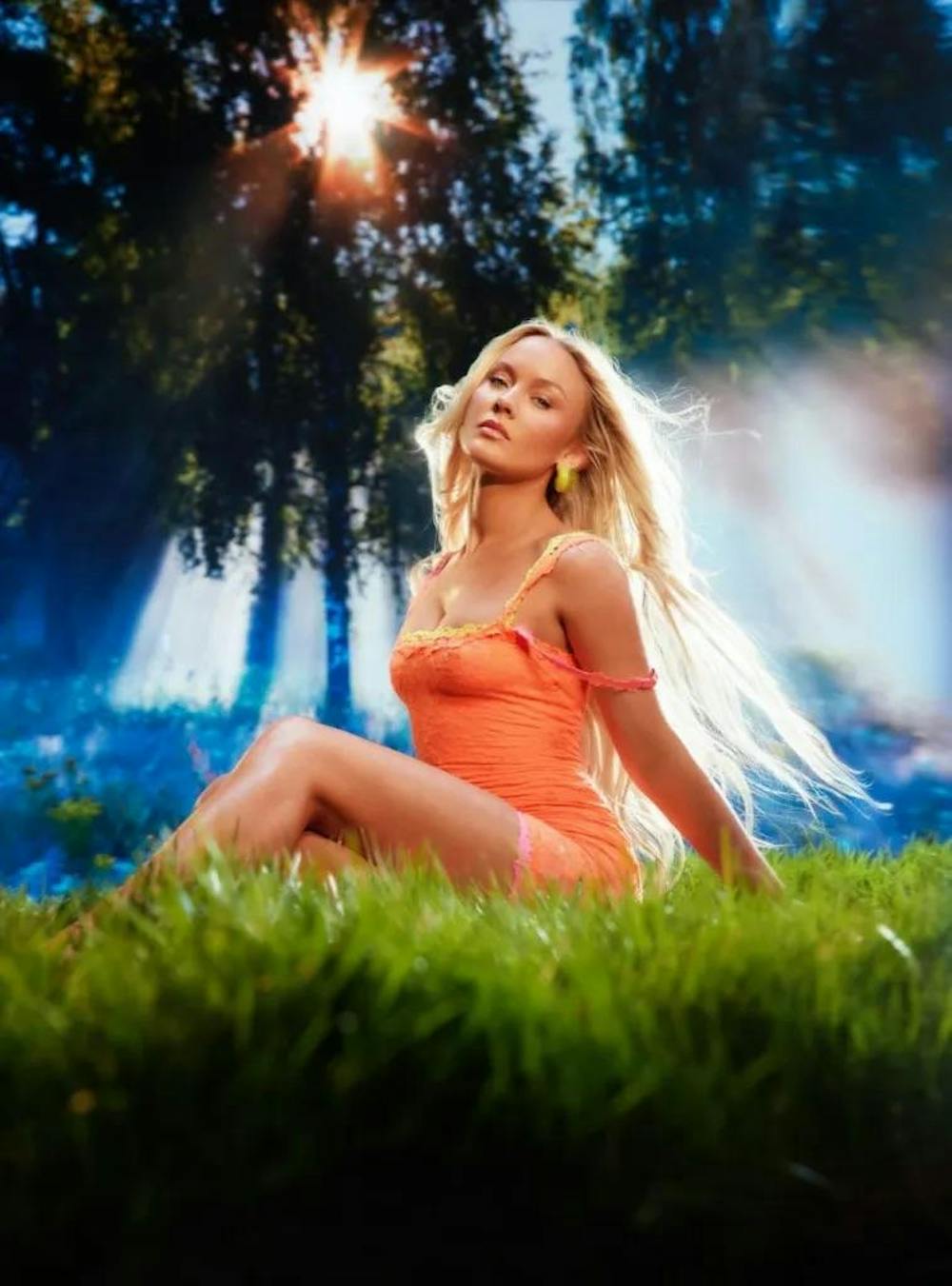
On Sept. 26, Swedish singer Zara Larsson released “Midnight Sun,” her fifth studio album. Marked by its bright, Malibu Barbie aesthetic, the album is meant to evoke the feeling of a Swedish summer, as evidenced by its title, which references the long periods of daylight Sweden experiences in the summer.
“Midnight Sun,” which comes 17 years into Larsson’s career, is markedly more personal than her previous work. Produced and written by Margo XS, Zhone, Helena Gao and longtime collaborator MNEK, the album aligns closely with Larsson’s typical Euro-pop sound while incorporating deeper lyricism and aspects of electronic music. Larsson — best known for her 2015 single “Lush Life” and “Symphony,” her 2017 collaboration with Clean Bandit — stated that “Midnight Sun” “just feels like me — knowing myself, this album is just really, really me. And also, no one can do me the way I can.”
The album’s first and eponymous track, “Midnight Sun,” starts off the project with an upbeat, electro-pop energy that highlights Larsson’s strong vocals, a key feature of the album. “Blue Moon” keeps the same upbeat tone and production of the previous song, while “Saturn’s Return” — the penultimate track — continues the pattern of celestial-themed titles.
But “Saturn’s Return” is a much more serious and introspective track, both lyrically and production-wise. Larsson uses the track to reflect on her past mistakes and accept the uncertainty of the future. “I tried to control all that was unknown / ’Cause I was scared / Thought I could grow out of uncertainty / But instead I grew not to care,” she sings in the second verse.
While not named after a celestial body, “The Ambition,” the album’s eighth track, takes a similar approach. While the track’s slow tempo is initially jarring in such an upbeat album, the lyrics fit in well with the theme of “Saturn’s Return.” Discussing how endlessly chasing success can be draining, especially in the music industry, Larsson sings, “I’m never satisfied ’cause I want number one / Doesn’t everyone?”
“Pretty Ugly” and “Hot & Sexy” take a different approach to production. Featuring a catchy, spoken chorus, “Pretty Ugly” feels more chaotic, looser and messier than the rest of the album. Larsson foreshadows this in the outro of the preceding track, “Blue Moon,” mentioning that she wants to “get messy … Like really messy” in a conversation with producer MNEK.
“Hot & Sexy” features a viral sound bite from TV personality Tiffany Pollard when she was on season 17 of Celebrity Big Brother UK. Pollard specially re-recorded a portion of her quote — “beautiful, fly, hot and sexy” — for Larsson’s song. Despite the fun, hedonistic energy of the track, Larsson sends an impactful message in the outro of “Hot & Sexy,” singing “Crime on womankind, scared to go outside / It still blows my mind how we just let it slide … There’s boys that need to be raised.”
On tracks like “Girl’s Girl” and “Crush,” the singer explores more vulnerable scenarios while keeping an upbeat electro-pop tone. In “Girl’s Girl,” Larsson plays the part of someone struggling to stay loyal to a close friend whose boyfriend she is in love with. On “Crush,” the singer explores the feelings of having a crush while already in a relationship. While both of the songs are a bit dated production-wise — more similar to Larsson’s hits from the late 2010s — they still have a clear, dynamic sound to them, making up for their antiquated feel.
“Puss Puss,” which translates to “Kiss Kiss” in Swedish, is the final track on the album. While the song is a symbolic way to close “Midnight Sun” — it’s about hanging up on a phone call — it leaves a bit more to be desired. Compared to other tracks on the album, “Puss Puss” is anticlimactic, although ethereal and sanguine. One would expect that on such a well-produced album, where each track seems to build upon the other, Larsson would either go fully introspective — like in “The Ambition” — or fully upbeat — like in “Midnight Sun” — but “Puss Puss” does neither.
Despite its minor flaws, “Midnight Sun” is undoubtedly a turning point in Larsson’s career. After almost two decades in the music industry, she has harnessed her strong vocals, Swedish cultural heritage and introspective songwriting to create her strongest project yet.


