
In the hordes of students at this year’s orientation, one classic question came up again and again. “What’s your concentration?” Strikingly, I noticed that it was rare to hear of a student who only intended to concentrate in computer science without an additional concentration or specialized track.
The Brown Daily Herald’s annual polls of first-year students reveal that the percentage of incoming students intending to concentrate in computer science has starkly declined. Among polled members of the class of 2028, computer science was the fifth most popular primary intended concentration, with 4.6% of students planning on studying the subject. By contrast, polling of the class of 2029 saw the computer science concentration fall to 10th place, with only 3.4% of students planning on choosing the subject as their primary concentration.
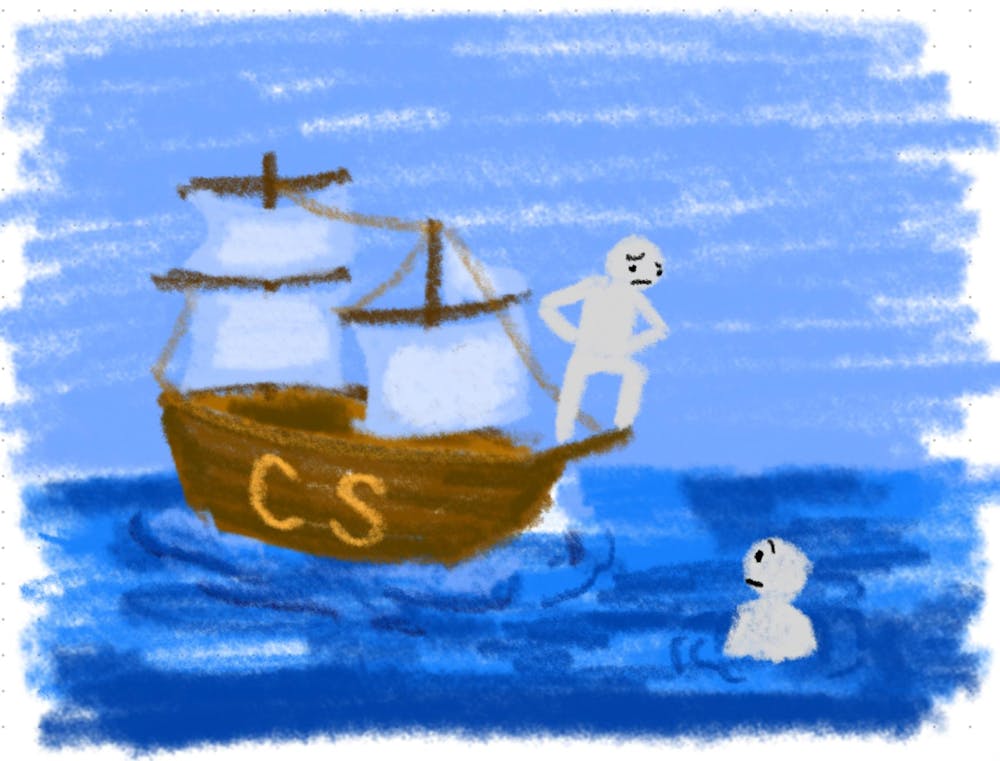
Undergraduates at Brown seem to be jumping from what many see as the sinking ship of computer programming in an era of artificial intelligence. The downward trend of computer science interest among Brown students is inversely correlated to the sharp growth of AI programming capabilities and the increase in big tech layoffs. While it’s important to recognize that the technology industry is changing, tracking the historical arc of tech innovations reveals a pattern of boom and bust cycles that indicate that there isn’t yet a reason to completely abandon ship.
In the last few months, many top publications have prophesied the end of the golden age of promising and high-paying entry level tech jobs for recent computer science grads. There is a constant stream of news that tech companies like Anthropic are heading towards replacing “half of all entry-level workers in the next five years” with AI and many depressing accounts of new grads filling out hundreds of job applications without even receiving an interview. There is no more “golden ticket” to a Silicon Valley dream job, once promised to any computer science grad.
But this isn’t the first time tech workers and society have been faced by a collapse of a promising marketplace. In the early 2000s, the tech industry had already risen and fallen. The dot-com bubble of the 1990s and its subsequent burst in 2000 came from the extremely rapid growth and investment in new online companies. The quick rise led to a crushing fall, with estimates that over 85,000 tech jobs were lost in Silicon Valley alone.
We see the problem of following a trend based on a promise that is simply too good to be true. It results in a prolific rise, and a crushing fall.
In our current cycle, AI has heightened this effect and supercharged the predicament of the engineers that created it. But luckily, we can look to history to see what might come next. After the dot-com bubble burst, tech rose again stronger and fresher, with companies like Facebook and Google growing rapidly in the years after the initial fallout.
If we follow this example, then we’re currently at the bottom of this oscillating curve, meaning that new opportunities are on the horizon.
Computer science doesn’t have to be synonymous with tech and software development. Unlike chatbots, humans aren’t made to simply generate lines of code. Where AI is limited, humans are creative. Computer science concentrators now have an increased opportunity to explore industries beyond tech, and many different fields would benefit from the analytical and gamified thinking that studying computer science teaches.
In an essay for the New York Times, former Wired Head of Editorial Robert Capps proposes 22 new jobs that may evolve around AI, all of which rely on three intrinsically human characteristics: “trust,” “integration” and “taste.” Under the factor of “truth,” Capps argues that because AI still produces content riddled with bias and false facts, computer scientists will need to become “trust directors” or “trust authenticators” who manage, screen and support chatbots’ decisions. As the designers of AI algorithms, new computer science graduates fit perfectly into the role of “AI integrators,” a role that would focus on how the technology can be most effectively used for companies. Finally, maybe the most exciting future of computer science and AI is using human creativity and artful taste to guide AI designs and solutions. All of these proposed titles represent an opportunity to make up for the entry level jobs cut by AI, as well as a chance to reshape and redefine what the future of computer science education looks like. If a pure computer science education can encourage the development of these skills, then it’s not yet a relic of the past.
With the freedom afforded to Brown students from the Open Curriculum, we’re in one of the best environments in the world to build upon these core skills. If we do this, then there is no concentration, including computer science, that will doom you to a career in a dying field.
Clara Murray ’29 can be reached at clara_murray@brown.edu. Please send responses to this op-ed to letters@browndailyherald.com and other opinions to opinions@browndailyherald.com.


