
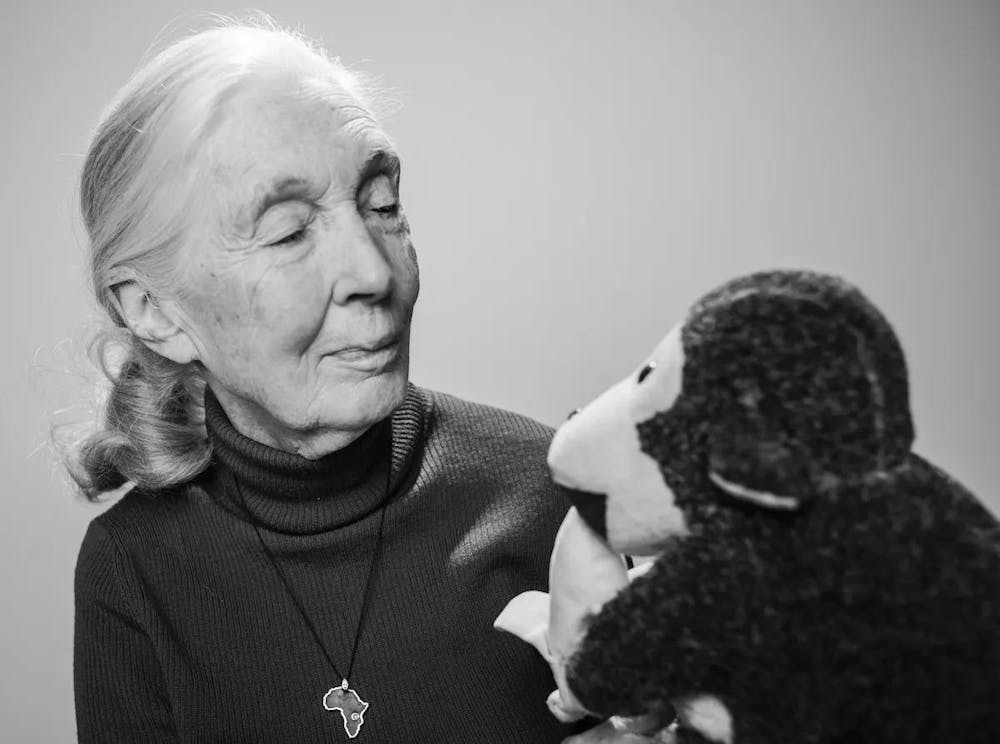
In the first episode of Netflix’s new docuseries “Famous Last Words,” Jane Goodall posthumously shares a final message of hope.
On Oct. 3, just two days after Goodall passed away, Netflix released a nearly hour-long interview between Goodall and Emmy Award-winning writer and director Brad Falchuk. Based on the Danish series “The Last Word,” the show will release detailed interviews with prominent figures — only after their deaths. Goodall’s interview, which was filmed back in March, marked the show’s first episode.
Goodall — a world-renowned anthropologist, conservationist, activist and more — passed away at the age of 91 on Oct. 1. She is remembered for her groundbreaking work in primate research and her years spent traveling around the world as an environmental advocate, among other achievements.
Throughout her career, Goodall spoke at countless universities and institutions, sharing her message with thousands of people around the world. Now, her message is forever memorialized.
The interview’s environment was intimate, with just Goodall and Falchuk in a darkened room. All cameras were remotely operated in hopes of maintaining privacy and confidentiality, eliminating cameramen and crew.
The show’s premise has the potential to weigh down conversations with melodrama or tension. But Goodall’s calm demeanor and peaceful presence emanate from the screen, shaping the episode into a meaningful reflection on her life and work.
Throughout the interview, Goodall tells stories from her youth and career, touching on nature, spirituality and her concerns for the current political and environmental state of the world. Goodall maintains that she “was somebody sent to this world to try to give people hope in dark times.”
“If people don’t have hope,” she adds, “we’re doomed.”
Notably, the show doesn’t attempt to summarize or touch on Goodall’s entire life. Instead, it gives the viewer insight into her character, her worldview and, above all, her dedication to causes she believes in.
Though Falchuk’s questions and follow-ups aid the flow of conversation, his presence is distracting. His attempts at authenticity often have the opposite effect, making his performance feel, at times, insincere. At one point, instead of asking further questions about Goodall’s contributions to the world, Falchuk focuses on her romantic relationships in a way that seems to center drama rather than substance.
Despite some small hiccups, the show ultimately succeeds at its purpose: It exhibits and honors Goodall’s wisdom and presence. “There are two Janes,” she says during the interview. “The icon Jane and the person Jane.” Here, we get to see the person Jane, and it makes for a poignant experience. But it’s still not clear if the show would hold up with a less inspiring figure in the interviewee’s chair.
At the end of the interview, Falchuk leaves the room and the viewer is left completely alone with Goodall. She looks into the camera as though she is locking eyes with the viewer. This is the show’s most touching and impactful scene, with the preceding conversation setting the stage for this moment.
“You have it in your power to make a difference. Don’t give up,” she tells viewers. “Do your best while you’re still on this beautiful planet Earth that I look down upon from where I am right now.”
Rachel Wicker is a senior staff writer covering affinity and identity. She is from Athens, Georgia and plans on concentrating in English on the nonfiction track and International and Public Affairs. Outside of writing, she enjoys reading books of any genre and doing yoga.


