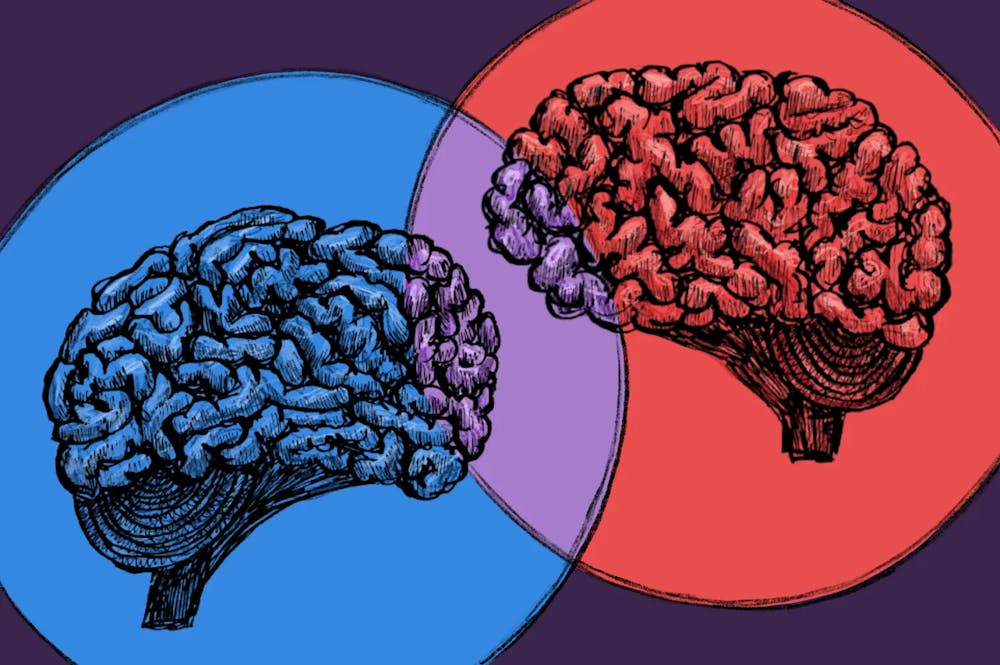
A study conducted by cognitive neuroscience researchers at Brown found that the brains of individuals on the extremes of the political spectrum process information more similarly to each other than to those that hold moderate beliefs.
The study, published in the Journal of Personality and Social Psychology earlier this year, shines a light on the physiological phenomena underscoring political polarization.
Daantje de Bruin GS, the first author on the study, said her research was inspired by the increasing political polarization in the United States.
“There’s this whole body of work focusing on affective polarization,” or the increasing animosity between those with different political views, de Bruin said. “When we try to counter extremism or political polarization, we should also think about these emotional and social aspects of polarization.”
De Bruin set out to investigate if there is a neural mechanism fueling this divide.
The research explores the Horseshoe Theory of Politics, which posits that those on the far right and left ends of the political spectrum are more similar to one another than those in the center. De Bruin believes the results of this study could lay the physiological basis for this theory.
To assess brain activity, the researchers recruited 44 participants with diverse political views and invited them to self-report their political beliefs. Participants held views on the far right, far left and center of the political spectrum.
Then, the researchers showed participants a clip of the 2016 vice presidential debate. While the participants watched, the researchers monitored their brain responses, paying close attention to parts of the brain that deal with social and emotional processing — such as the amygdala, the periaqueductal gray and posterior superior temporal sulcus.
After observing increased neural activity in these parts of the brains of far-right and far-left individuals alike, the research team concluded that both groups had a stronger emotional response to the political content than those who identified as moderate, according to de Bruin.
They then set out to determine how similar the groups’ responses were to each other. In comparing the responses, the researchers focused on the superior temporal sulcus and the temporoparietal junction — areas that are active when evaluating someone else’s viewpoint, a process known as perspective-taking, and when understanding that others have different perspectives and emotions, a capability called theory of mind.
De Bruin found that “extreme individuals show more similar brain responses in brain regions linked to perspective taking, theory of mind and social cognition.”
Compared to the extreme individuals, moderate individuals exhibited more variety in their brain responses — in line with the Horseshoe Theory, de Bruin noted.
“Polarization goes so deep,” de Bruin said. “Even when people are presented with the same information, … they can get totally different facts out of that.”
Beyond neural activity, researchers also investigated how individuals process extreme language.
First, the team used artificial intelligence to score how politically extreme segments of the debate were based on the language used.
“We find that the synchrony between people that are extreme is especially strong when extreme language is being used,” said de Bruin.
For her, this insight is “worrisome,” as politicians purposefully use such language because it is divisive.
De Bruin hopes the results of this research will encourage more communication between individuals with differing political beliefs.
“For people who are on the extreme ends, knowing that you’re actually more similar to those on the other side might give you a different perspective,” she said.
In an interview with The Herald, Assistant Professor of Political Science Marques Zarate said the results observed by the researchers lend credence to “some of the existing notions that we already had.”
Zarate was struck by the stronger neural response illustrated by those with extreme views compared to the moderate participants.
“While ideological polarization has increased, it hasn’t (increased) as much as affective polarization,” Zarate said. De Bruin’s research is “able to reconfirm a lot of what political scientists have been theorizing before.”
Like de Bruin, Zarate hopes these results will spark more dialogue between those with differing political views.
“Members of either party aren’t as far apart as I think much of the media or politicians themselves would like us to believe,” Zarate said.