
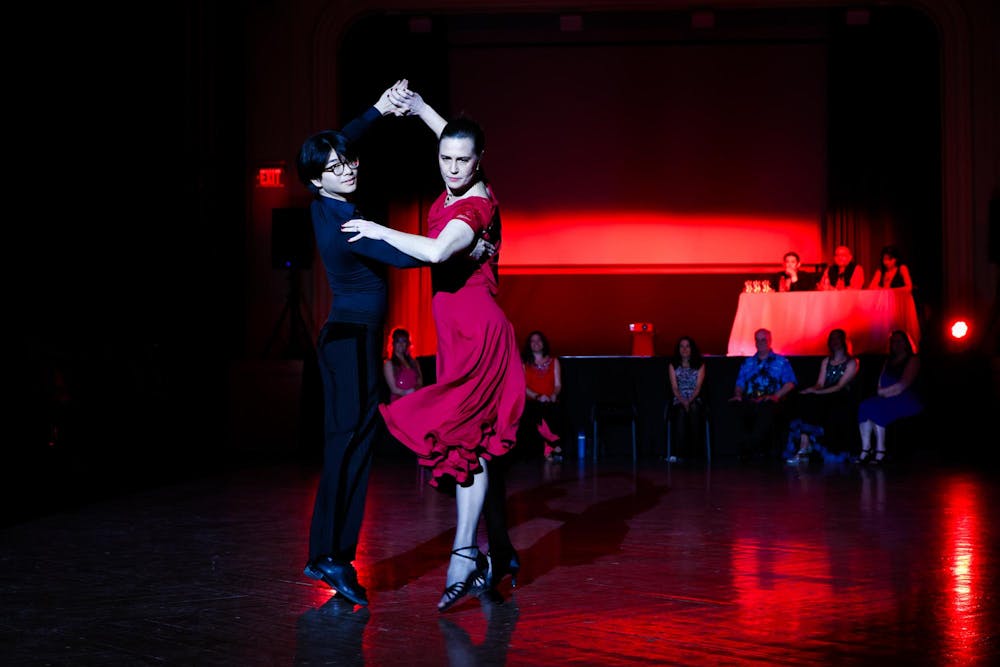
Framed by a spotlight on the ballroom floor of Alumnae Hall, Ian Chow ’28 and Associate Professor of Engineering Kareen Coulombe opened their performance of the paso doble, a Latin ballroom dance that mimics the theatrics of a bullfight, in total silence. As judge Emilie Lum ’24 MD’30 later remarked, “you could hear a pin drop.” Then, the music came in.
Their dance, set to “España Cañi” by Pascual Marquina Narro, required powerful movements synced to the music’s marching rhythm — a skill far outside Coulombe’s academic expertise. But with just over a semester’s worth of rehearsal under their belts, the pair’s strong technique and storytelling earned them the “Audience’s Choice” award at the Brown Ballroom Dance Team’s annual “Dancing with the Professors” show, held on Sunday in Alumnae Hall.
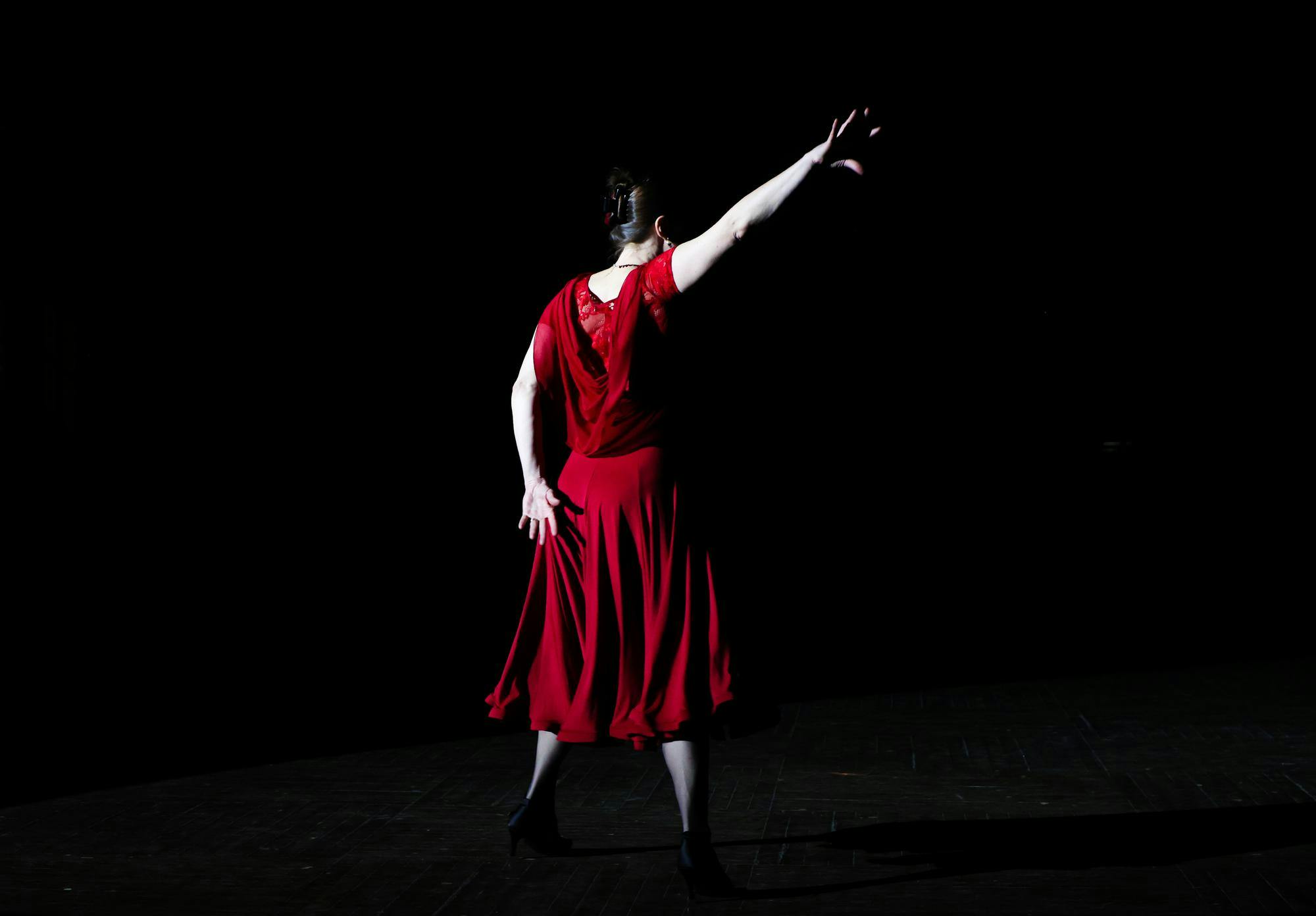
Associate Professor of Engineering Kareen Coulombe
Modeled after ABC’s “Dancing with the Stars,” Dancing with the Professors has been organized by the Brown Ballroom Dance Team since 2008. While the event experienced a prolonged break due to the COVID-19 pandemic, Chow and his fellow organizers have worked to reestablish it as an annual tradition since its revival last year.
This year, the judging panel consisted of Professor of Chemistry Amit Basu, who was a previous contestant, as well as Eddie Kay and Lum, both of whom have competed in ballroom dance and are affiliated with the BBDT. While the judges decided on an overall winner, the audience voted to determine the winner of the “Audience’s Choice”and “Most Creative” awards.
Patrick Bai ’27 and Assistant Professor of Mathematics Benjamin Kwon Younghan Dees took home the Judge’s Choice Award for their graceful Viennese waltz, a technically challenging style due to its speed.
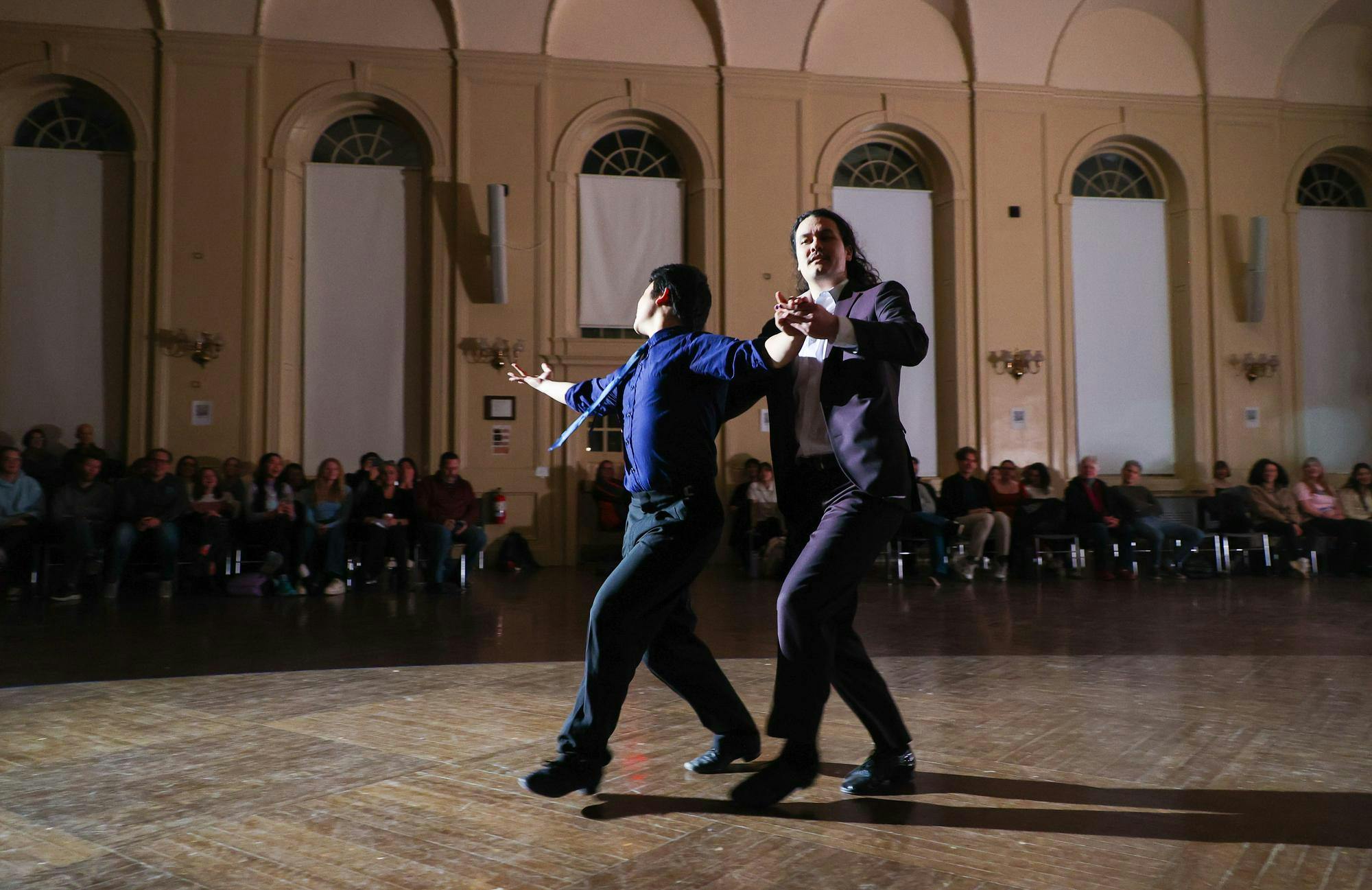
Patrick Bai ’27 and Assistant Professor of Mathematics Benjamin Kwon Younghan Dees
“There was such a beautiful (lyricism) to that dance,” Basu said as part of his feedback. “If mathematics is the poetry of numbers, this was really poetry in motion.”
Basu gave similarly glowing feedback to Marshall O’Callaghan ’28 and Assistant Professor of Biostatistics Stavroula Chrysanthopoulou, who went on to win the “Most Creative” award with their cha-cha and mambo. “My head was spinning,” Basu said. “This is definitely nowhere close to (the) mean. This is an outlier.”
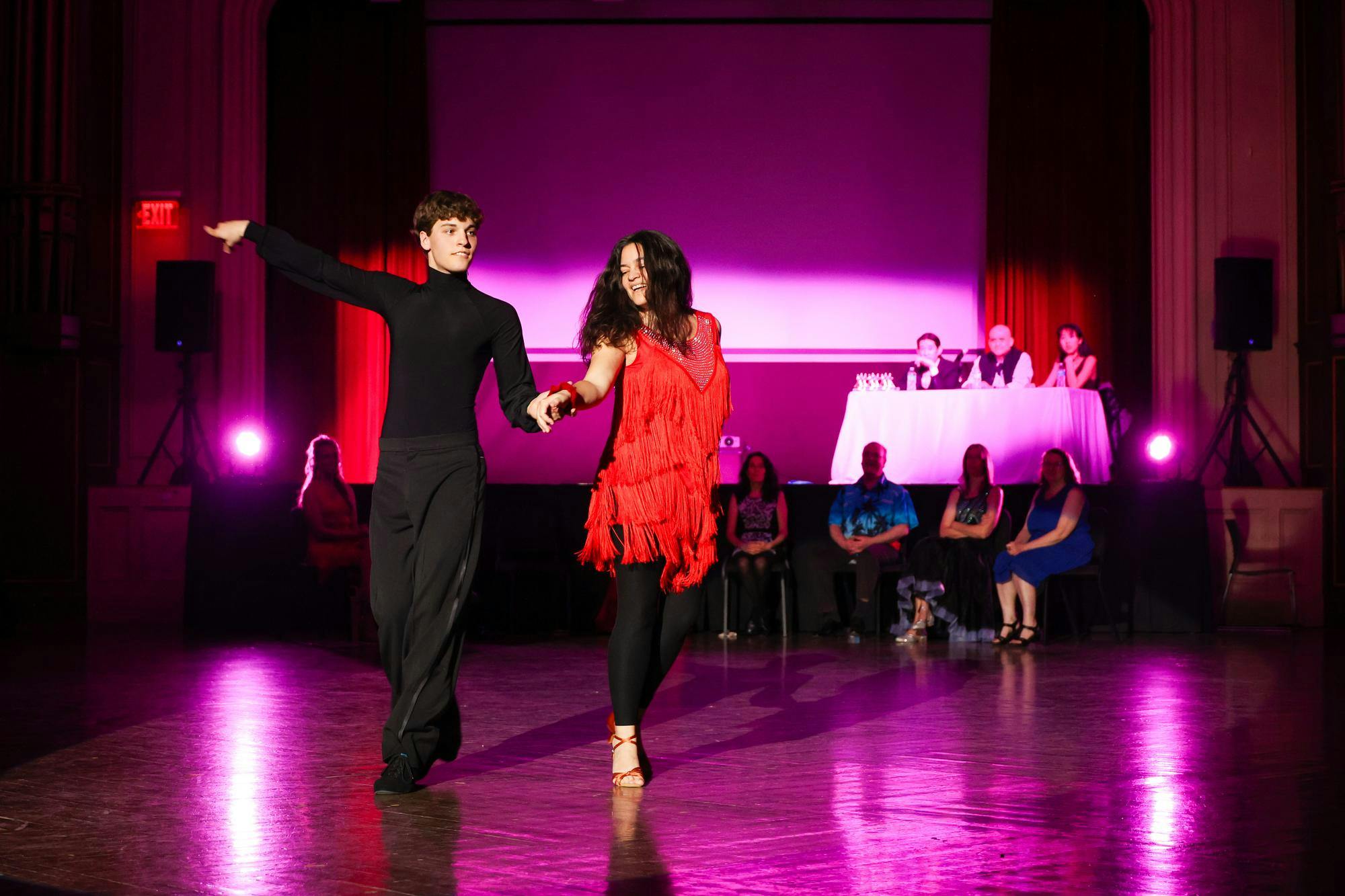
Marshall O’Callaghan ’28 and Assistant Professor of Biostatistics Stavroula Chrysanthopoulou
Chow noted that the BBDT has been preparing for the event— which welcomed approximately 160 students and faculty — for “the entire year.”
“So for it to all end up in this really joyous event is a really fulfilling experience,” Chow added.
“I really like that (the competition) puts the professor in the learning mode,” Coulombe said. She hopes that this role reversal in DWTP will help her build a stronger connection with her students.
“It might have been a long time ago, but we were in your shoes at one point,” Coulombe said. “I think dancing with professors is a great way … to overcome some of these barriers.”
Although BBDT members took the lead in choreographing and rehearsing their teams’ routines, the process was collaborative from the outset. Chow and Coulombe’s performance was based on one of Chow’s competitive routines, which allowed him to teach Coulombe the basics of the paso doble, he said. Coulombe also shared YouTube videos she found online with Chow, who incorporated her inspiration “really seamlessly into what was originally his competition choreography,” she said.
“I enjoyed it so much, and it went by so fast,” she said. Coulombe, who had previously dabbled in various styles of dance, said that she particularly enjoyed “bringing dance back” into her life.
For Professor of Behavioral and Social Sciences Jennifer Merrill, whose office is located down the hill, DWTP is a particularly meaningful way of interacting with students and other faculty members.
“I’m not really on campus that much,” Merrill said in an interview with The Herald. “I kind of wanted to do it as a way to feel like part of the Brown community.”
Merrill has always loved dance, having learned tap, jazz and ballet as a teenager — but learning ballroom dancing for DWTP has been a completely different experience, she said. “I thought I still knew what I was doing,” she joked. “I don’t.”
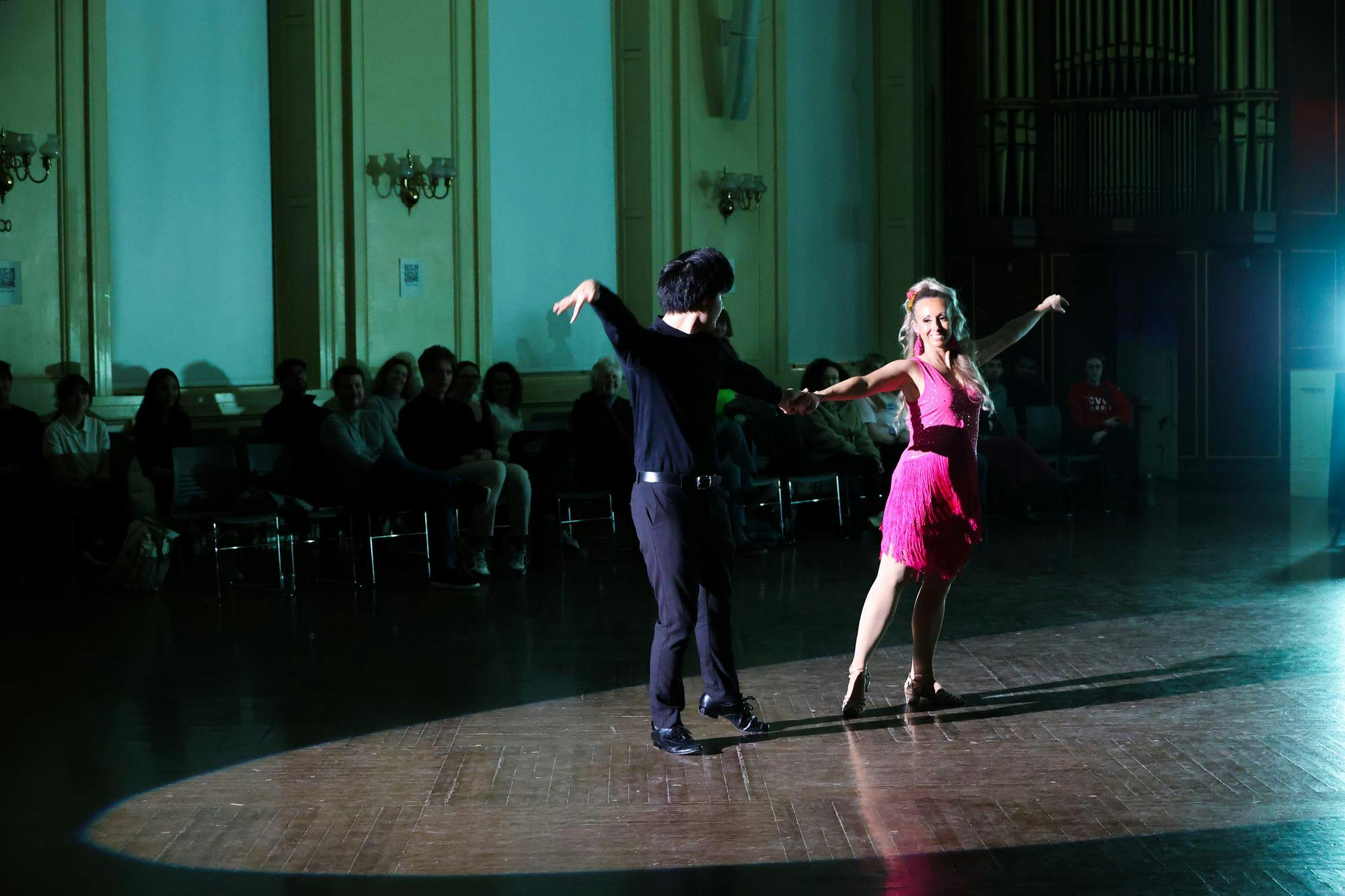
Professor of Behavioral and Social Sciences Jennifer Merrill and Ben Reyes '27
“I think it’s cool for students probably to see that professors aren’t just constantly in academics and that they can have fun,” Merrill added.
Merill performed a cha-cha to “Crazy in Love (feat. JAŸ-Z)” by Beyoncé with Ben Reyes ’27. They ended the performance with a crowd-pleasing dip that garnered cheers and applause.
“I love the energy, I love the sass, the flare, I love the song choice. I really saw you impersonate the character of the dance,” Lum commented after their performance.
Jim Egan, a professor of English, and Anh Nguyen ’28 performed a playful jive and cha-cha to “Do You Love Me” by The Contours and “Boogie Wonderland (feat. The Emotions)” by Earth, Wind and Fire. The performance was a crowd-pleaser. Kay commended the pair’s energy and the incorporation of lip syncing into the opening number.
“I was just beep-bopping my way through that whole dance. You two are so joyful,” Basu said.
Egan had no dance experience prior to DWTP, but despite some challenges, he said he still thoroughly enjoyed the rehearsal process. “I’m not a very good dancer, which maybe I shouldn’t have been surprised at, but it’s become painfully obvious,” he told The Herald.
“The most fun part has been getting to know Professor Egan,” Nguyen said onstage after their performance. “We always have so much fun during our rehearsals. I always lose my breath laughing before I lose my breath dancing.”
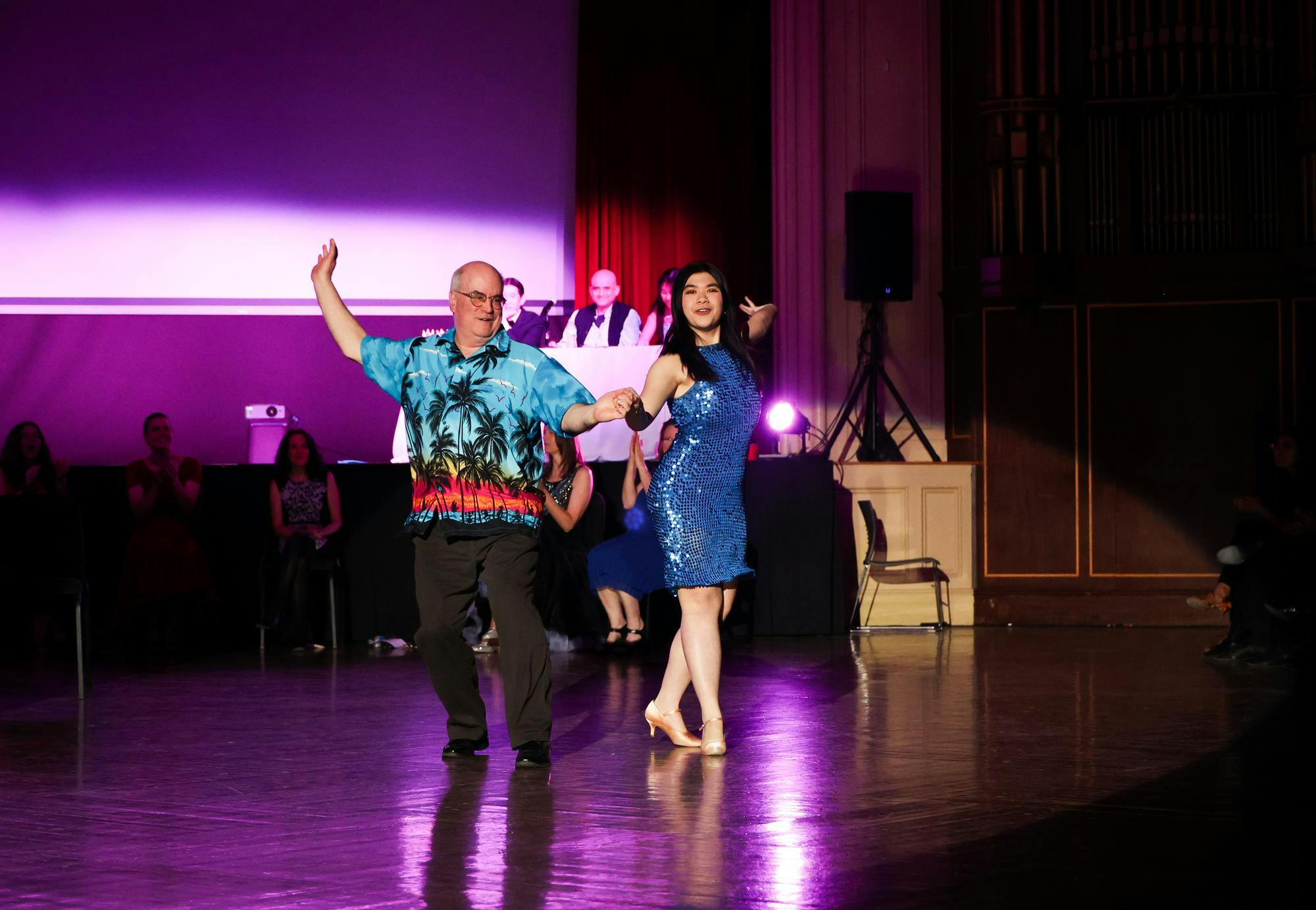
Jim Egan, a professor of English, and Anh Nguyen ’28
After a brief intermission, Laura Colella, an assistant professor of the practice in literary arts, performed a rumba and swing with Korbin Johnson, a community member who is in the BBDT. Basu noted the contrast in their performance between the “gentle intimacy” of the first segment and the “explosion of joy and exuberance” of the second.
Mascha van ’t Wout-Frank, associate research professor of psychiatry and human behavior, performed an elegant waltz with John Loncke ’27, set to a cover of “Never Enough” by Loren Allred. The emotional performance was praised by the judges for the “sculpted” quality of the dancers’ movements and their connection with the music.
“There were times when I didn’t feel like I was watching the dance. I was watching music personified,” Basu said.
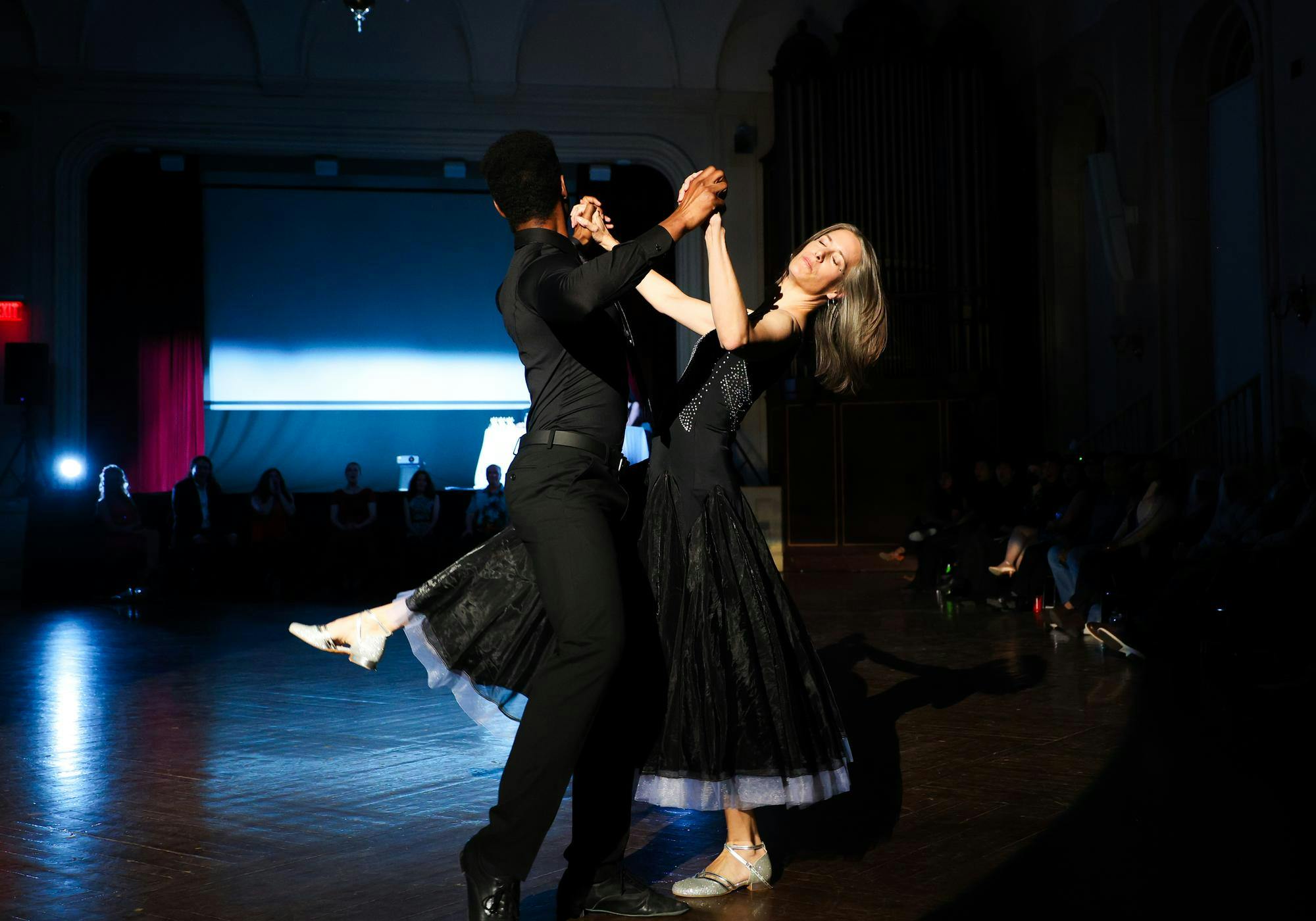
Mascha van ’t Wout-Frank, associate research professor of psychiatry and human behavior, and John Loncke ’27
In an email to The Herald, van ’t Wout-Frank — who has some basic experience in jazz ballet and ballroom dancing — wrote that she had attended a previous DWTP event to support a colleague and was excited to give it a try herself.
Loncke, on the other hand, had no previous dance experience prior to joining the BBDT in his first year, and as someone who “had always been naturally uncoordinated,” ballroom dancing proved to be a challenge. He wrote in an email to The Herald that he wanted to participate in DWTP because he liked the idea of teaching someone who is in the “same position” as he once was.
Kathi Fisler, a research professor of computer science, performed a cha-cha with Leela Young ’28. Fisler wanted to participate in DWTP because it’s “vital for professors to periodically experience what it is like to be a novice at something and to let students see us in that process,” she wrote in an email to The Herald.
“Learning requires vulnerability, and I’ve always believed in showing students that I, too, am vulnerable when learning something new,” she added.


