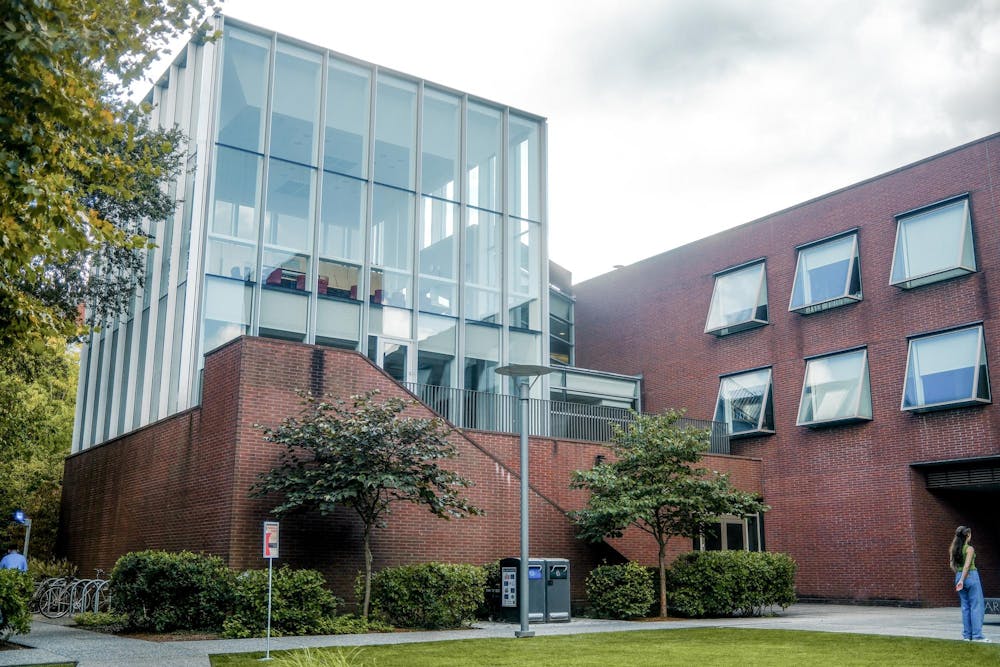
On Monday, the Saxena Center for Contemporary South Asia hosted Niraja Gopal Jayal, a political scientist at King’s College London. In her talk at the Watson School of International and Public Affairs, entitled “Academic Freedom and its Discontents in India,” Jayal discussed governmental incursion into universities in India.
The talk is part of the OP Jindal Distinguished Lecture series, established in 2012 to promote the discussion of politics, economics, culture and social change in India. Patrick Heller, director of the Saxena Center, welcomed Jayal on stage, describing the political scientist as “one of the most important theorists of … democracy in the world today.”
In her lecture, Jayal detailed how the current crises of academic freedom in India and around the globe stem from two interconnected forms of “unfreedom” — conjunctural unfreedom and structural unfreedom
“Conjunctural unfreedom describes moments like the present, where threats to academic freedom can be directly related to a particular political conjuncture” or state of affairs, Jayal explained.
Structural unfreedom, on the other hand, denotes structural constraints on the autonomy of higher education institutions “that shape the quotidian practices and possibility of academic freedom,” she said.
Jayal argued the current “convergence of conjunctural and structural unfreedom” has “seriously deleterious implications for the freedom of speech and expression.”
In India, universities have historically lacked institutional autonomy, a legacy of colonial administrative structures, she said.
“There is no doubt at all that the former state of India’s democracy today holds the key to the presently dismal state of its academic unfreedom,” Jayal said. But she cautioned against tying the suppression of academic freedom entirely to the state of India’s democracy.
Though the two may coincide, this framing “obscures the other structural ways in which academic freedom has always been constrained,” Jayal said.
Some of these structural features can be found at public universities in India, where the state government has some control over faculty recruitment, promotion rules and tenure.
“We rarely ask why the president of India or why the governors of states should hold ex officio university offices,” Jayal noted. “They are intended to be symbolic, but increasingly they are anything but: Government nominees are present as watchdogs, supposedly on committees for faculty recruitment standards.”
Reflecting on “the challenges and prospects for academic freedom in a post-authoritarian future,” Jayal foresees the possibility that “the public university ceases to be the premier site of scholarship.”
“The work of scholarship could then migrate … to the premier environment of private universities in India or universities overseas,” she added.
Ela Snyder ’26, an international and public affairs concentrator, attended the lecture because she thought it would be relevant to her senior thesis.
“It was incredible,” Snyder said. “The tension between how public versus private universities are dealt with across a variation of states in India was really striking to me.”
Before Jayal’s lecture, Heller’s opening remarks noted the relevance of these discussions amid threats to academic freedom in America.
“One of the most important institutions of civil society, for anchoring and stabilizing democracy, is academia,” Heller said. “And yet academia today is in crisis. It’s under assault here in the United States, but also very much so in India.”
“The undermining of academic freedom generates deep concerns that go beyond individuals, that go beyond institutions,” Jayal said. “These are concerns about the future of scholarly integrity, the future of scholarship itself.”

Ivy Huang is a University News and Science & Research editor from New York City. Concentrating in English, she has a passion for literature and American history. Her favorite authors include Marilynne Robinson, Vladimir Nabokov, and Toni Morrison. Outside of writing, she enjoys playing basketball, watching documentaries, and beating her high score on Subway Surfers.