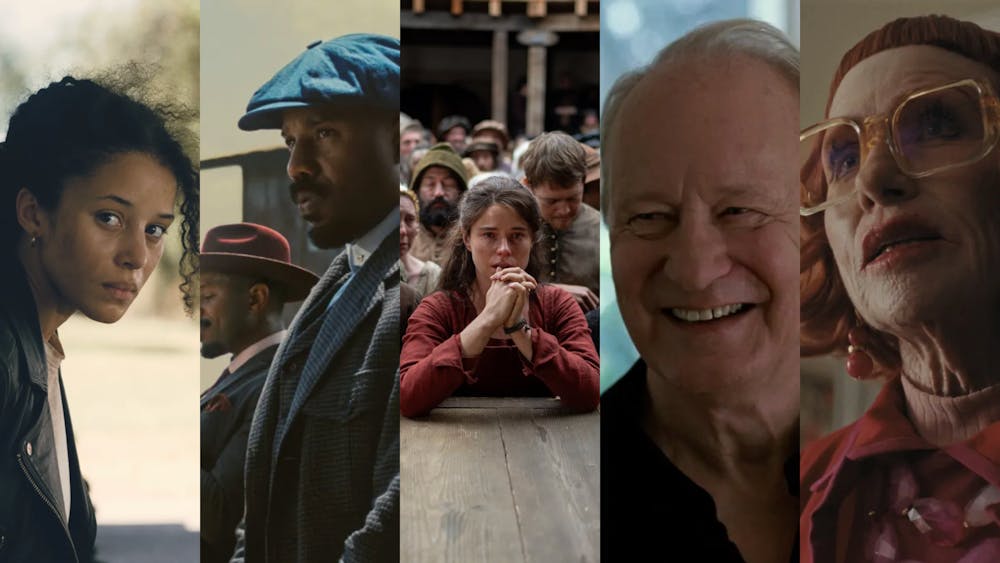
In preparation for the 98th Academy Awards this Sunday, The Herald selected the films and performances that deserve the film industry’s most prestigious prizes. These selections are based on performance, writing and the overall production of the films and are not meant to predict the Academy’s actual choices.
Best picture
“Bugonia”
“F1”
“Hamnet”
“Sinners”
Unlike many other action films centered on the military, “One Battle After Another” takes an explicitly anti-authoritarian stance. In the film, the two protagonists — Bob Ferguson (Leonardo DiCaprio) and his daughter Willa (Chase Infiniti) — are on the run from the authorities, pursued by a corrupt military officer, Colonel Steven Lockjaw (Sean Penn).
Despite its occasionally unserious tone, the film is a thrilling, action-packed experience supported by outstanding performances from its cast. Much of the cast is rightfully nominated for many of the night’s top categories — DiCaprio for best actor, Penn and Benicio del Toro for best supporting actor and Teyana Taylor for best supporting actress. But its most impressive performance, from newcomer Infiniti, was snubbed.
The film’s cinematography is also stunning, utilizing the forests and deserts of the fictional Baktan Cross, California for its backdrop. The ending sequence features a car chase between Bob, Willa and a member of the white supremacist group “Christmas Adventurers.” Cars race up and down rolling hills in the desert, building suspense as Willa attempts to escape the hitman sent after her.
“One Battle After Another” has a bit of everything: a major movie star, thrilling action and memorable set pieces. The film manages to mesh overt political messaging and irreverence with Hollywood-level spectacle and entertainment.
This year is the fourth time that director Paul Thomas Anderson has been nominated for best picture, and the nomination is for one of the strongest films of the year. The combination of the spectacular script adapted from Thomas Pynchon’s novel “Vineland,” entertaining performances from every member of the cast and visually captivating scenes makes “One Battle After Another” the obvious pick for the night’s top award.
Best director
Chloé Zhao, “Hamnet"
Josh Safdie, “Marty Supreme"
Paul Thomas Anderson, “One Battle After Another"
Joachim Trier, “Sentimental Value"
Ryan Coogler, “Sinners"
This year’s battle for best director — often considered one of the highest honors in cinema — will inevitably be a bloodbath. Zhao is a close second pick for her heart-wrenching portrayal of a young William Shakespeare’s world in “Hamnet.” Trier wields a similarly deft hand in “Sentimental Value,” a film that grasps the audience and allows viewers to experience the nuanced emotions of a parent and adult child reckoning with past trauma. Anderson and Safdie each manage a gripping masterful pacing, which is no easy feat considering “One Battle After Another” and “Marty Supreme” both push the two-and-a-half-hour mark.
But Coogler takes the cake for intertwining the emotional and the thrilling in his genre-bending “Sinners.” The film has moments that tug at one’s heart strings and make one’s pulse race. And Coogler’s masterful direction is the sealing factor in making a movie with such a wide cast of characters — and Michael B. Jordan playing two distinct individuals — feel cohesive.
Best actor in a leading role
Timothée Chalamet as Marty Mauser in “Marty Supreme”
Leonardo DiCaprio as Bob Ferguson in “One Battle After Another”
Ethan Hawke as Lorenz Hart in “Blue Moon”
Michael B. Jordan as Elijah “Smoke” Moore and Elias “Stack” Moore in “Sinners”
Wagner Moura as Armando Solimões / Marcelo Alves in “The Secret Agent”
In “Sinners,” Michael B. Jordan portrays both of the Smokestack Twins — Elijah “Smoke” Moore and Elias “Stack” Moore — notorious for their involvement in crime. Although the two are identical in appearance, they diverge in personality: Smoke tends to be more serious, mourning the loss of his infant child and rekindling a relationship with his estranged wife while Stack leans more youthful and charming, never settling into a permanent relationship. Despite the twins’ identical appearances, viewers do not have to rely solely on the differing color palettes of the characters’ clothing to tell the two apart. Thanks to Jordan’s superb acting, the twins can easily be identified based on the subtle differences in their personalities.
But this isn’t the only aspect of his performance that should be lauded. In the latter half of the film, Jordan’s acting feels natural as his characters progress through complex emotions of fear, grief and betrayal. Rather than merely portraying the Smokestack Twins, Jordan practically transforms into them.
A close second is Chalamet in “Marty Supreme.” He is charismatic, determined and unrelenting, maintaining charm while playing a man who, on paper, makes zero likeable decisions. In an extremely difficult role, Chalamet’s brilliant performance brings importance and urgency to his character’s ambitions.
Best actress in a leading role
Jessie Buckley as Agnes Shakespeare in “Hamnet”
Rose Byrne as Linda in “If I Had Legs I’d Kick You”
Kate Hudson as Claire Sardina in “Song Sung Blue”
Renate Reinsve as Nora Borg in “Sentimental Value”
Emma Stone as Michelle Fuller in “Bugonia”
No performance on this list is as poignant and heartwrenching as Jessie Buckley’s portrayal of a grieving mother in “Hamnet.” Buckley brings a necessary emotional depth and nuance to her version of Agnes Shakespeare. Her melancholy is not always explicit: Sometimes it creeps into conversations at the dinner table or the transformation in how she protects her children. At times, Agnes’s sadness subsides, and flickers of her old self re-emerge as she comes to terms with the loss of her son.
Watching Buckley’s performance, viewers can’t help but go beyond empathizing with her character’s sadness. She brings the viewer in the room with her to experience her emotions and tragedy, to feel for her pain without pity.
Though Rose Byrne’s portrayal of overwhelming anxiety in “If I Had Legs I’d Kick You” would come in second place for how viscerally it makes viewers feel the character’s stress, “Hamnet” features one of the best acting performances in recent years. It would be a shame to not recognize Buckley in this category.
Best actor in a supporting role
Benicio del Toro as Sensei Sergio St. Carlos in “One Battle After Another”
Jacob Elordi as The Creature in “Frankenstein”
Delroy Lindo as Delta Slim in “Sinners”
Sean Penn as Colonel Steven Lockjaw in “One Battle After Another”
Stellan Skarsgård as Gustav Borg in “Sentimental Value”
Stellan Skarsgård is unlikely to win the Oscar this year alongside his more punchy nominees, but his chances are not in any way a reflection of the quality of his work. Playing an estranged father and renowned director, Skarsgård expertly conveys layers of guilt for how his character has prioritized his career over his children superimposed with layers of love that sometimes comes out critically. While he’s not playing a character one initially wants to like, Skarsgård’s captivating and thoughtful performance makes viewers pity, resent and ultimately understand a complex figure. Skarsgård’s performance in “Sentimental Value” is a gold star in his long career.
Best actress in a supporting role
Elle Fanning as Rachel Kemp in “Sentimental Value”
Inga Ibsdotter Lilleaas as Agnes Borg Pettersen in “Sentimental Value”
Amy Madigan as Aunt Gladys in “Weapons”
Wunmi Mosaku as Annie in “Sinners”
Teyana Taylor as Perfidia Beverly Hills in “One Battle After Another”
Amy Madigan secured her film’s only Academy Award nomination, and her performance in “Weapons” deserves to be awarded. Madigan’s character, Aunt Gladys, has less than 15 minutes of screentime, but her position as the central antagonist makes her one of the most memorable characters. Her portrayal of a ruthless witch ties together the story of “Weapons,” and her eerie demeanor is downright frightening in some of the film’s most critical moments. Despite her limited screentime, Madigan managed to create a performance that stands out among this year’s nominees, bringing horror to the forefront of the Academy Awards.
Writing (original screenplay)
“Blue Moon,” written by Robert Kaplow
“It Was Just an Accident,” written by Jafar Panahi with Nader Saïvar, Shadmehr Rastin and Mehdi Mahmoudian
“Marty Supreme,” written by Ronald Bronstein and Josh Safdie
“Sentimental Value,” written by Eskil Vogt and Joachim Trier
“Sinners,” written by Ryan Coogler
“Sinners” gives audiences something undoubtedly original. It’s no doubt that the others in the category do so as well —“Marty Supreme” presents a won’t-stop-for-nothing aspirational table tennis champion and “It Was Just An Accident” makes audiences question the morality of revenge through the lens of former political prisoners in Iran.
But Coogler’s screenplay is sharply and uniquely original in numerous veins: in the writing, in the story, in the genre-mesh and in the ensemble-like use of the actors. His “Black Panther” movies showed a similar skill at genre-bending with their sci-fi like settings and action-packed scenes, but “Sinners” showcases Coogler’s talent miles beyond the sometimes cookie-cutter quality of the Marvel Universe. The movie thrives in its ability to portray the complexities of evil, leaving viewers disturbed in a way other movies cannot.
Writing (adapted screenplay)
“Bugonia,” Will Tracy; based on the film “Save the Green Planet!” by Jang Joon-hwan
“Frankenstein,” Guillermo del Toro; based on the novel by Mary Shelley
“Hamnet,” Chloé Zhao and Maggie O’Farrell; based on the novel by Maggie O’Farrell
“One Battle After Another,” Paul Thomas Anderson; based on the novel “Vineland” by Thomas Pynchon
“Train Dreams,” Clint Bentley and Greg Kwedar; based on the novella by Denis Johnson
This category holds some of the most interesting films of the year. “Hamnet” and “Train Dreams” are heartbreaking stories about family tragedy and grief, and “Bugonia” draws inspiration from a South Korean film to comment on the politics of the modern-day United States.
But Paul Thomas Anderson’s “One Battle After Another” is the year’s best adaptation for the screen. The film immediately throws viewers into the action of the revolutionary group “French 75,” complete with heists, anti-government operations and explosions. Oddly enough, its most entertaining aspect is its comedy. Although the film centers on the thrilling story of a family trying to literally survive one battle after another — as Bob Ferguson tracks down his daughter, Willa — the absurd humor in “One Battle After Another” never feels out of place.
Lockjaw’s weird kinks and Ferguson’s inability to discretely find his daughter are comedically ironic for a corrupt military officer and a washed-up revolutionary, respectively. The combination of comedy and drama can be tricky to work with, but Anderson found the perfect balance in his adaptation of Thomas Pynchon’s “Vineland.”
Manav is a senior from Indiana, concentrating in International and Public Affairs. In his free time, he likes attempting the daily Connections puzzle or falling down Wikipedia rabbit holes.