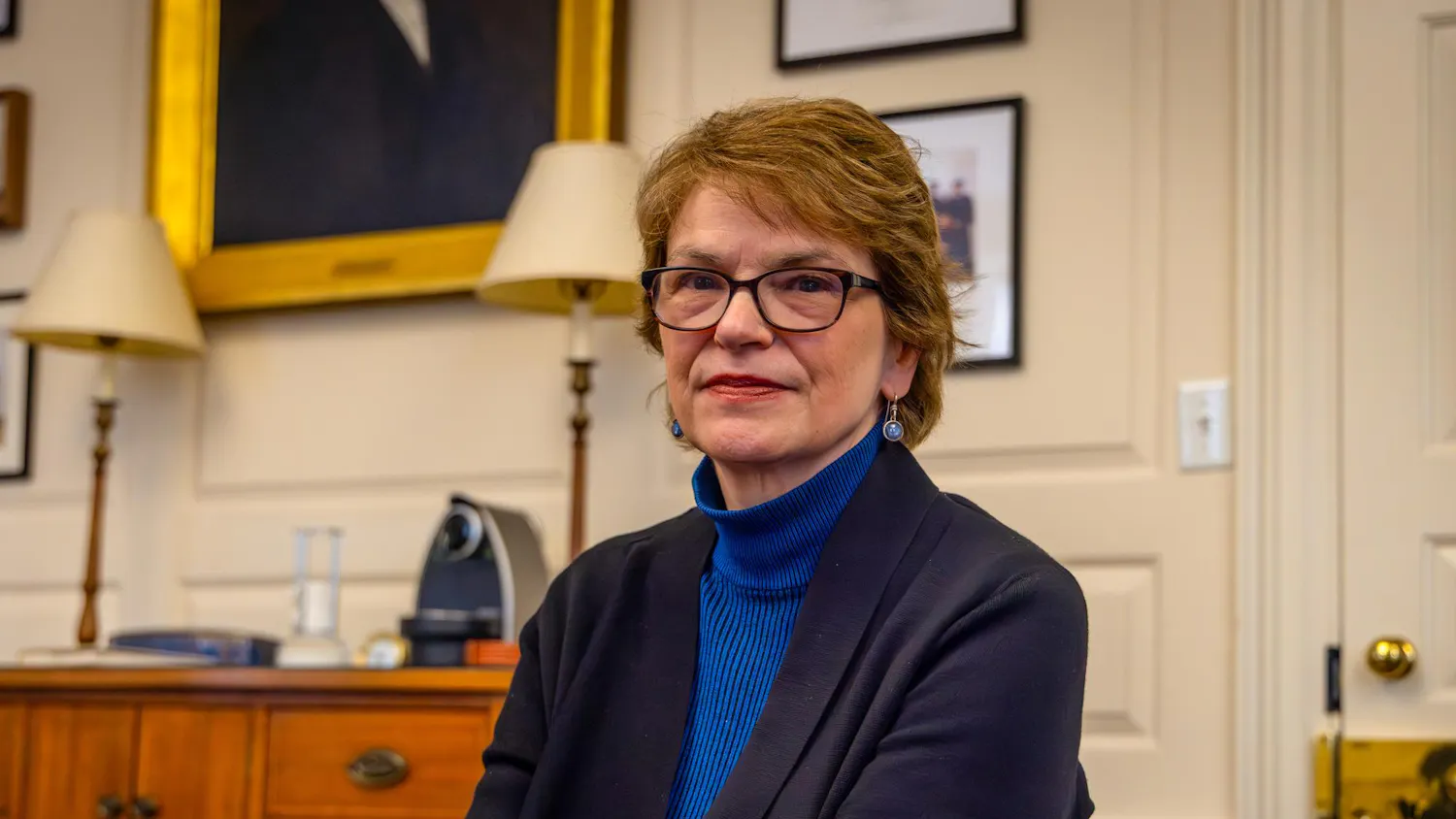
At Tuesday’s faculty meeting, Provost Francis Doyle outlined the potential impact of federal actions on long-term University finances.
Federal financial aid changes, an increased endowment tax and immigration-related barriers inhibiting master’s student enrollment could pose challenges for the University’s budget, Doyle said at the meeting.
The difficulties have also led to a number of changes to the University’s doctoral programs.
Admission to a “small number” of programs was paused for the fall 2026 cohort, Doyle explained. One program “proactively volunteered” to pause admission, while others were directed by the University or “self-elected” to pause new admits.
“But this is not the way that we want to be doing things, cycle over cycle,” Doyle said. “We really want to have a careful, thoughtful review of how Brown can continue to train the next generation of scholars.”
The pause for fall 2026 Ph.D. admissions follows reductions in cohort sizes this fall in accordance with specific programs’ funding sources.
As departments in the sciences are primarily funded through federal grants, these Ph.D. cohorts were adjusted due to federal funding uncertainty. For humanities and social science programs that primarily receive funding from the University, “targets were adjusted … in concert with addressing the budget deficit,” Doyle said.
According to Doyle, “the cost of doctoral education is rising quite rapidly” due to a larger number of students as well as increases in graduate student stipends from unionization efforts.
During spring and summer 2025, doctoral programs were closely evaluated in coordination with the Academic Priorities Committee based on “strength of admissions,” student experience and “placement and career outcomes.”
For the fall 2025 cohort, no program was decreased by more than two admission slots beneath the typical minimum program size, Doyle said.
Doyle added that he has convened a small group of faculty to evaluate the University’s approaches and goals for doctoral education in alignment with Brown’s priorities.
Co-chaired by Janet Blume, interim dean of the Graduate School, and Susan Harvey, a professor of history and religion and member of the Academic Priorities Committee, the group will prioritize soliciting diverse input from colleagues across the University.
Federal actions may also impact University financial aid programs and endowment returns in future years as well as continued uncertainty surrounding research funding.
Changes to federal financial aid programs will likely affect the University starting in fiscal year 2027, with an annual impact of around $2 million to $3 million, Doyle estimated.
The “One Big Beautiful Bill Act,” established a new endowment tax system where private universities with a higher proportion of endowment dollars per student are required to pay higher taxes.
Due to its relatively smaller endowment, Brown “escaped” an increased endowment tax when the act was passed, Doyle said. Brown’s endowment ratio sits at about $625,000 per student — below the $750,000 threshold required for a 4% endowment tax rate. But if the University’s endowment performs well in future years, it could cross that threshold, requiring Brown to pay that 4% tax, rather than the current tax rate of 1.4%, Doyle explained.
Doyle also expressed “high uncertainty” surrounding potential changes to federal research funds in the near future, as well as shifts in master’s student enrollment due to impacts on F-1, J-1 and H-1B visas.
As a result of federal actions, University officials expect an additional $30 million financial loss in fiscal year 2026, which they hope to address through both campus-wide and “unit-level” actions, Doyle said.
Actions include “monetizing non-strategic real estate,” “pausing spending on net-zero emissions plans” and “prioritizing fundraising for current-use gifts,” according to a slide displayed during the meeting.
At the meeting, Professor of Engineering and Physics Alexander Zaslavsky — the former chair of the Tenure, Promotions and Appointments Committee — also discussed TPAC’s annual report. During the 2024-25 academic year, TPAC reviewed and made recommendations to Doyle for 94 tenure, promotion, appointment or reappointment cases, he said.
During the last academic year, 25 individuals were recommended to be promoted from assistant to associate professor with tenure as well as 22 individuals from associate to full professor.
Meeting attendees also voted to amend the TPAC election process. According to past committee rules, each academic division nominates two faculty members to represent the division on the committee. One is then approved to take the position.
In April, faculty voted to add teaching professors positions to TPAC, and they are permitted to vote in cases that involve teaching professor promotion. TPAC has four teaching professor positions to represent faculty in the humanities, social sciences, physical sciences and life sciences.
But some academic divisions did not have enough teaching professors to nominate two candidates for the position, explained Anna Lysyanskaya, chair of the Faculty Executive Committee and professor of computer science.
Now, if there are fewer than 10 teaching track faculty eligible for a TPAC position, it is acceptable for an academic division to nominate only one individual and hold an approval vote. The motion had passed with 83% of voting faculty members voting in favor of the change.

Samah Hamid is a university news editor covering faculty and career & alumni. She is from Sharon, Massachusetts and plans to concentrate in Biology. In her free time, you can find her taking a nap, reading, or baking a sweet treat.