
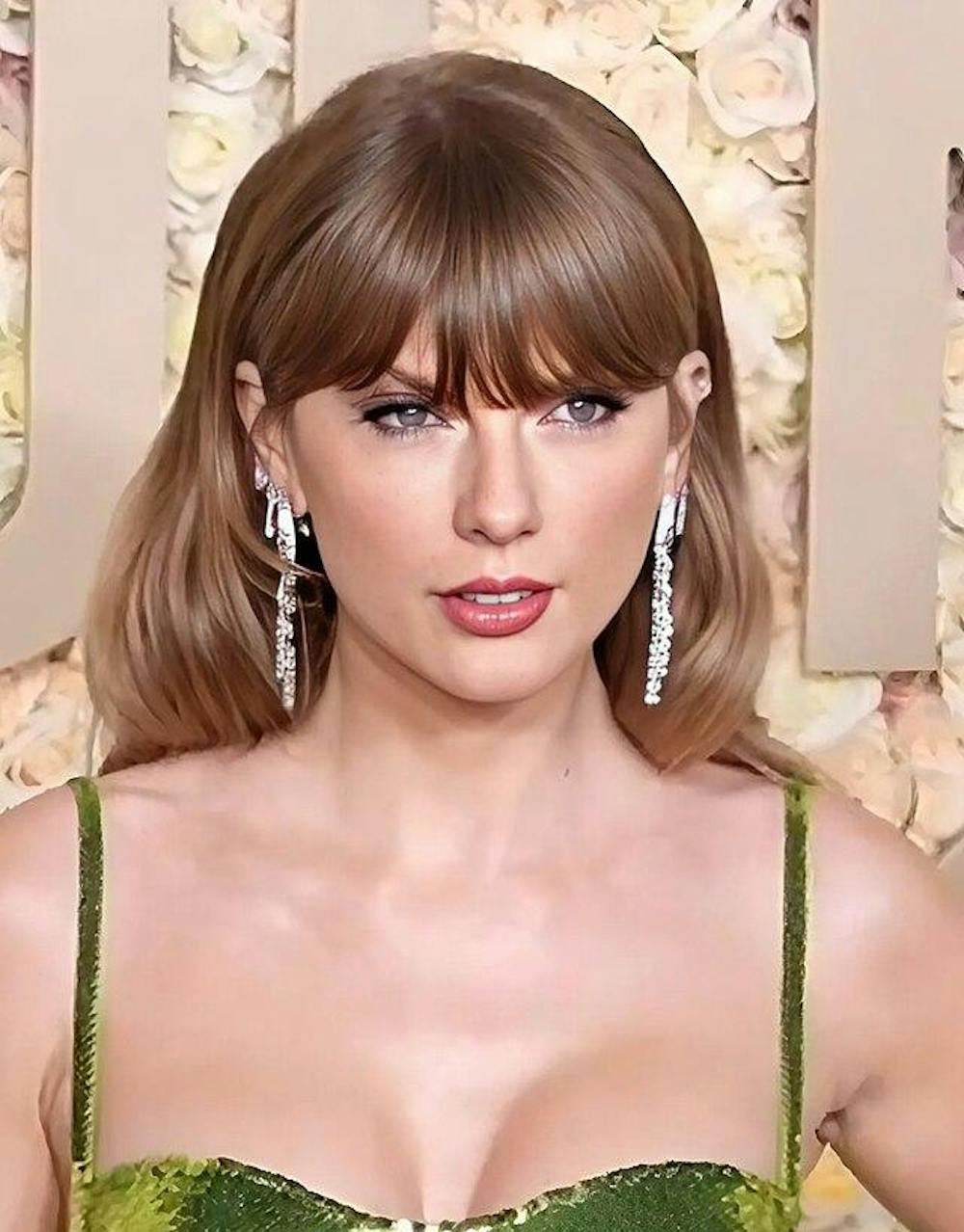
For Taylor Swift, announcing her latest album “The Life of a Showgirl” on “New Heights” — a podcast hosted by her fiance Travis Kelce and his brother, Jason — was extremely out of character. Rarely had she acknowledged her romantic partners outside of her music, let alone used their platform to announce her own work.
But in hindsight, the decision makes total sense: “The Life of a Showgirl” has the emotional depth of a Kelce brothers podcast episode.
Released on Oct. 3, Swift’s 12th studio album has only 12 tracks and signals a new era in her discography. For the first time in 13 years, Swift’s album features no production credited to Jack Antonoff. Instead, she returned to Swedish producers Max Martin and Shellback, who produced some of her greatest pop hits, including “Shake it Off” from “1989.” While this choice reveals a desire to bring a different energy into her music, listeners were instead given 42 minutes of insipid background noise.
The album opens with “The Fate of Ophelia,” a song in which Swift takes inspiration from William Shakespeare’s “Hamlet” to describe an end to her heartbroken past. The song is the album’s lead single, and for good reason: With a thrumming tempo and infectious beat, “The Fate of Ophelia” is a formulaic pop earworm that has already broken records, achieving the highest number of single-day streams in Spotify history.
But the album’s greatest shortcoming is its juvenile and clunky lyrics, which start to emerge as early as its opening track. The hook in “The Fate of Ophelia” — “Keep it one hundred on the (Land), the sea (Sea), the sky / Pledge allegiance to your hands, your team, your vibes” — doesn’t work the way Swift intends it to. The lyrics are, quite simply, awkward and misplaced. The colloquial phrases on the opening track point to a concerning pattern that plagues the rest of the album.
The second track, “Elizabeth Taylor,” is the album’s shining point. The song’s explosive chorus is a thankful distraction from the lyrical cliches Swift employs. But the track that follows — “Opalite” — is painfully forgetful. Lyrics like “But my Mama told me, ‘It’s alright / You were dancing through the lightning strikes / Sleepless in the onyx night / But now the sky is opalite’” are callow for a singer who’s been writing music since her childhood. The song’s production is more appropriate for a Disney movie soundtrack than a 14-time Grammy Award winner.
After “Opalite,” the quality of the album takes a nosedive. “Father Figure” interpolates the iconic George Michael song of the same name. Swift’s version is believed to be about Scott Borchetta, the founder of Swift’s former label Big Machine Records who was embroiled in scandal after selling the artist’s masters. Yet again, the impact of this journey is stunted by lines like “You made a deal with this devil, turns out my dick’s bigger.” By foregoing the nuance of her typical songwriting, Swift forgets how to cultivate artistry.
The cringe continues on “Eldest Daughter,” the album’s fifth track. Swift has a practice of placing her most vulnerable and personal songs as track five. On “Lover,” fans received the powerful track “The Archer.” On “folklore,” the fifth track is the stirring “my tears ricochet.” Great, vulnerable art is truly timeless, affecting listeners both in the moment and years later. But there is nothing immortal about a song flooded with words like “trolling” and “memes.” On “Eldest Daughter,” Swift sings, “But I’m not a bad bitch / And this isn’t savage.” At only 35 years old, Swift has managed to embody the embarrassing millennial archetype of desperately trying to stay hip and cool.
“Ruin The Friendship” is equally lazy. While the song’s 2000s-inspired production matches its lyrics regarding teenagehood, it closes with a lame address to listeners. There is nothing inventive about this or the empty advice Swift offers to “ruin the friendship.”
In “Actually Romantic,” Swift seems to respond to Charli xcx’s “Sympathy is a knife” from her explosive 2024 album “BRAT.” Charli xcx has incomparable musical prowess: Despite having a club sound, “Sympathy is a knife” is excruciatingly vulnerable in exploring the artist’s feelings of inadequacy. In the song, Charli xcx supposedly references Swift as the “one girl taps (her) insecurities.”
But Swift’s response in “Actually Romantic” lacks all of the nuance mastered in “BRAT.” In “Actually Romantic,” Swift equates Charli xcx’s attention with that of a crush, which culminates in a bridge that features the lyrics “It’s kind of making me wet (Oh).” Cruel and out of proportion, “Actually Romantic” doesn’t achieve the glory that Swift hoped it would.
“Wi$h Li$t” is Swift at her most insufferable. In an era when the average American’s life is characterized by political turmoil and financial instability, it rings hollow to hear a billionaire sing about hoping for the little things in life. Swift’s tireless public relations team leaves no authenticity to be found: “We tell the world to leave us the fuck alone, and they do, wow,” Swift sings. How can this be authentic when both Swift and Kelce have profited endlessly from their relationship?
“CANCELLED!” is a similarly bizarre subject matter for Swift to take on, especially when she sings “Good thing I like my friends cancelled / I like ’em cloaked in Gucci and in scandal.” Inducing major eye rolls, the song reiterates the perpetual victimhood in Swift’s self-perception. Yet again, Swift lengthens the chasm between herself and her listeners.
As the album nears its end, every track’s production blends together to produce a tedious body of work. On “Wood,” she pushes the boundaries of just how asinine her lyrics can be. Listeners are subjected to countless euphemisms about Travis Kelce’s manhood. There is nothing charming about these lyrics: “Forgive me, it sounds cocky / He ah-matized me and opened my eyes / Redwood tree, it ain’t hard to see / His love was the key that opened my thighs” is, quite frankly, offbeat. Intimacy is an important aspect of love, but the surface-level nature of “Wood” raises questions of how hastily assembled this album was.
Swift’s sexual references across “The Life of a Showgirl” take a page out of Sabrina Carpenter’s 2025 album “Man’s Best Friend,” but Swift’s fall short because she can’t quite commit to the bit the way her protege does. Unlike Carpenter’s, Swift’s innuendos are softened by crashing instrumentals or entirely void of explicit vulgarity.
“Honey” is an unremarkable song that precedes the album closer, “The Life of a Showgirl.” The album’s namesake track features Sabrina Carpenter, but unfortunately, the two artists’ combined star power couldn’t save the track from sounding like it belongs in a drama class’s musical production. What happened to the glitz and glamour of Swift’s “I Can Do it With a Broken Heart,” which — in under four minutes — achieved what the album “The Life of a Showgirl” failed to do?
Art that is purposeful has a dual role: It is deeply personal, and it is reflective of the cultural moment. “The Life of a Showgirl” fails on both counts. Not only are the poignant diaristic elements of her writing gone — replaced by bizarre sexual details no one asked for — but she mistakes employing Gen Z sayings for cultural commentary. There is no intellectual labor to be done when listening to this record. Swift and her producers created unoriginal melodies and wrote superficial lyrics, packaging it up to listeners as the next great pop record. But any pop music lover knows that the genre is more than just formulas, references and shock factor. The recent cementation of Swift’s legacy had a blinding effect: Her worldwide success has produced an album that rings hollow, unable to resonate with anyone but herself.

Alyssia Ouhocine is a Senior Staff Writer covering Arts & Culture. Hailing from Bayonne, New Jersey, she is concentrating in English and History with a particular interest in Algerian history and literature. When she’s not writing, she can be found listening to music and sending Google Calendar invites.


