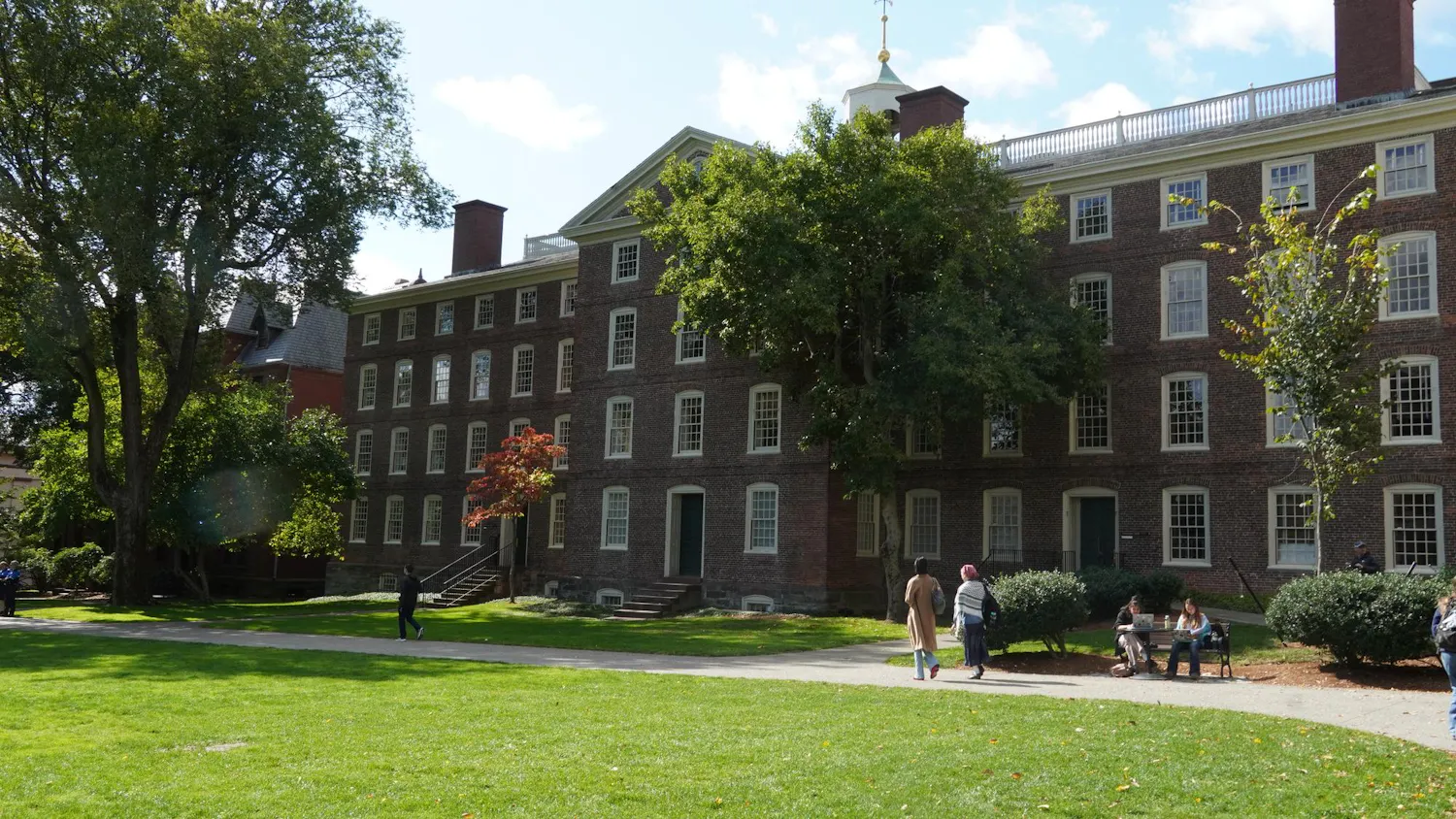
Over 1,000 alums, students, faculty and parents flocked to College Hill this weekend to attend a celebration of 130 years of Jewish life at Brown. The event falls on the 130th anniversary of the graduation of Brown’s first two openly Jewish students.
The event featured a series of lectures, panels and religious services — several of which The Herald attended. Themed “L’dor V’dor,” a Hebrew phrase that means “from generation to generation,” the programming aimed to unpack the history of Jewish life at Brown and unite an intergenerational community, organizers said.
“It’s really about coming together,” said Noel Rubinton ’77, a member of the event steering committee and a former Herald editor-in-chief. “We are hoping that the Brown Jewish community is going to be much stronger and larger coming out of this.”
Since winter 2024, committees composed of almost 100 alums have worked to fundraise and schedule the weekend’s events, according to event organizer Abby Doft ’91 MA’92 P’27.
The collection of panels and lectures was designed to “showcase the amazing Jewish faculty that we have at Brown and also the alumni that have gone on to do really amazing things in their professions,” Doft said. Events ranged from a Hebrew sing along to professional panels on journalism and theater.
For many attendees, the weekend served as a way to connect with other members of the Brown Jewish community. “It’s really nice to meet people who were here before us, and to put into context what their experience was like,” Denise Rosin Portner ’84 said. “The stories they tell are priceless.”
The weekend was “such a smart decision by Brown and something that’s really needed by Jewish alumni to continue to feel part of the community,” Rosin Portner added.
Shabbat dinner
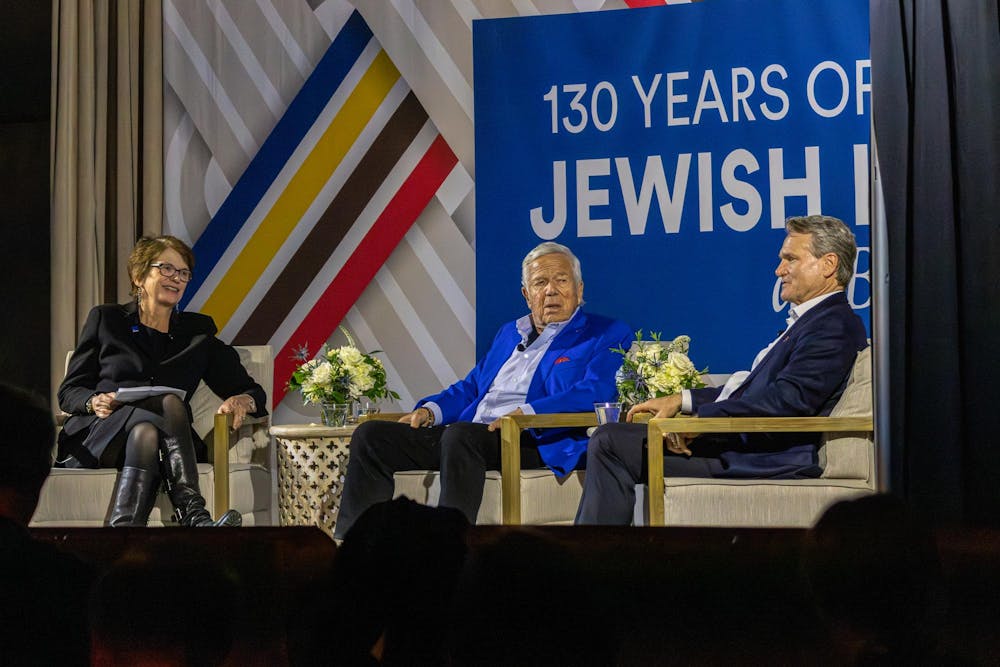
On Friday evening, hundreds of students and alums gathered on Pembroke Field under a large tent for Shabbat dinner. The meal was accompanied by a discussion between University President Christina Paxson P’19 P’MD’20, New England Patriots owner Robert Kraft and University Chancellor Brian Moynihan ’81 P’14 P’19.
Brown’s Jewish community “enables our students and scholars to do amazing things, build knowledge and understanding in the pursuit of academic excellence,” Paxson said after walking out to a standing ovation.
After the 2017 Unite the Right demonstration, during which neo-Nazis marched in Charlottesville, Virginia, and a 2018 shooting at Tree of Life synagogue that killed 11 people, Kraft founded the Blue Square Alliance Against Hate.
Kraft believes that while a majority of “Americans are good people, (they) don’t really understand what’s going on when it comes to antisemitism,” he said. “Our job is to educate and make them feel comfortable to stand up to hate.”
Kraft and Moynihan said they believe initiating conversations between people of different backgrounds is critical to combatting prejudice.
“You have to have affinity groups,” Moynihan said, speaking from his experience as CEO of Bank of America. But he also emphasized the importance of having conversations “among groups.”
Tyler Fischman ’27 said he enjoyed the dinner and discussion. “It’s not often that you get this many Jews at Brown in a room,” he said. “It really feels special.”
Fischman called Kraft’s work to raise awareness about antisemitism “commendable.”
But some attendees contested Kraft and Moynihan’s appearance. A flyer distributed by students at the event noted that Kraft donated to President Trump’s first inauguration fund and that Bank of America, under Moynihan’s leadership, has contributed billions to fossil fuel companies.
“Are these the guests of honor you want at our Shabbat table?” the flyer read, calling on guests to email Paxson to express their disapproval.
In response to Moynihan and Kraft’s appearance, Jews for Palestinian Liberation, a student group on campus, ran “alternative Shabbat services,” spokesperson Rafi Ash ’26 wrote in a statement to The Herald on behalf of the group. “These men do not represent our Jewish values nor our experience of Jewish life at Brown.”
In a Monday statement to The Herald, University Spokesperson Brian Clark wrote, “Students are free to share their views,” as long as they follow the University Code of Conduct, “just as event organizers are free to host speakers and guests of their choice.”
Spokespeople for Moynihan and Kraft did not immediately reply to The Herald’s request for comment.
‘Historical Perspective: Key Moments in Brown and Rhode Island Jewish Life’
Earlier on Friday, panelists discussed the history of Jewish life at Brown from the early 1900s to the modern day.
Amy Sohn ’95, a New York Times-bestselling author whose grandmother graduated from Pembroke College, dissected her research on Jewish quotas at Brown in the 1920s and 1940s.
“Pretty much everything you know about modern college admissions at Brown and most other universities,” Sohn said, “was created with the explicit purpose of limiting the number of Jews.”
She explained that these discriminatory practices included geographic diversity requirements, limited scholarships, preference for legacy applicants and minimum SAT scores.
Karin Wulf, director and librarian at the John Carter Brown Library, noted the “rise of support for Jewish students and resources for Jewish students” at Brown in the latter half of the 20th century. New initiatives included the establishment of the campus’s Hillel center in 1947, a weekly Shabbat dinner and the formation of Jewish student groups on campus.
But she noted that Jewish students still faced challenges during this era, such as the lack of a Kosher meal plan, which wasn’t implemented until the 1990s.
‘How Brown Women Broke through the Jewish Stained-Glass Ceiling’
On Saturday evening, a panel of six female alums — five of whom became rabbis — discussed how their time at Brown shaped their journey in becoming leaders in the Jewish community.
“Brown has produced a tremendous cadre of female Jewish leaders and the women who are on that panel really are superstars,” Doft said.
For Rabbi Jane Kanarek ’92, her time at Brown helped her feel connected to a strong legacy of Jewish women. She added that then-Rabbi Alan Flam’s leadership — along with learning how to read the Torah and lead services at Brown Hillel, which later became known as Brown-RISD Hillel — provided the support necessary to lead her to the rabbinate.
Flam provided similar support to Rabbi Julie Roth ’95, who said when she first came to Brown, the community Brown-RISD Hillel offered was “mind blowing.”
Rabbi Laura Geller ’71 P’03 P’10, who graduated from Brown only a year before the first female rabbi in North America was ordained, discussed the challenges she overcame on her journey to join the rabbinate.
“I didn’t have any mentors,” Geller said. In the years since, female mentorship has evolved to be more collaborative. Having more women rabbis “has changed the way we think about the rabbinate.”
‘From Generation to Generation’
Three generations of the Hirschfeld family participated in a Saturday morning panel about how Jewish life at Brown has evolved.
Neil Hirschfeld ’59 P’84 P’85 P’91 said Jewish students could only join one of the 17 fraternities on campus.
After being rejected from a fraternity, he and his friends “made lemonade out of lemons by joining together with other non-Jewish and Jewish students who were not accepted to the fraternities, and we made our own social life.” Still, feelings of exclusion lingered.
He also said students were required to attend Christian chapel services every Friday.
“I felt very uncomfortable being there, and I felt that I didn’t really belong,” he said. “But … I had to accept things as they were and go from there. And that’s what I did.”
While Hirschfield did not personally experience incidents of antisemitism, he said someone urinated on the door of his friend, who is Jewish, writing “Jew bastard” on it.
A decade-and-a-half later, Stuart Himmelfarb ’74 said he did not encounter any major experiences of antisemitism, although he recalled some students coming to campus and telling him they had never encountered a Jewish person before.
He also strengthened his Jewish identity on campus, crediting a course on American Judaism. “I came here and I took that course, and all of a sudden life changed for me,” he said. “I switched to become a religious studies major.”
He also said the Jewish community was particularly “galvanized” after the Yom Kippur War — a conflict stemming from an Egyptian- and Syrian-led surprise attack on Israel aimed at winning territory lost during the 1967 Arab-Israeli War.
“There were outpourings of support, there was unity, there was deep commitment and deep attention to what was happening,” he said.
Hirschfeld’s granddaughter, Elizabeth Hirschfeld ’25, said the modern-day Jewish community at Brown was inviting. She noted that events at Brown-RISD Hillel and Chabad of College Hill see hundreds of students in attendance, which is “emblematic of the Jewish community at Brown.”
“I just quickly felt so welcomed into the community,” she said.

Zarina Hamilton is a university news editor covering activism and affinity & identity. She is sophomore from near Baltimore, Maryland and is studying mechanical engineering. In her free time, you can find her reading, journaling, or doing the NYT mini crossword.

James Libresco is a senior staff writer covering staff & student labor. He is a first-year student from Alexandria, Va. studying political science and contemplative studies. In his free time, he can be found playing basketball, meditating, or losing in Among Us.