
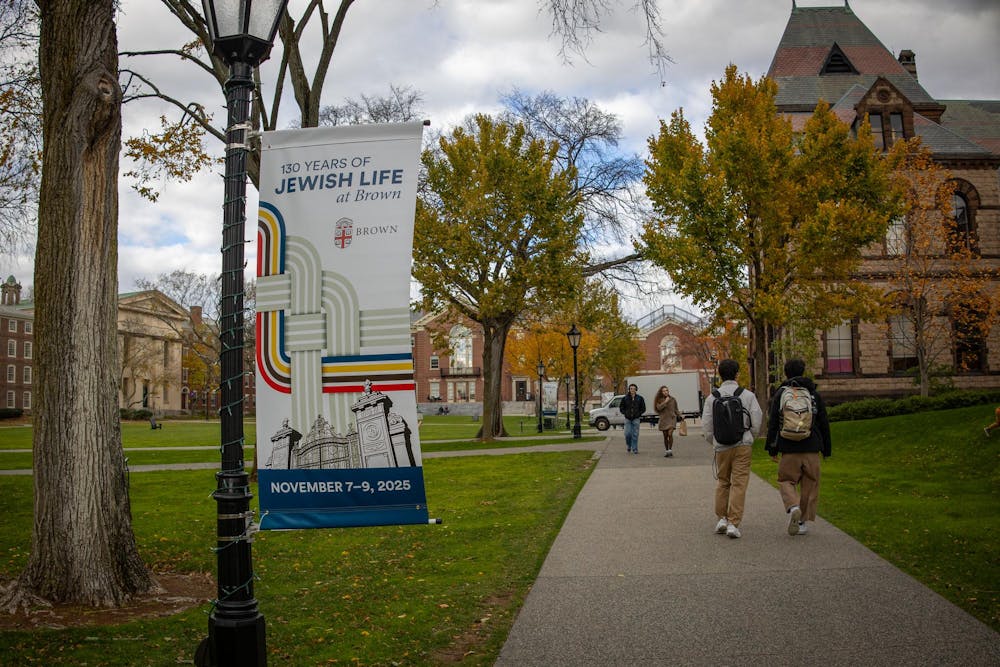
As one of the first two Jews to graduate from Brown, Israel Strauss, class of 1894, was told by then-University President Elisha Andrews, class of 1870, to pursue different career paths because of his religion. Such comments were not unique in the long history of Jews in the diaspora. It would be hard to imagine that Strauss, in this Christian-centric University community, did not experience significant social isolation while receiving his education, but Jewish students at Brown are no longer pushed to the periphery. One hundred and thirty years later, Jewish life at Brown is thriving.
While other universities, especially in the Ivy League, have seen decreases in Jewish student enrollment over the past decade, Brown has seen a steady increase in the number of young Jews choosing to spend their formative years on College Hill. In 2015, 15% of Brown undergraduates were Jewish. Almost a decade later, that number has risen to 24%. Today, Brown has the highest percentage of Jewish students of any Ivy League university and has the 10th most Jewish students at any private university in America.
This increase is the result of the Brown community’s efforts to create a supportive environment for Jewish students. Impressive renovations at Brown-RISD Hillel and Chabad of College Hill have provided more space for Brown’s growing Jewish population. In 2017, the University expanded the Providence Eruv, a symbolic enclosure that eases restrictions for observant Jews on the Sabbath. Six years later, it built a kosher meat and dairy kitchen in the Sharpe Refectory. Beyond providing observant Jewish students with the food that meets their religious needs, the kosher kitchen also allows them to eat with the rest of their peers and provides non-Jewish students with a taste of Jewish culture. As a result of these efforts, Brown has fostered an environment where Jews do not have to choose between their faith and their social life.
Brown’s Jewish students now have the option to attend an Orthodox prayer service every morning and can choose from four different styles of services on Shabbat and other holidays. For many Jews, prayer is the heart of their connection to their faith, and these services provide opportunities to strengthen this foundation. There’s something special about students singing niguns next to their friends, professors and, on occasion, their University president.
Jewish learning, both religious and academic, is abundant on College Hill. One pillar of Judaism — and perhaps my favorite — is “Machloket l’Shem Shamayim,” or argument for the sake of heaven. Judaism encourages respectful debate while learning in order to reach a deeper understanding of the material. Brown’s course offerings and academic programs epitomize this principle. The Program in Judaic Studies offers several classes for students to explore Jewish history, theology and Hebrew. Outside of traditional classes, students can also meet weekly to study Jewish texts at Mishmar and other informal events. In these spaces, Brunonians passionately debate life’s central questions through a Jewish lens.
And, as instances of antisemitism become more frequent worldwide, Brown remains steadfast in its commitment to supporting all of its students, regardless of religion. Amid the past two years of war in the Middle East, Jews have been chased in Amsterdam, gunned down in Washington and harassed on college campuses. While no university has been perfect in its response to campus tensions, Brown has made efforts to ensure its Jewish students feel welcome on campus. The University has created initiatives aimed at promoting inclusive and respectful dialogue and provided opportunities for students to share their thoughts on Brown’s investment practices last year. In a journal article this spring, Paxson effectively articulated the University’s role in fostering a community that allows for free speech and diverse perspectives while maintaining safety and equality for all its members. And, Brown’s recent launch of the campus climate survey, sent to students last week, will help the University improve the student experience, especially in regards to antisemitism and other forms of discrimination.
Statistics and anecdotes are helpful, but the true vibrancy of Brown’s Jewish life can only be felt when on campus. As a Jewish student, I feel like I belong at Brown when the Hillel lobby is alive with chatter; when every seat at the Chabad dinner table is filled each Friday night; when I hear seniors inviting first-year students to their apartments for post-Oneg hangouts; and when I grieve with my friends one day, but then celebrate the next.
To those who have come before me and have built this joyous community — thank you. And to those who will join the Brown Jewish community in the next 130 years, I look forward to seeing how you continue to build a meaningful Jewish presence on College Hill.
Ethan Canfield ’28 can be reached at ethan_canfield@brown.edu. Please send responses to this column to letters@browndailyherald.com and other opinions to opinions@browndailyherald.com.
Ethan Canfield is the head of the Editorial Page Board and an opinions editor. He previously was a columnist and a copy editor for the Herald. He is a sophomore from Houston, Texas and is studying Applied Mathematics-Biology.


