
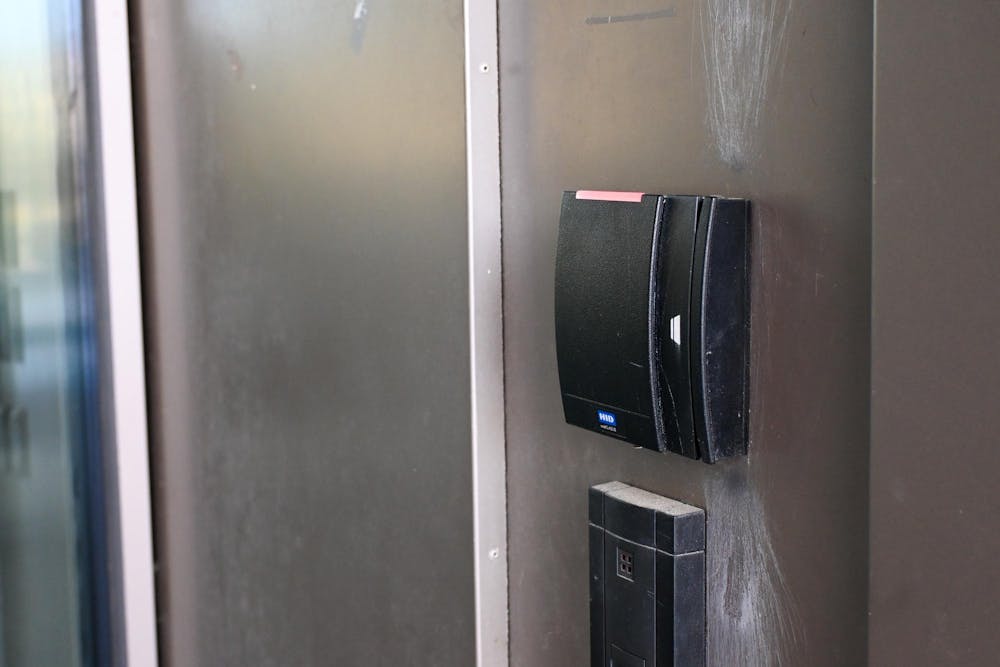
In the wake of the Dec. 13 shooting, President Christina Paxson P’19 P’MD’20 announced a number of security upgrades that would be implemented across campus. These changes include installing card readers in buildings that previously used physical locks and keys, requiring students to swipe their ID cards to enter all academic buildings and restricting entry hours. Paxson has emphasized the importance of community input in the University’s continued effort to update campus this semester. Considering that Brown is already making changes to the building access system, now is the perfect time for a complete overhaul rather than incremental changes to the current system. The University should use this opportunity to implement a long-overdue improvement: a digital card entry system.
Brown has already acknowledged the promise of a digital ID system. In April 2022, the University announced plans to roll out a scannable virtual Brown ID that would provide students with the ability to enter dining halls, use recreational facilities and board the Brown Shuttle. This plan was indefinitely postponed, in part because students voiced a preference for a virtual Brown ID that could be tapped and give students access to facilities. This would require the installation of “completely new sensors for a variety of services, which would have been a ‘major investment,’” according to Don Rogers, assistant chief information officer for information technology support and customer experience. While the University has not committed to such an investment, it has been installing “tap-compatible hardware” when replacing card readers, implicitly recognizing that a digital future is inevitable.
Digital access systems offer clear advantages for both security and convenience. Physical ID cards are easily lost when they’re being taken in and out of pockets, especially now that all academic buildings require to be swiped into. When students drop their cards, any individual who finds it is then capable of swiping into all of the buildings to which that student has access — a significant and unnecessary security risk. While students can deactivate lost IDs, this system relies on timely reporting and does little to prevent misuse in the interim. Lost phones do not pose the same threat, given that they are password protected and much less likely to be misplaced.
While some might be concerned about phones dying or students without mobile phones, these issues are easily addressed by the fact that virtual IDs would only be additional to physical IDs. We do not propose to abandon physical cards, but to pair them with virtual IDs, as our peer institutions do. Students could choose which to use, though most would likely default to their phones out of convenience. Although physical IDs would still exist in wallets and backpacks, their handling and its associated risk would inevitably decrease.
Shifting to digital IDs is not a novel idea. In a moment when security has become a central concern for our community, virtual IDs would address some of the current system’s vulnerabilities while providing students with improved convenience. To delay a digital transition now — when institutional focus is already honed in on security — would be a waste of a moment uniquely suited for comprehensive reform.
Editorials are written by The Herald’s editorial page board, and its views are separate from those of The Herald’s newsroom and the 136th Editorial Board, which leads the paper. A majority of the editorial page board voted in favor of this piece. Please send responses to this column to letters@browndailyherald.com and other opinions to opinions@browndailyherald.com.


