
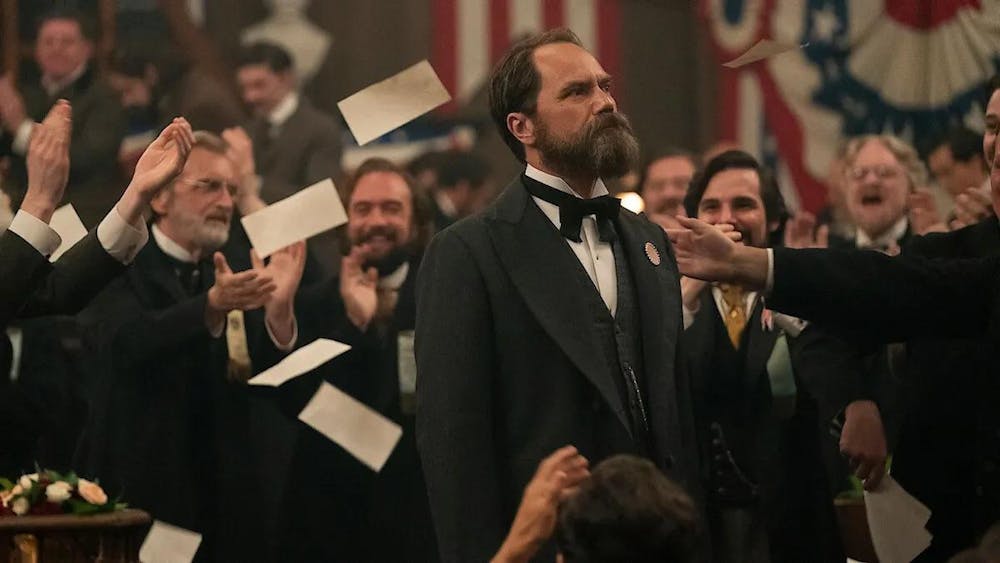
Of the four presidential assassinations in United States history, only two — those of Abraham Lincoln and John F. Kennedy — have withstood the test of time and pervaded modern discourse. The murders of William McKinley and James Garfield are often left in the past. But earlier this month, Netflix released “Death by Lightning,” a riveting chronicle of the assassination of Garfield (Michael Shannon), the United States' 20th president.
The four-episode limited series stars two men: Garfield and the man who ultimately kills him, Charles Guiteau (Matthew Macfadyen). Based on the 2011 book “Destiny of the Republic” by Candice Millard, the show has been lauded for its accurate portrayal of the assassination. Though some details are omitted, it is less egregiously false than other political dramas, like “The Crown” or “Reign.”
In the miniseries, Garfield shows no intention of running for president, which aligns with historians' assessments of Garfield's candidacy. After Garfield accidentally wins the Republican nomination for president in 1880, he is immediately cast as a shoo-in for the position.
The series excels at its portrayal of mental illness in Guiteau, the show’s antagonist. Viewers watch as Guiteau descends from merely delusional to crazed stalker, where each negative interaction he has seems to rattle him further. His mental illness is a documented historical fact, not just a plot point invented by the book’s author.
A post-mortem analysis of Guiteau’s brain by modern pathologists revealed that he may have suffered from chronic malaria and cerebral syphilis, both of which can cause significant cognitive impairment. Since then, experts have called this finding into question, arguing that Guiteau more likely had schizophrenia. Regardless of his true diagnosis, this background contextualizes Macfadyen’s performance and his ability to capture Guiteau’s erratic behavior.
Beyond the assasination, the show also serves as a crash course in 1880s U.S. history, accurately depicting a number of events that occurred across the nation during Garfield’s time. For instance, the series entertainingly portrays Guiteau’s one-sided rivalry with Garfield’s secretary of state, James Blaine (Bradley Whitford). While amusing, the show’s depiction also illuminates the elitism and hostility that has long been central to American politics.
The series also focuses on Guiteau’s entry into the Oneida Community — a utopian Christian society based in New York. The leader of the revolutionary community believed in living a sin-free life through gender equality and complex marriage where members could have sex with multiple partners. The show’s portrayal of the community is precise, even if it leans more toward a crude mockery than an unbiased depiction.
The execution of parallel storylines marks another highlight of the show. As Guiteau grows ever more manic, viewers get wrapped up in dirty politics. Chester A. Arthur (Nick Offerman) — Garfield’s vice president who reeks of liquor even through the screen — attempts to sabotage all of Garfield’s political appointments. As the two stab each other in the back, viewers also get a glimpse into Garfield’s family life — though this is where the show deviates from the historical record. While he’s portrayed to have a happy and healthy marriage with his wife, Lucretia Garfield (Betty Gilpin), their true relationship was far more strained.
It’s easy to imagine that without a mainstream show like this, Guiteau’s name would be long lost to history, much to the assassin’s dismay. But fortunately for him, his name will remain in the public eye for the time being — or at least until people lose interest in the show. Given present-day political turmoil and high-profile assisnation attempts, the show feels all too present.

Talia LeVine is a section editor covering arts and culture. They study Political Science and Visual Art with a focus on photography. In their free time, they can be found drinking copious amounts of coffee.


