When Eiden Spilker ’24 learned that a decades-old elm tree was being removed from Brown’s Main Green in May 2024, he went to see if he could recover any of its wood. But the tree was gone in a matter of hours.
Spilker, a Providence-based artist, didn’t let that stop him. Through his work as a technical specialist and maker in residence at the Brown Design Workshop, he heard rumors of branches that might have survived the removal. Spilker learned that Louise Manfredi, the BDW’s director and associate professor of engineering, had obtained several of the tree’s branches, but that “the projects they had (originally) intended for the main trunk fell through,” he said.
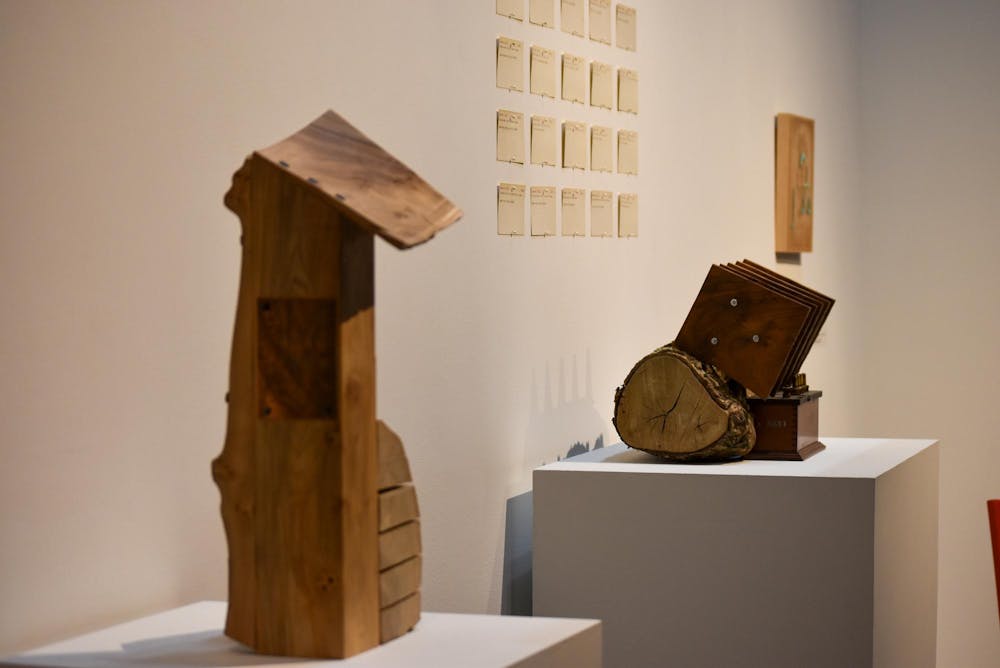
After reaching out to the Brown Arts Institute and Grounds Superintendent Nicholas Mol, Spilker got access to the wood. Using the material, Spilker developed “Between Past and Future,” a solo exhibition on view in the Fribourg Family Atrium at the Granoff Center for the Creative Arts through Dec 12. Presented by the BAI, the show explores questions about history and memorializing the past.
Most of the pieces in the exhibition were carved from smaller branches and scraps, Spilker explained in an interview with The Herald. The exhibit marks Spilker’s first time working with wood that had not yet been dried or treated, so he experimented with axes, drawknives and other techniques as he created the exhibit, he said.
Rather than shaping the wood into clean, uniform shapes, Spilker chose to highlight its natural irregularities. “Conceptually, a lot of my work was focusing on what’s evoked by that live edge,” he said.
One of his favorite works in the exhibit, “Polis and Arcadia,” juxtaposes polished and rough surfaces — a contrast that, to Spilker, reflects the way people romanticize the past. Other items in the exhibit include bookshelves with jagged edges and smoothed Shabbat candlesticks carved into the elm’s trunk.
When designing the exhibit, Spilker began by thinking about the elm’s history on the Main Green. But his ideas soon expanded to consider what it means for art to be “historic.” He added that he hopes the exhibit is not “not too didactic and restrictive and more of an initial invitation to be able to question larger (narratives) of history,” he said.
Spilker also drew inspiration from the exhibition’s namesake, a 1961 collection of essays by Hannah Arendt, which he said helped him contextualize the show. “Her writing has this expansiveness that zooms out in a way that brings the present more into focus,” he said.
BAI Curatorial Coordinator Kate Hao said the institute immediately saw the potential for the exhibit. “We thought it was a great idea,” Hao said. “It’s very specific to campus, and we always love supporting staff artists.”
Cesar Orduña ’22, who attended the opening reception after seeing the exhibition on Brown’s Instagram, said he was intrigued by Spilker’s use of the Main Green elm’s wood. “It’s really cool seeing the material being used,” he said, noting the “interesting” contrast between “the raw edges of the wood along with some of the more refined woodwork.”
This fall, Spilker and the BAI will select 10 community members to create art using the elm that will be added to a similar exhibit in spring 2026.
Ultimately, Spilker hopes viewers approach the show as “the beginning of an exploration,” he said.
Correction: A previous version of this article incorrectly identified the shabbat candlesticks featured in the exhibit as chess pieces. The Herald regrets the error.

Summer Shi is a senior staff writer and illustrator for the Brown Daily Herald. She is from Dublin, California and is currently studying design engineering and philosophy.