
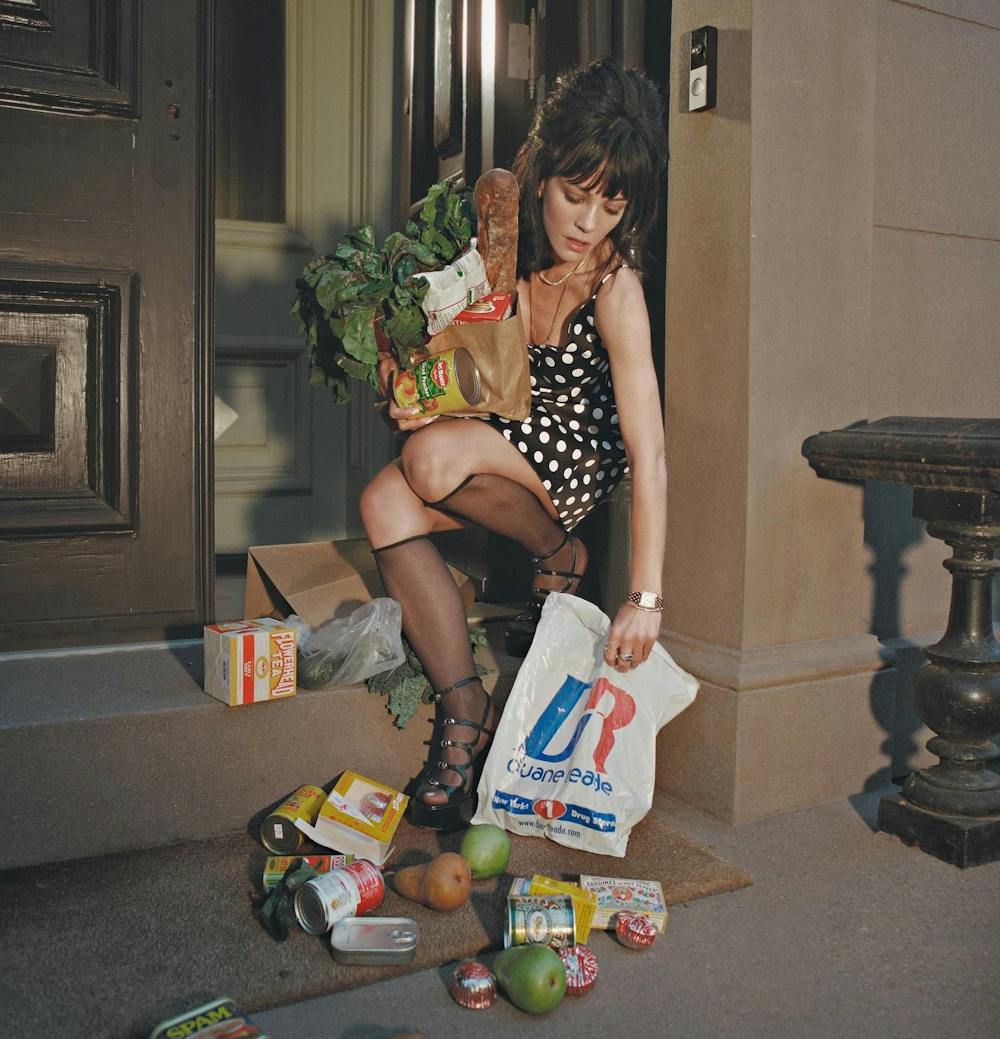
British singer-songwriter Lily Allen has been no stranger to controversy over the course of her decades-long internet career, but she has found herself in the spotlight once again — and for a painful reason. In February, People Magazine confirmed the end of Allen’s four-year marriage with David Harbour, an American actor best known for his portrayal of Jim Hopper in “Stranger Things.” In the wake of the drama surrounding the couple’s split, Allen has reemerged onto the music scene with her first album in seven years: “West End Girl.”
Released on Oct. 24, the album takes listeners through Allen’s shock and pain, making references to infidelity, betrayal and regret. The project’s 44-minute runtime is confessional and arresting: Her trademark wit allows her to insert her own take into the cacophony of tabloid press.
The record opens with the titular track “West End Girl,” taking listeners through Allen’s journey from New York to London to chase the opportunity to be a part of the acclaimed West End play “2:22 A Ghost Story.” The track’s lighthearted sound and simplistic lyrics are punctuated by a darkness that pervades the rest of the album — Allen’s excitement is tempered by a jealous partner, whose “demeanor started to change” after he finds out about her chance at stardom. The tone of the rest of the album is confirmed in the reenactment of a FaceTime call at the end of the song, during which Allen is presented with a revelation that listeners are not yet privy to.
“Ruminating” is the album’s shining point. The hyperpop track’s intense beat and Allen’s distorted voice turns listeners into prisoners of the desperation and panic she feels over her partner’s infidelity — the likely subject of the earlier FaceTime call. Lyrics like “And I can’t shake the image of her naked / On top of you, and I’m disassociated” as well as “And I’m not hateful but you make me hate her / She gets to sleep next to my medicator” speak to her spiraling mental state. The track’s lyrical repetition is consuming — Allen is unafraid to bare it all, no matter how closely she draws the outside world in.
Fans of Allen’s 2006 hit song “Smile” will recognize her signature vocal style on “Sleepwalking.” The track details Allen’s feelings of “sleepwalking” as a result of her partner’s manipulation. It’s emblematic of Allen’s appeal over the course of her career: While she doesn’t employ a particularly expansive vocal range, Allen has mastered the art of emotion. The poignant sincerity in her spoken-word style melds perfectly with her frank lyricism.
The song “Tennis” is integral to the album’s narrative: After looking through her partner’s phone, Allen discovers his affair with a woman she names “Madeline.” The pseudonym set the internet ablaze, with everyone seemingly searching for the mysterious figure. The search came to an end with the Daily Mail’s exclusive interview with costume designer Natalie Tippett, who admitted to an affair with Harbour that began on the set of the film “We Have A Ghost.” The track sees Allen ask what later became a viral question — “And who the fuck is Madeline?” — while also complicating the character of the infidelity. Details like, “You’ve broken the rules / I tried to accommodate” and “If it was just sex, I wouldn’t be jealous” point to an open marriage in which boundaries have been violated.
“Madeline” seemingly confirms the nature of Allen’s marriage to Harbour, with her singing “We had an arrangement / Be discreet and don’t be blatant / There had to be payment / It had to be with strangers.” But the album’s indictment emerges with the refrain: “But you’re not a stranger, Madeline.” The song interpolates a reconstruction of Madeline’s response to Allen’s confrontation — this device has the unfortunate consequence of turning average listeners into voyeurs. Allen walks a difficult line in the album: Her creative genius wars with the album’s salacious narrative to capture listeners’ attention.
The record becomes more expansive following the establishment of its narrative thread. “Relapse” describes Allen’s devastation following her discoveries and the threat this emotion poses to her sobriety. “Just Enough” is subdued with a sparse production, placing the attention solely on Allen’s pained vocals. Lyrics like “Look at my reflection, I feel so drawn, so old / I booked myself a facelift wondering how long it might hold” speak to the ramifications of infidelity that extend beyond the end of a relationship. Allen is unafraid to explore the reality of infidelity — how she feels it reflects on her appearance, the intrusive thoughts she can’t escape from and her utter isolation as a result.
“Dallas Major” represents an attempt to get back into the dating world and the dejection associated with the decision. Allen’s adoption of the character “Dallas Major” is not particularly inventive, despite its amusing sardonic tone. “Let You W/In” is similarly forgettable, blending into the rest of the record.
The best tracks of the album are those in which Allen leans into the anger following the implosion of her marriage. “Pussy Palace” is utterly nauseating. The song details what Allen finds upon entering “the apartment in the West Village” where her partner had been staying. The appalling revelations are juxtaposed by Allen’s elegance in the song’s chorus, which plays along to a dreamy production. Her question — “How’d I get caught up in your double life?” — cuts to the core of the album.
“Nonmonogamummy” sees an exciting feature from British artist Specialist Moss, whose verse — along with the song’s groovy sound — breaks up the diaristic nature of the record that borders on dizzying.
The track “4chan Stan” distills Allen’s gripes into, “What a sad, sad man / It’s giving 4chan stan,” a label that purposefully evokes the insidious valence of the internet forum 4chan. “Beg For Me” is a gritty and demanding dance track that emerges from the record’s despair, while “Fruityloop” closes out the album and pulls no punches, with Allen boldly declaring, “It’s not me / It’s you / And there was nothing I could do / You’re stuck inside your fruity loop.”
“West End Girl” is evidence of a life lived — the record’s detailing of Allen’s lowest moments positions art in its purest form: catharsis. In its entirety, Allen’s album doesn’t perform well for casual listening. Instead, the audience is thrust into the role of autopsying the relationship alongside Allen, raising questions about how much the public is entitled to in the lives of their icons.

Alyssia Ouhocine is a Senior Staff Writer covering Arts & Culture. Hailing from Bayonne, New Jersey, she is concentrating in English and History with a particular interest in Algerian history and literature. When she’s not writing, she can be found listening to music and sending Google Calendar invites.


