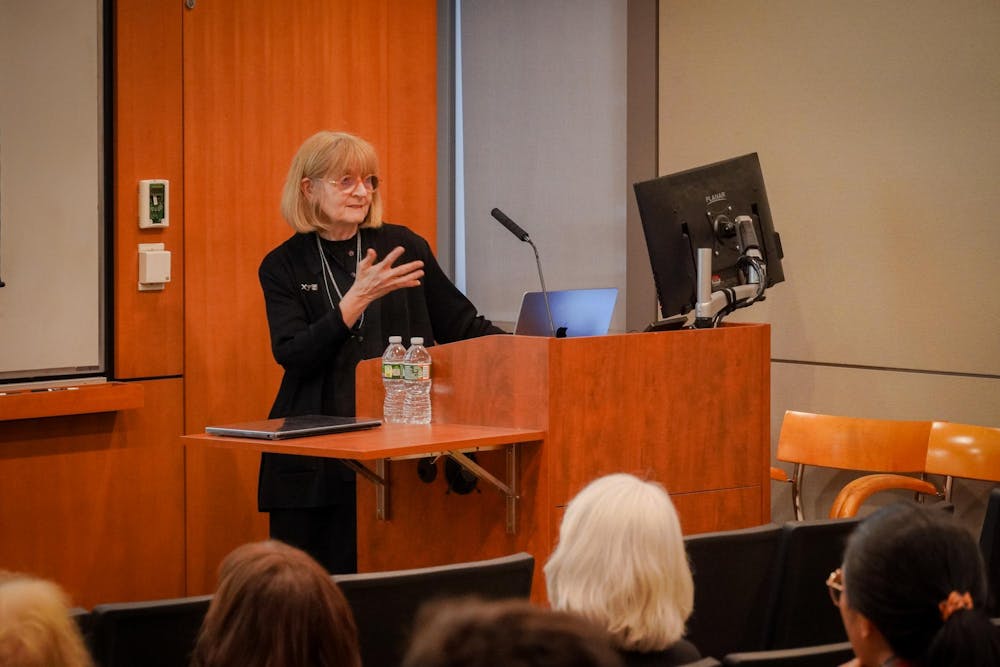
At a Friday lecture, Helen Mayberg, a professor of neurology, neuroscience, neurosurgery and psychiatry at the Icahn School of Medicine at Mount Sinai, spoke about her pioneering work in deep brain stimulation, which uses electrical impulses in the brain to treat patients with depression.
Deep brain stimulation involves inserting a small wire to the brain through a small incision in the skull. The wire is connected to a battery or pulse generator that delivers impulses to the brain.
Mayberg, who has been studying the treatment for over two decades, traced her current research back to a seminal study published in 1983 by Robert Robinson, who was Mayberg’s mentor and collaborator at Johns Hopkins Hospital. Robinson found that stroke-induced lesions in the left hemisphere of the brain — and specifically of the left frontal lobe — were correlated with depression.
Mayberg continued to study the neurological impacts of depression, finding that depressed patients displayed reduced activity in the frontal lobe, a part of the brain responsible for decision making and processing, among other functions.
In a later experiment, Mayberg analyzed the brains of healthy patients who were instructed to recall sad memories or provoke sad thoughts. She showed that prefrontal cortex activity declined, while a specific region of the brain — area 25 — experienced increased activity.
While not completely understood, area 25 is a region that is correlated with mood and thought to be a mediator of emotional and memory functions.
“We did study after study with different treatments and area 25 kept showing up over and over again,” Mayberg said.
Following these findings, Mayberg was intrigued by an emerging treatment for Parkinson’s disease used by her colleagues at the University of Toronto. Using a technique called deep brain stimulation, which entailed inserting tiny electrodes in the brain to regulate activity of a region associated with Parkinson’s, researchers could treat symptoms of Parkinson’s disease, Mayberg said.
This inspired her to study how the same technique could be applied in area 25 to help people with depression.
In a 2005 study of patients with depression, Mayberg found 66% of patients experienced improved symptoms after six months when deep brain stimulation was used in area 25. A later study showed the treatment may have long-term benefits. Following an eight-year observation period, 71% of patients experienced an improvement of 25% or greater, based on a rating scale measuring the severity of clinical depression.
She shared a quote from one of her patients who experienced improvements from deep brain stimulation: “DBS doesn’t make it easy, it just makes it possible.”
“For a patient, it really is having the capacity to do whatever it is you want to do, and just move forward through your life,” Mayberg said
Attendee Caroline McLaughlin GS, who is studying neuroscience, said she was intrigued by Mayberg’s ability to distinctly characterize depression in study participants.
“It was very interesting that she was able to disentangle depression and anxiety, which is very hard to do in these types of studies,” she said.
Maarten Ottenhoff, a postdoctoral research associate studying neuroengineering at Brown, shared his interest in the potential of DBS for depression treatment.
“It’s just an amazing story of more than 20 years of research that started small and ended up with something really helping people,” he said.
Jonathan Kim is a senior staff writer covering Science and Research. He is a second-year student from Culver City, California planning to study Public Health or Health and Human Biology. In his free time, you can find him going for a run, working on the NYT crossword or following the Dodgers.