
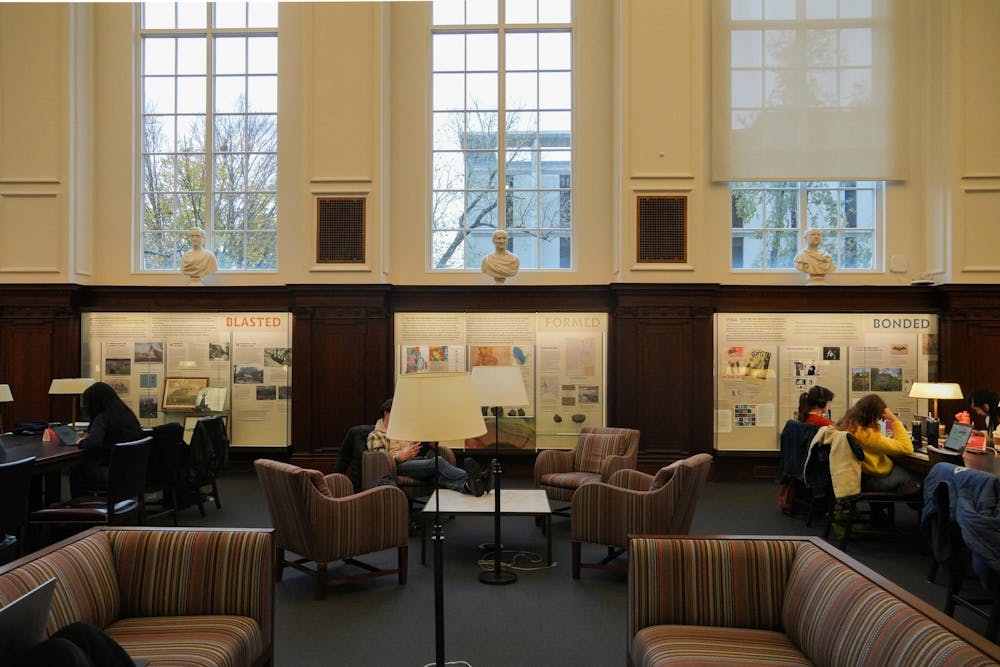
Earlier this semester, the John Hay Library opened their latest art exhibition, titled, “Shared Magma: An American and Swedish Collaboration on Sisterhood and Sister Ore.”
The exhibition displays work by Swedish artist and exhibit curator Kajsa Eriksson, which aims to capture the significance of Cumberlandite — Rhode Island’s state rock — and titanomagnetitolivinit, two similar magnetic rocks found only in Rhode Island and Sweden, respectively.
Each rock has the same composition of minerals — magnetite, feldspar crystals, olivine and iron — and will turn rust-colored if left outside in the elements, according to fellow exhibit curator Robin Wheelwright Ness MA’18, a senior library technologist in digital preservation at the Hay. Samples of rock, pieces from the library’s special collections and Swedish archival material are also on display.
The exhibit also showcases the intersection between this shared geology and Eriksson’s decades-long friendship with Ness. The pair first met over four decades ago, when Ness was studying abroad in Sweden.
“We were basically immediately friends and have been friends ever since,” Ness told The Herald.
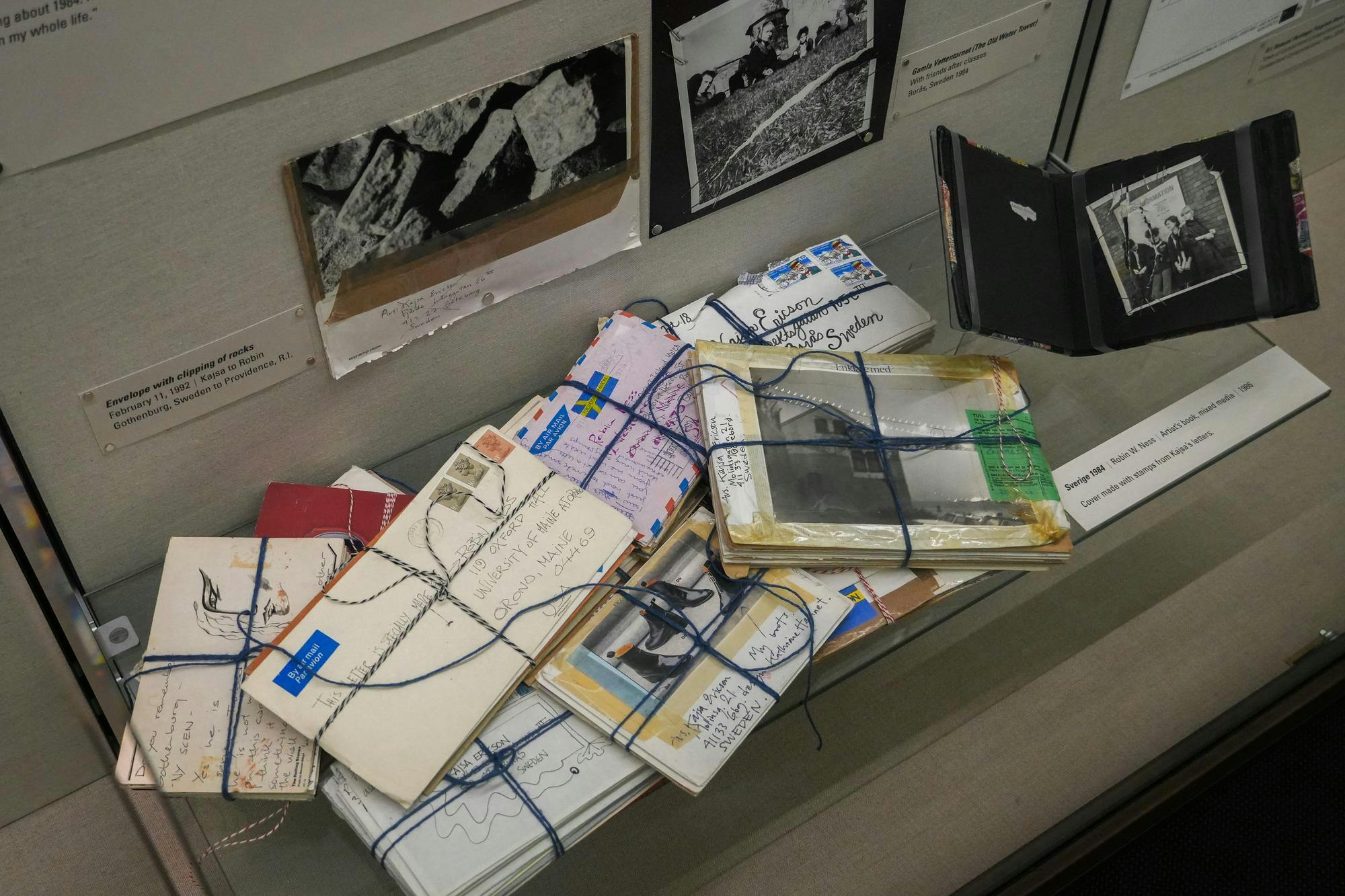
As part of the exhibit, viewers can visualize the connection between Sweden and Rhode Island by observing the rocks on display and reading letters Kajsa Eriksson and Robin Wheelwright Ness MA’18 wrote to each other during the early years of their friendship.
The idea for “Shared Magma” came in 2023 when Eriksson was painting atop Taberg — a mountain in Taberg, Sweden — and noticed a sign explaining how the mountain’s rock is only found in one other place: Cumberland, Rhode Island. She immediately texted Ness, who has worked at Brown since 1990.
Later that weekend, Ness found Cumberlandite in the Blackstone River near her house. “It feels like it came to us,” Ness said. It’s “like the rocks wanted to be connected and we were there.”
In creating the exhibit, “we were hoping to point out the long history of some of our beautiful natural monuments and geological features around us, and to protect them,” Ness said.
The exhibit also hoped to “point to the value of sustained relationships,” she added.
“It’s not easy to maintain relationships over 40 years,” Ness said, “especially when you’re 3,000 miles away from each other.”
The exhibit’s displayed rock samples are accompanied by letters that Eriksson and Ness wrote to each other in the early years of their friendship, helping viewers draw both the emotional and physical connections between Sweden and Rhode Island.
Eriksson’s original artwork also features watercolors with iron-based pigments. Eriksson settled on this material because of her interest in the “analogy between landscape and body,” noting iron’s role in the human body. According to the Providence Journal, these pigments were ground from Cumberlandite in a lab at Brown.
She added that she chose watercolor because it’s “the only painting medium that is basically pigment on paper.” Unlike many other mediums, watercolor lacks additives like wax or oil.
![Photo of Kajsa Eriksson’s “Huggen, Hugga, Huggas [Cut, Cut, Cut],” which features two hanging mobile made of four hanging watercolor paintings arranged squarely around a central wooden crossbeam.](https://snworksceo.imgix.net/bdh/d418b62f-838c-47cf-9ee7-698ea2a9f10a.sized-1000x1000.jpg?w=1000&dpr=2)
The two hanging mobiles in Kajsa Eriksson’s “Huggen, Hugga, Huggas” were painted an ocean apart— one on top of the mountain in Taberg, and the other atop Iron Mine Hill in Cumberland.
One of Eriksson’s pieces displayed in the exhibition includes “Huggen, Hugga, Huggas” or “Chopped, chop, chopped,” which features two hanging mobiles. Each mobile was painted by Eriksson, but an ocean apart — one on top of the mountain in Taberg, and the other atop Cumberland’s Iron Mine Hill, a prime location for Cumberlandite. Hanging behind the piece is “Friendship Field Painting at Iron Mine Hill,” a photograph of the two friends creating art on the hill.
Curating the entire exhibit took about two years, Ness explained. While the two friends collaborated closely on every aspect, Ness took on more of the research component because of her connection to Brown faculty members and the Hay’s collection materials. Meanwhile, Eriksson worked with local historians and primarily took on the artistic components.
For Ness, curating the exhibit provided perspective.
“When you’re looking at a billion years of history, and you know you can touch something that’s been around for that amount of time, it does affect your thinking about day-to-day events,” she said.
After the Hay exhibit closes in 2026, Ness and Eriksson hope to modify it and move it to Sweden. The two also hope to create an artist book — written in both Swedish and English — to further document their work.


