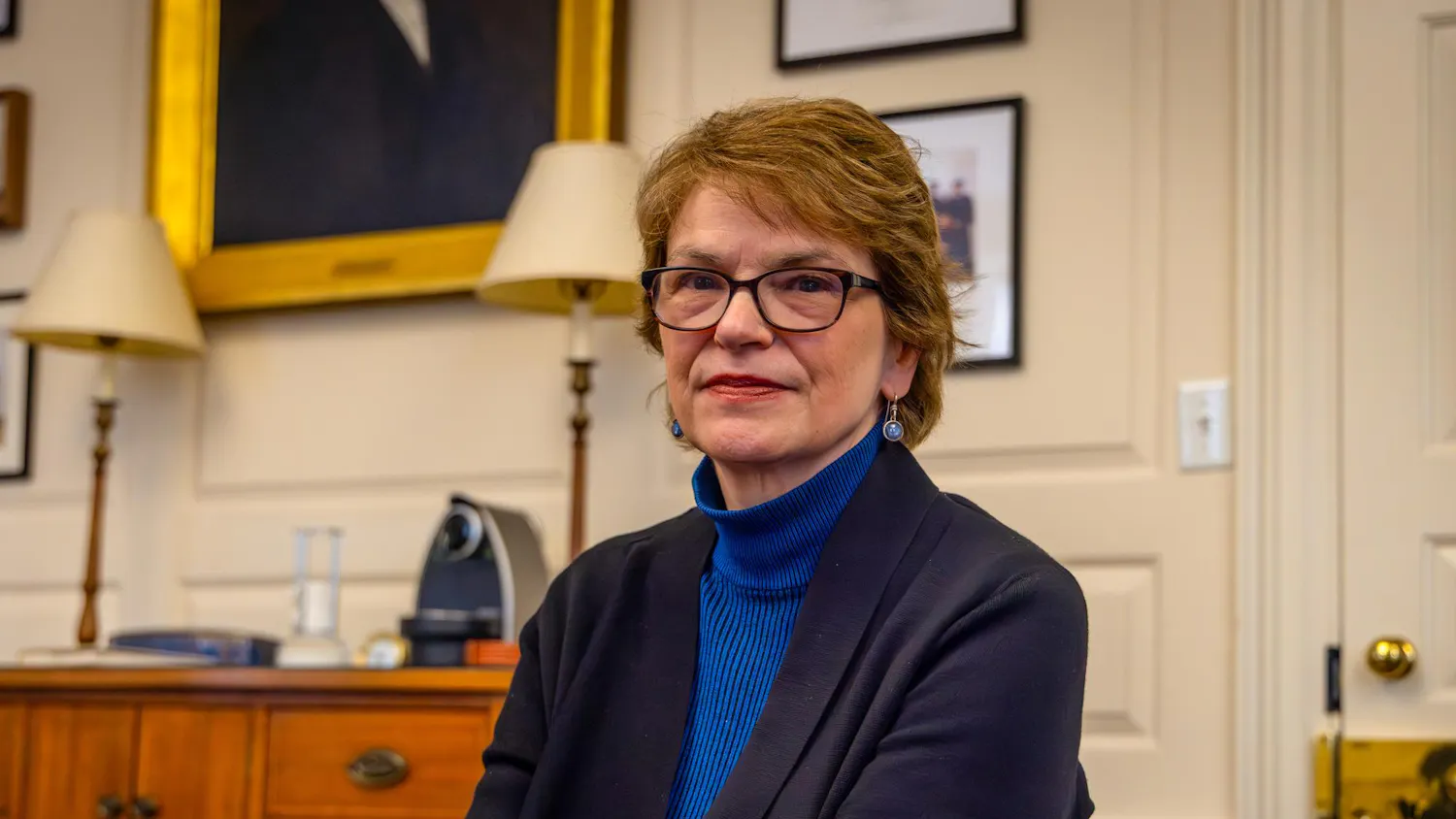
President Christina Paxson P’19 P’MD’20 was paid over $3.1 million in 2023, according to nonprofit tax filings for fiscal year 2024 released by the IRS and reviewed by The Herald. This marks a roughly 74% increase from her total compensation of $1.8 million in 2022.
In 2023, Paxson received the highest total compensation that she had received thus far during her tenure as University president, beating her previous compensation high of $2 million in 2021 by 55%.
Paxson was the second-highest paid Ivy League president in 2023, excluding Larry Jameson, who became Penn’s interim president in December 2023 after serving as Penn’s executive vice president for the health system and dean of their medical school. Paxson’s compensation was below only that of former Columbia President Lee Bollinger, who earned $3.5 million.
Paxson was also the second-highest paid Brown administrator, after Jane Dietze, Brown’s vice president and chief investment officer, who made over $3.2 million in 2023.
Other high-paid Brown administrators include Deputy Chief Investment Officer Joshua Kennedy ’97, Investment Office Managing Director Peter Levine ’95 and Vice President for Athletics and Recreation Grace Calhoun ’92 P’26 P’26, who earned $1.4 million, $1.3 million and $1.2 million, respectively.
The Corporation’s Committee on Senior Administration annually reviews compensation for the president and other senior administrators “who hold significant influence over University affairs,” according to Senior Vice President for Communications Cass Cliatt.
A major contributor to an increase in compensation for senior administrators can be “payouts from deferred compensation arrangements,” which “are common across higher education in many senior administrator packages,” Cliatt wrote in an email to The Herald.
Deferred compensation arrangements are funds set aside annually to be paid to employees “upon specific payout dates that fall in subsequent years,” she added.
Cliatt also explained that senior administrators may receive “bonus or incentive compensation,” and salary increases can be tied to job performance.
When budget constraints allow, “executives whose performance far exceeds expectations” can obtain annual bonuses for “major leadership contributions, substantial success in reaching pre-determined goals or in concert with pre-determined annual incentive programs,” she wrote.
In 2023, Paxson earned $1.3 million in base compensation, an additional $1.25 million in bonus and incentive compensation and $72,000 in other reportable compensation. Additionally, she received $382,500 in compensation from retirement or deferred plans and $160,405 in nontaxable benefits.
Dietze’s base compensation amounted to $730,000, nearly $1.5 million in bonus and incentive compensation, $275,900 in retirement or deferred compensation plans, $54,000 in nontaxable benefits and around $700,000 in other reportable compensation.
According to Cliatt, total cash compensation for University executives “is generally targeted to the 25th to 75th percentile of the market on an overall basis.”
In March, Paxson announced that she would be taking a 10% salary cut for fiscal year 2026 due to financial uncertainty from federal actions.
In May, Paxson’s contract, which was initially set to expire in June 2026, was extended by two years to a new expiration date of June 2028.

Roma Shah is a section editor covering University Hall & Higher Education and Admissions & Financial Aid. She's a sophomore from Morgan Hill, CA studying neuroscience. In her free time, she can be found doing puzzles, hiking or curled up with a book.

Samah Hamid is a university news editor covering faculty and career & alumni. She is from Sharon, Massachusetts and plans to concentrate in Biology. In her free time, you can find her taking a nap, reading, or baking a sweet treat.