
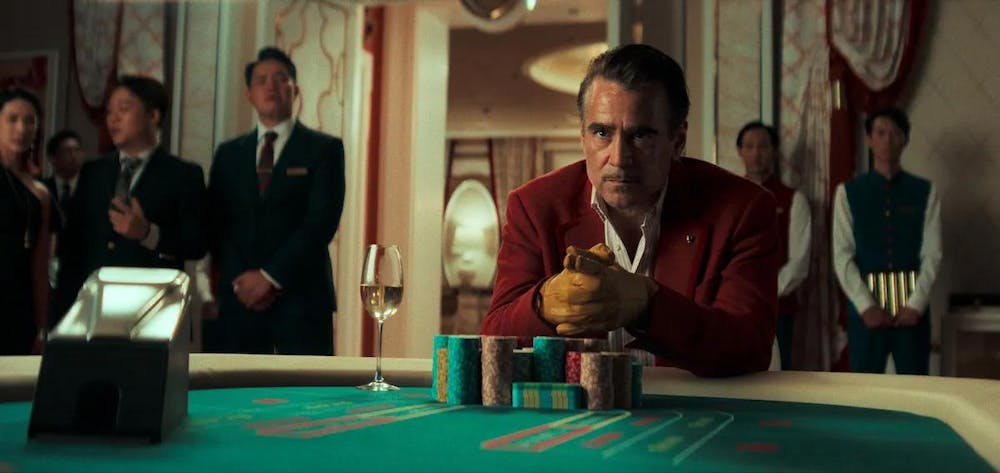
The draw of “Ballad of a Small Player” — a psychological thriller directed by Edward Berger — lies precisely in its mediocrity, and it does not disappoint. Its story is beautifully poetic but the film fails at being what it is — a film.
Based on the eponymous novel by Lawrence Osborne, the film tells the classic, tragic story of a gambler known as Lord Doyle (Colin Farrell). Doyle is an English con man living in Macau, who is spiraling into gambling debt. Just as his luck starts to run dry, an enigmatic woman named Dao Ming (Fala Chen) appears. Although the film fails to develop any real emotional connection between the two, their relationship mysteriously grows stronger.
Still, the movie’s opaque characters and their lack of emotional depth authentically capture the struggles of a gambling addiction.
Doyle is a gambler through and through. But neither love nor supernatural forces can overpower Doyle’s addiction from overwhelming him at a critical moment: Doyle is given access to a hidden stash of cash that he is not permitted to touch. By portraying the crippling power of addiction without a magical rescue, Berger admirably strays from classic cinematic representations of the tragic and relatable anti-hero.
Yet, Doyle’s lack of emotional depth makes it increasingly difficult for audiences to sympathize with his addiction. This disconnect is amplified by the monotony of his behavior, which serves as a stark contrast to the dramatic color schemes of his wardrobe.
“Ballad of a Small Player” isn’t a bad movie. Its shift away from traditional plot- and character-based storytelling is intriguing. Fifteen minutes into the film, a brief shot introduces an incendiary moment: An unidentifiable character — presumed to be Doyle — commits suicide by jumping off of a building. From that moment on, the movie departs from a simple gambler’s story and hones in on Macau’s traditions with the Hungry Ghost festival, a traditional festival where restless spirits of the dead can travel to the human world. These hungry ghosts are driven by greed that can never be satisfied, even if they win over and over again.
Throughout the film, Dao Ming serves as a spiritual guide on Doyle’s journey for redemption. She shifts between fancy silk dresses, a comforting presence on a Lamma Island cabin and a recluse of a vacant Macau apartment. But, after warning Doyle about the hungry ghosts, her character shifts: Dao Ming phases in and out of the rest of the movie and is increasingly saturated with the supernatural.
The beauty of this movie is in its mediocrity. It doesn’t seek to raise the tension at every moment. Doyle never seems to take any joy in the luxuries he indulges in, cursing cigars as he smokes one. He doesn’t wish for opulence, but has no choice but to partake in it. This makes his supposed redemption — the act of burning all of the money he wins — pointless, hinting at the film’s deeper message: Redemption is not real.
Audiences leaving theaters after watching “Ballad of a Small Player” will not find characters to attach to, nor a storyline to invest in. Instead, the opaque characters serve as a backdrop for reflection, reminding viewers to cherish life’s moments and face reality with honesty — to stop “winning” and start living.


