This is the sixth installment in a series of articles about the science of various aspects of college life.
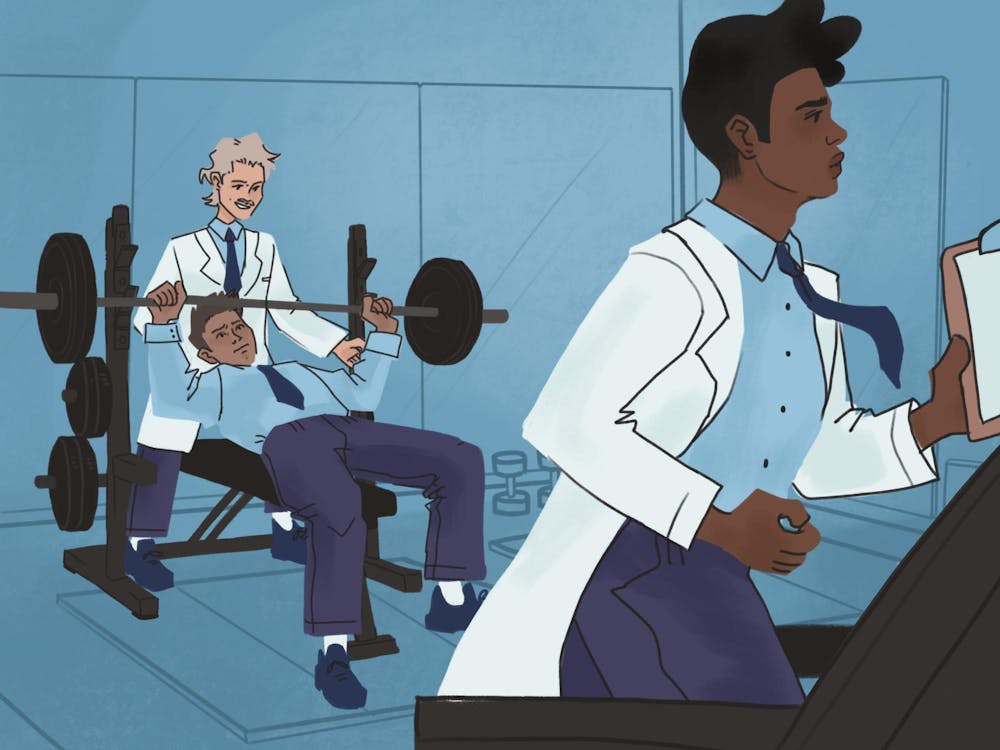
Some Brown students don’t go a day without trekking up to the Nelson Fitness Center to run on treadmills, lift weights or use various other workout equipment. As students focus on hitting new personal records, their bodies are undergoing complex biological processes to sustain their exercise routines.
In fact, leveraging principles of biology when planning workouts can be beneficial to meeting fitness goals, according to Senior Teaching Associate Andrea Smith, who teaches BIOL 1160: “Principles of Exercise Physiology.”
Smith explained that in the body, there are two types of muscle fibers: fast-twitch, which are “power fibers,” and slow-twitch, which are “endurance fibers.” She added that specific changes within those fibers lead to different exercise developments.
“You should be training either slow-twitch or fast-twitch if you really want to optimize the results in either of them,” she said. “If you’re doing it mixed, you will still get changes in them, but they might not be as … aggressive.”
Smith added that training slow-twitch fibers increases the volume of cellular “machinery,” including mitochondria, which generate cellular energy. Targeting slow-twitch fibers increases the number of capillaries that bring blood, and therefore oxygen, to the cell.
Smith added that cardiovascular exercise, often referred to as “cardio,” is an important part of any exercise routine because it increases cardiac output, or how much blood the heart can pump per minute. When cardiac output is increased, “heart rate doesn’t have to go as high at rest, so therefore it’s less work on the heart,” Smith said.
Nutrition also plays an important role in the science behind exercise. According to Smith, some gym-goers’ understanding of the amount of protein they need is not completely accurate.
When exercising, you do “need more protein because you are increasing your protein synthesis,” Smith said. But the trend of bulk-eating protein “just became really big,” she added, and there are “different types of protein.” Protein bars, for example, might not provide “the right protein for what you’re looking for.”
Assistant Teaching Professor of Education John Palella, who is teaching EDUC 0810: “‘Education of a Bodybuilder’: Histories of Physical Fitness in the United States” this semester, said that the topic of exercise is “so relevant to everyone’s life, even folks who don’t purposely engage in fitness.” Palella’s class, which had an expected enrollment of forty students, has 160 students this semester.
“They can’t escape it, because now … with influence, culture, social media, everything is in our hands,” said Palella.
Palella noted that the history of “gym bros” can be traced back to German immigrants in the 1850s. Since then, cultural norms, including the recent rise of fitness influencers during the COVID-19 pandemic, have shifted what the term represents.
Despite there being “a lot of pressure for folks of all gender identities to perfect their bodies,” Palella said he has seen an openness from his students to learn from each others’ experiences.
“I think that physical fitness and weightlifting and bodybuilding gets a bad rap, but I see folks having great conversations about body positivity and inclusivity,” Palella said.
In interviews with The Herald, students described the gym as an empowering and social space.
Salter Arms ’27, who shares his passion for the gym on Instagram, said he began exercising regularly with his friends to mix up his normal fitness routine.
“Mutual accountability,” Arms said, was what encouraged him to keep going even when he didn’t want to.
Eventually, Arms’s passion for the gym grew as he noticed it had a positive impact on him. “It’s a great way for me to step away from my work and really … change the trajectory of how I’m feeling,” Arms said.
On social media, gym culture can be “toxic,” Arms said, adding that “extrinsic motivators” like wanting to look a certain way can play an outsized role in fitness culture. But in his experience, the gym is “really safe, warm and healthy.”
Alejandra Hernandez Moyers ’26, co-president of Girl Gains Lifting Club, said that she has watched women become more comfortable at the gym through the time she’s spent working with the club.
In her opinion, social media exaggerates what is needed to start working out.
“It’s just very simple,” she said. “Eat nutritious food, protein, carbs and fats.”
For Hernandez Moyers, going to the gym is a source of empowerment and a consistency that she can rely on.
“Lifting three times your body weight feels like a superpower,” she said.
Angel Lopez is a senior staff writer covering Science and Research. He’s a first-year student from Tyler, Texas and planning to study neuroscience and literary arts. In his free time, you can find him playing ping pong, listening to music, or reading.