
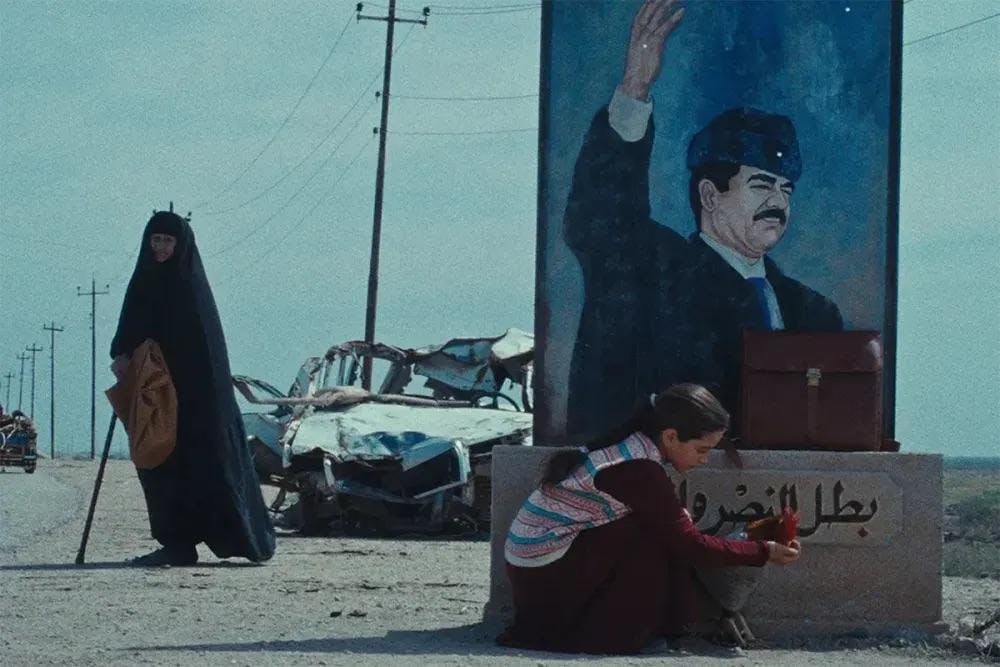
Today’s audiences have grown accustomed to an onslaught of media, with easy access to pictures and videos from every corner of the world and movie sets that realize even the wildest of fantasies. But how often are consumers exposed to something new? With a world premiere at the 2025 Cannes Film Festival in May, “The President’s Cake,” is that something new.
Set in Iraq in the 1990s under the rule of President Saddam Hussein, the tragicomedy was selected as the Iraqi submission to the 2025 Academy Awards for Best International Feature Film. The film was inspired by the real-life experiences of its writer-director, Hasan Hadi.
Throughout the 105-minute film, the Iraqi Mesopotamian marshes are portrayed with a delicate beauty that is almost unseen in mainstream media. At the start of the film, viewers are filled with almost an envy for the world that the character inhabits. Not as a battleground or a site of catastrophe, as it’s often portrayed on the news, but as a place full of natural wonder and everyday life.
But would a story like this be considered worthy of mainstream media attention — like the Academy Awards — if it wasn’t inherently intertwined with trauma?
Particularly in relation to the Middle East, media appears to only gain visibility when it centers on some combination of devastation, suffering and political crisis. “The President’s Cake” builds on this precedent, replete with hardship and devastating twists and turns. Even though it follows a similar playbook as its predecessors, the film refuses to reduce its characters or settings to symbols of despair. Instead, it utilizes moments of whimsy, humor and childhood adventure alongside the harsh political realities of the era to present a more nuanced portrayal.
The movie opens with 9-year-old Lamia (Baneen Ahmad Nayyef) at sunrise in the marshlands, rowing a small, canoe-like boat from her home to school. Instead of depicting poverty to gain sympathy from the audience, the scene opens the film with images of strength and beauty as the water glistens in the sunlight.
The film takes place in the wake of Iraq’s invasion of Kuwait — a period of mass economic sanctions by Western countries. Despite the intense rationing that followed the sanctions, one student in every classroom at Lamia’s school is chosen to bake a mandatory cake to celebrate the president’s birthday or face severe punishment.
Lamia’s grandmother Bibi (Waheed Thabet Khreibat) instructs her to avoid selection, yet Lamia is unluckily chosen for this “honor.” For Lamia, who lives in poverty with her sick grandmother and her pet rooster named Hindi, cake ingredients are costly and scant.
Without the resources to bake the cake — or raise a child — Bibi takes Lamia by taxi into the city to give Lamia away to a family friend, much to Lamia’s dismay. Lamia runs away, joining forces with her peer, Saeed (Sajad Mohamad Qasem). Together, the children embark on an adventure to acquire each ingredient for the cake, encountering a seemingly nonstop sequence of adults who take advantage of them at every turn and exploit their youth. Meanwhile, Bibi frantically searches for Lamia with help from the taxi driver, Jasim (Rahim AlHaj). Despite the missing 9-year-old, the police are entirely uninterested in helping, as they are preoccupied with the president’s birthday celebrations.
Despite its devastating undertones, “The President’s Cake” manages to be tender and sweet, with a touch of humorous charm. But it is also profoundly tragic from the climax to its ending. In fact, the whimsy contributes to an even more desolate yet heartfelt piece.
Lamia and Saheed are young and rambunctious children, full of complexities, and their search for each ingredient with their rooster sidekick feels like the kind of adventure one would laugh along to in a Disney program. The viewer can feel the optimism with which the two view the world, but still, the inescapable knowledge of injustices is baked into everything unfolding on screen.
During a question-and-answer session with the director following the film’s screening at the London Film Festival, audience members — and even the director — were moved to tears when talking about the importance of Iraqi representation. While the story of Iraq during Hussein’s presidency is one that is often forgotten, ignored and misrepresented, “The President’s Cake” shared it with dignity, nuance and care.
The film’s ability to represent Iraqi life without framing it solely through weakness or victimhood is the very core of what gives it power and meaning.
In “The President’s Cake,” the Iraqi people are not weak. Rather, they have long been victims of an oppressive regime, exploitative global politics and ravaging war. This film offers a rare vision of the beauty — cultural, environmental and emotional — that continues to be threatened in Iraq to this day. While “The President’s Cake” uses the narrative framework that Western audiences so often gravitate toward, it does so without collapsing Iraqi identity into suffering or spectacle, avoiding exploitation and preserving humanity.


