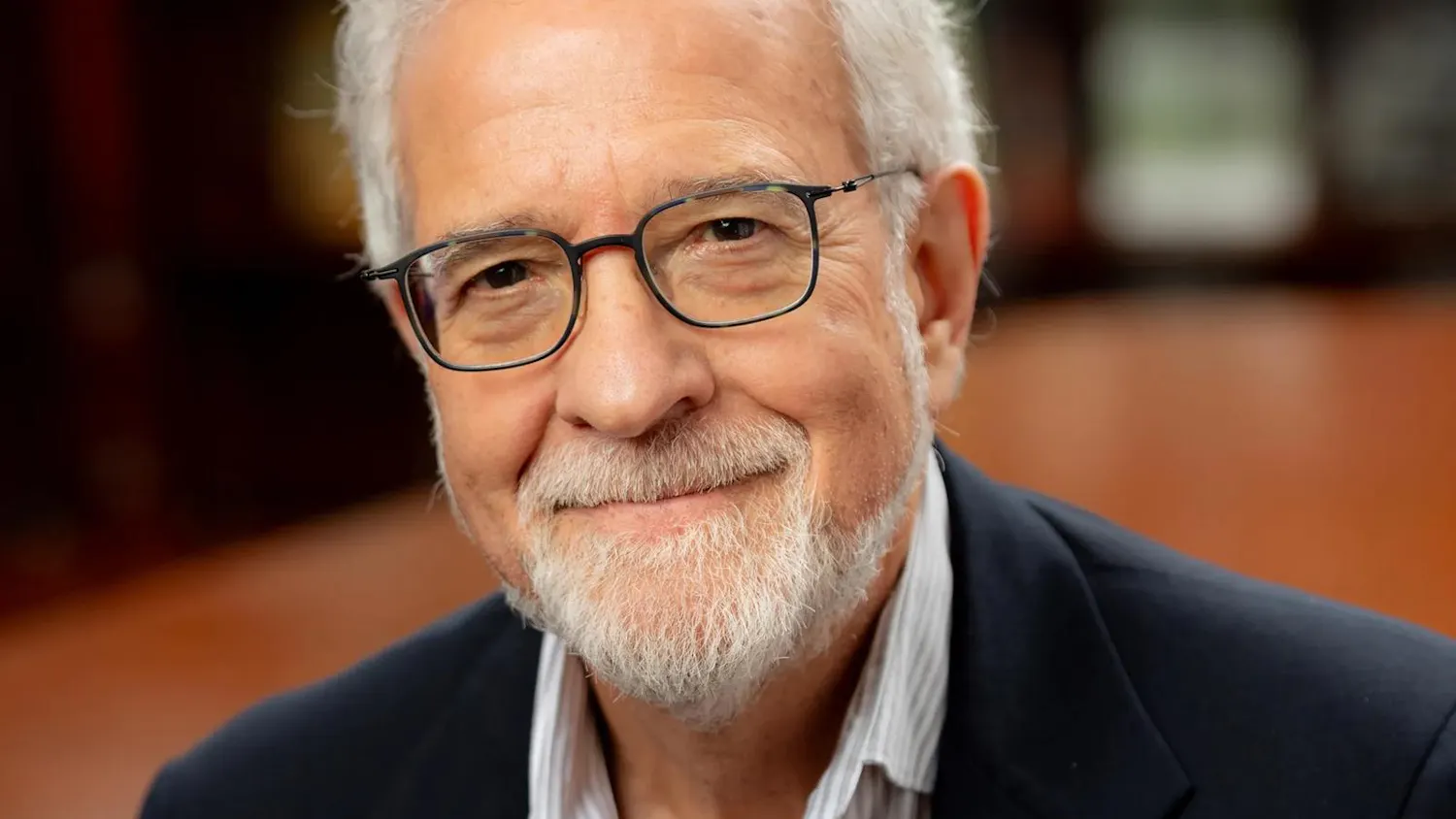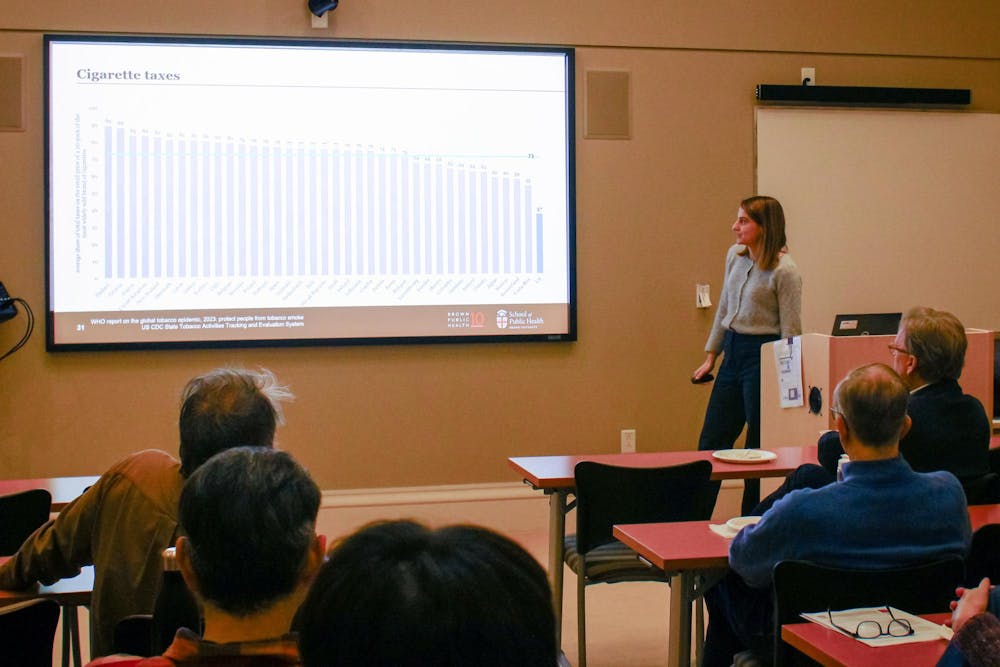
In a Thursday afternoon talk, Professor of Health Services, Policy and Practice Irene Papanicolas examined the difference between the United States’s health care spending — which eclipses that of any other high-income country — and the shortcomings in U.S. population health outcomes. Papanicolas’s talk also aimed to dispel common explanations for both phenomena.
The event, titled “Examining U.S. Health Policy Narratives from a Comparative Perspective,” was hosted in Mencoff Hall by the Population Studies and Training Center.
Papanicolas drew from publicly available global health data and her own research to illustrate how comparisons with different countries’ health care systems provide a valuable framework to improve U.S. health outcomes, she said in her talk.
“The big question in a lot of U.S. health policy is, ‘Why?’” she asked the audience. “Why are we getting so little return for the large amounts of money that we spend in the health system?”
Papanicolas challenged prevailing explanations for higher health spending in the United States, such as assertions that Americans “overuse care” or have a “wasteful” private health care system.
Compared to other high-income countries, the U.S. population utilizes health care resources at an average level, she said. She also pointed to data suggesting that the U.S. spends less on hospital discharges and in-person doctor visits — two metrics that imply frequency of care use — than other members of the Organisation for Economic Co-operation and Development. OECD is a group of 38 countries with the aim of improving quality of life.
Papanicolas also pushed back against claims that the U.S. spends less on social services, such as funding for housing, pensions and disability services.
“In a lot of health policy circles, we hear that we’re spending too much (on) health and not enough in other social areas, and that more social spending could decrease health spending,” she said during the event.
But, after analyzing a data set produced by the OECD, Papanicolas found that spending on social services in the U.S. is also comparable to other high-income countries. During the talk, she also noted a positive correlation between social spending and health spending worldwide.
Instead, to explain the U.S.’s comparatively higher spending, Papanicolas pointed to factors like administrative inefficiency and high prices in health care.
“U.S. prices are higher in every part of the system and … grow faster than in other countries,” Papanicolas said, attributing the discrepancies to increasing health care consolidation and minimal price regulation.
But Papanicolas also said that despite recording poor health outcomes overall, the United States excels at delivering effective acute care to patients within the hospital system.
“The system appears to do a good job finding (people) that are sick and treating them,” she said.
Risk factors outside of the health care system also lead to poor health outcomes, Papanicolas added.
She presented figures illustrating common risk factors for Americans, including higher rates of daily calorie consumption, opioid use and homicide compared to citizens of other OECD countries.
“Health outcomes are getting worse, and there’s a lot of variation within the U.S., but this is pretty much systemic across the U.S.,” she said.
As a Population Studies and Training Center fellow and Ph.D. student studying economics, Emily Emick GS said she was intrigued to hear Papanicolas’s perspective on the U.S. health care system.
“I think she did a really nice job of looking at this big picture comparison of the U.S. to other countries to give you a sense of the overall status” of the health care system, Emick said.
Jonathan Kim is a senior staff writer covering Science and Research. He is a second-year student from Culver City, California planning to study Public Health or Health and Human Biology. In his free time, you can find him going for a run, working on the NYT crossword or following the Dodgers.