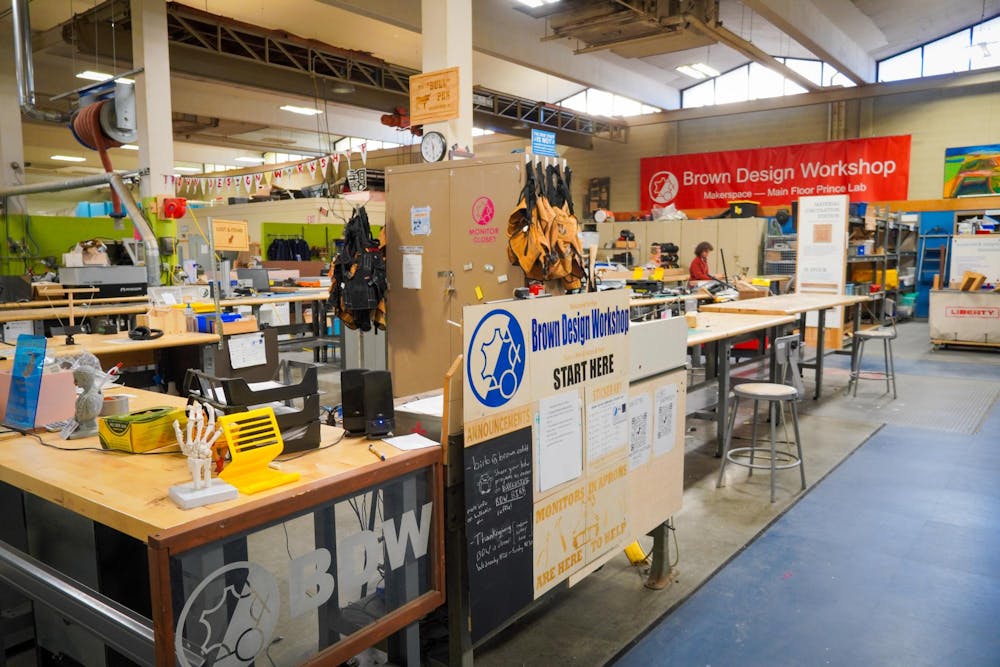
Last semester, the Brown Design Workshop launched their Maker Grants, which intend to encourage student curiosity and finance passion projects. Designed to support up to 25 students each semester this year, the grant allots $500 per student project.
Charley Wernli ’27, a BDW manager, explained that the grant — which was initially seeded by one donor — fills the gap left by other funding sources, encouraging students to take on projects they wouldn’t otherwise think of pursuing.
While intended to be a year-long grant, the BDW still has remaining funds as of late November and plans to continue accepting applications for as long as the funds hold out, Wernli said. She added that the BDW is hoping to secure funding for the project beyond the initial donation.
The Herald spoke to three recent grant recipients to learn about their projects.
Leatherworking, from Barcelona to Providence
Madeline Goldsmith ’26, who works as a BDW monitor, decided to apply for the Maker Grant after a spring break trip to Barcelona. On her trip, she “happened to stop by an old artisanal leather store,” she said. Initially, she only hoped to purchase something from the store, but a long conversation with the owner sparked her interest in the craftsmanship behind the products.
Goldsmith requested $400 for materials to get started, and after a brief application process — requiring her to submit a Google Form detailing the project and her budget — she began working on her first project: a diamond chisel holder. Since then, she’s made several pieces, including a two-tiered jewelry box and a patchwork leather pouch.
The grant “didn’t pigeonhole me into making something specific, which was really nice,” Goldsmith said. “If I didn’t have the Maker Grant, I would not have gone out of my way to buy $100 worth of equipment just to try leatherwork,” she added.
Looking to the future, Goldsmith plans to use leatherworking as an “outlet away from (her) job.” She added that crafting brings her “a lot of joy” and sees herself working on projects as “something for myself.”
An interdisciplinary approach
Having frequented the BDW for the past three years, Fuka Ikeda ’26 — who now works as a manager — noticed that students tend to stick to machines or crafts they are already comfortable with. With her grant funding, she is seeking to create a series of interdisciplinary workshops that combine the BDW’s various offerings.
Ikeda is planning lessons on how to craft wooden boxes with stained glass, metal engravings and wallets using a combination of metal and leather.
“My final product is not only making a product itself, but hopefully a collection of zines,” she said, adding that the collection would teach readers how to recreate her projects. “I want to be able to inspire other people and hopefully give guidance to other people making these projects, too.”
Ikeda described the BDW’s culture as an “amazing community that supports you and drives you to keep on creating.”
Bassoon reeds
Allie Hunnius ’28, a recent grant recipient, has played the bassoon for over eight years. This October, with the help of the Maker Grant, she began learning how to make her own reeds. She explained that this craftsmanship is an important part of becoming an advanced bassoon player and that it is a “unique process” for the musician.
The entire reed-making process takes about two to three weeks, she explained. First, Hunnius must “make the blank,” a technique that involves forming the base wood. The blank must then dry for up to two weeks before Hunnius can begin making a series of fine adjustments that perfect the shape and details of the reed. Since the wood is incredibly delicate, these adjustments must span several days so as not to break the reed, Hunnius said.
She said that the grant would allow her to purchase 20 pieces of wood. Since she doesn’t need 20 reeds at once and aims to improve her craft over time, she expects the project to span several semesters.
For now, Hunnius’s biggest problem is waiting for her supplies to arrive. Since she ordered most of the wood from international suppliers, she expects the shipping process to take some time. Even with these delays, she hopes to have at least one reed completed by the end of the semester.
Noa Saviano is a senior staff writer covering Graduate Schools and Students. She is a freshman from New York City and plans on concentrating in Comparative Literature and Cognitive Science.