
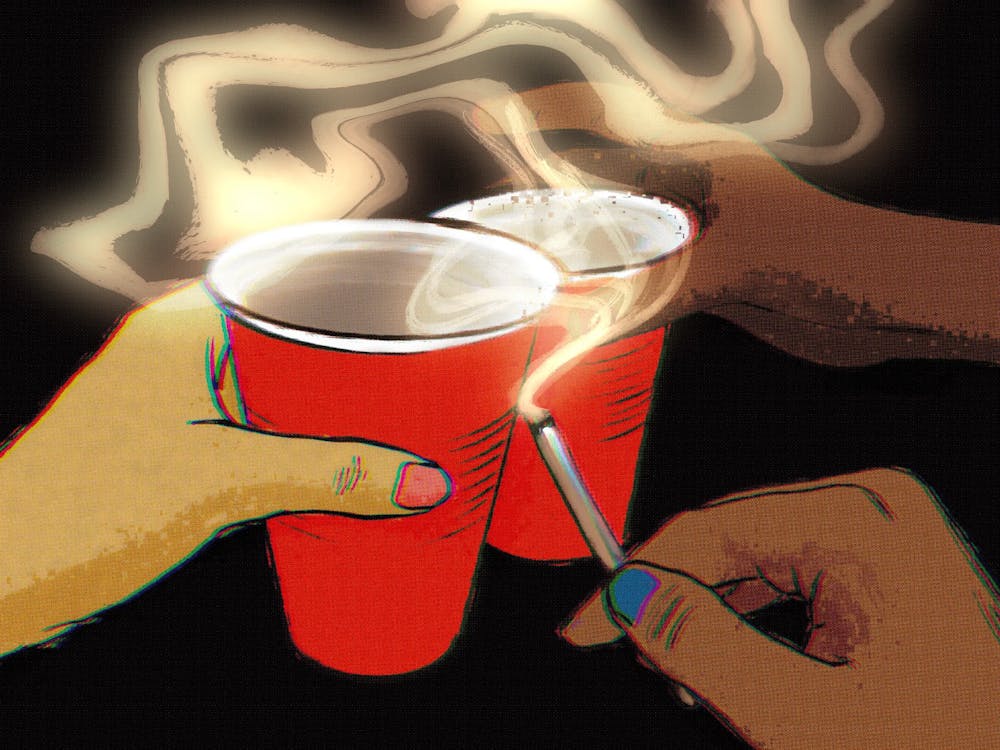
While many Brunonians have their go-to spots for alcoholic beverages, a group of Brown researchers added their own makeshift bar to the mix.
But once inside the bar, participants of a new research study led by Professor of Behavioral and Social Sciences Jane Metrik were offered cannabis cigarettes in an effort to learn more about how smoking cannabis affects how much alcohol people drink.
After they smoked the cannabis cigarettes which contained varying levels of THC unknown to them, participants were invited to indulge in alcoholic drinks. The bar offered a wide variety of alcoholic beverages and participants were invited to relax in comfortable chairs where they could even watch TV — all while every drink and inhale of marijuana is meticulously observed by a research team.
In the study, researchers found that smoking cannabis that contained THC caused a reduction in participants’ short term alcohol consumption.
The study, published in the American Journal of Psychiatry in November, is one of the first to isolate how an individual’s alcohol consumption is acutely affected by their consumption of cannabis. Using a randomized, double-blind, crossover design, each participant smoked cannabis cigarettes with varying levels of THC — the main psychoactive compound in marijuana — across different sessions.
The study also distributed placebo cigarettes in some sessions. In other research designs, “you don’t have a placebo control,” Metrik said, adding that performing a randomized clinical trial was necessary to say for sure that cannabis usage directly causes a reduction in alcohol consumption.
“Everybody in the study got all the conditions so that you can test how cannabis affects alcohol within the same person,” she explained. “You eliminate any kind of variability between people that way.”
“This is gold standard evidence that (lets us) talk in causal terms,” Metrik added.
After smoking their assigned cannabis cigarettes, participants completed an alcohol choice task, during which they could drink as much or as little as they wanted, up to a blood alcohol concentration of 0.10. The study found that participants who smoked larger amounts of THC cannabis drank less alcohol.
But the findings generally challenge previous understandings of substance use. When Metrik first proposed the study nearly a decade ago, she hypothesized that cannabis use would actually increase alcohol consumption.
“You would certainly expect that when people are intoxicated, they tend to want to do other kinds of pleasurable things more,” explained Christopher Kahler, a co-investigator of the study and a professor of behavioral and social sciences and psychiatry and human behavior, who is also the director of Brown’s Center for Alcohol and Addiction Studies.
While the study indicates that marijuana consumption results in a decrease in alcohol consumption, “we would never recommend that people start using cannabis as a way to change their drinking,” Kahler said. He explained that there are additional “risks and unknowns” that come with mixing two substances and that there are “lots of other ways” to lower alcohol intake.
Metrik said the mechanism behind this connection between marijuana and alcohol remains unclear, though she believes it is “likely” a combination of physiological and psychological effects.
The study’s double-blind design helps to rule out expectancy effects, as participants are instructed that they will get cannabis in a “moderate potency range” but not what specific amount they’re getting.
While the highly controlled environment offers strong internal validity, real-world effects may differ, the researchers said. The experiment only tested smoked cannabis, but ingesting marijuana edibles or other products may result in different outcomes. Furthermore, the cannabis they used was a specific type approved and provided by the National Institute on Drug Abuse, which is unlikely to be used by everyday people.
The study aimed to recruit those who “drank regularly” who were also frequent cannabis users — those consuming marijuana two or more times every week — meaning the findings apply only to this specific group.
Still, Kahler emphasized that this research “sets the stage for future studies.”
The study offers “a really important data point” that suggests a possible substitution effect, said Johannes Thrul, an associate professor at the Johns Hopkins Bloomberg School of Public Health who was not involved with the study.
But Thrul cautioned against drawing policy conclusions too soon, noting that “a single study is probably a bit too premature to say now we should go out and design policy based on this.”
Miriam Davison is a Senior Staff Writer for University News covering Academics & Advising. She is a first-year from Los Angeles, CA and plans to study tentatively the realm of International & Public Affairs and English, though her interests span from linguistics to history to music. In her free time, she plays on one of Brown's ultimate frisbee teams and likes writing silly poems.


